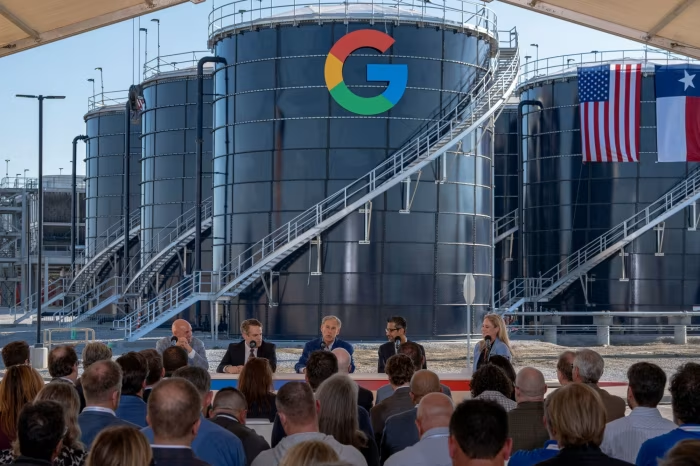
Google AI data centers are at the heart of one of the biggest infrastructure pushes in tech right now — and investors are firmly on board. As the artificial intelligence boom intensifies, the company is pursuing a uniquely sophisticated strategy to overcome the hurdles that have slowed rivals, particularly when it comes to securing the enormous amounts of power these facilities demand.
Investors Back the Big Bet
Google’s parent company, Alphabet, made waves this week with a plan to raise $85 billion in equity, largely to fund its infrastructure buildout. The company had initially aimed for $80 billion, but an effort to sell shares drew more investor interest than expected, prompting it to raise the target.
A Tough Environment for Building
Connecting massive data centers to the power grid is no simple task, and tech giants face no shortage of obstacles. Among the biggest challenges are:
- Supply-chain backlogs
- Permitting disputes
- Power-supply constraints
These issues have repeatedly pushed data-center construction behind schedule. A JPMorgan analysis last month underscored the scale of the problem, finding that more than 60% of the data-center capacity planned for completion in 2027 isn’t yet under construction — with another 7% already delayed.
Google’s Competitive Edge
Against this backdrop, Google has developed one of the more advanced approaches to clearing these hurdles. According to analysts and power-industry experts, the company’s strategy hinges on two key advantages: securing its own power sources and being able to shift computing loads to follow available power supply.
Together, these capabilities could allow Google to connect its data centers to the grid faster than its competitors — a crucial edge in a race where speed increasingly matters.
Owning the Power Source
Google has been putting that strategy into action through major investments. Earlier this year, the company paid $4.75 billion to acquire Intersect, a wind and solar developer that had recently pivoted toward building projects specifically to support data centers.
The fruits of that acquisition are already taking shape. This week, the two companies announced plans to build a new data center in the Texas Panhandle that will feature its own dedicated power generation right alongside it — a model that sidesteps many of the grid-connection bottlenecks plaguing the industry.
The Bottom Line
In the high-stakes AI race, raising money is only part of the equation. Ultimately, the ability to actually build data centers — and power them reliably — may be what separates the winners from the rest. Google’s vertically integrated approach to energy suggests it understands this reality well, positioning the company to turn its massive capital investments into operational infrastructure faster than competitors still wrestling with the grid.
Author