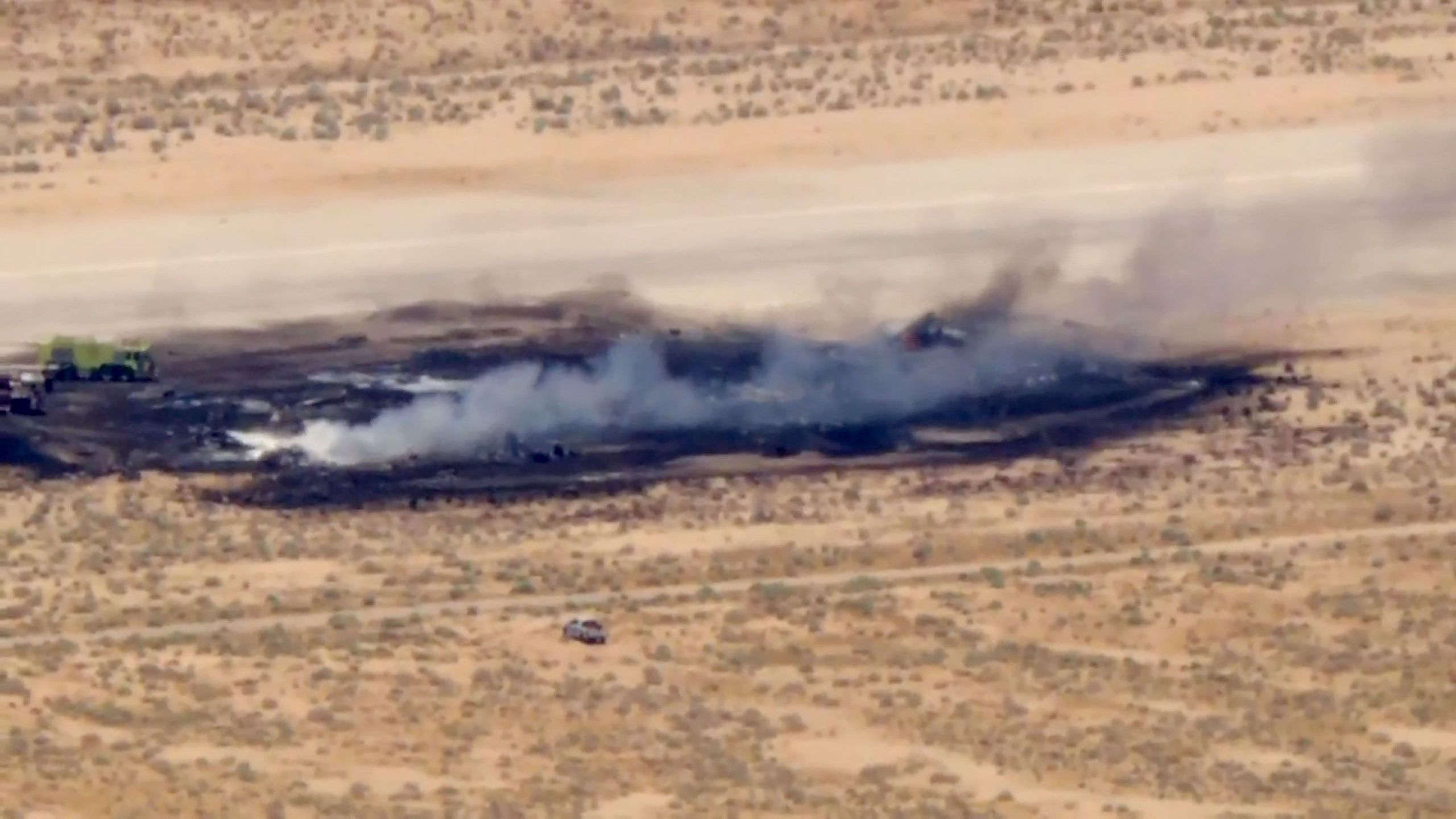
The B-52 crash at Edwards Air Force Base in California has left investigators searching for answers after a routine test flight ended in disaster within seconds. The aging bomber barely lifted off before slamming back down roughly halfway along the runway, killing everyone on board.
All eight people aboard the Boeing B-52 Stratofortress died in Monday’s fiery accident. The aircraft had been participating in a test mission tied to an ambitious program meant to keep America’s oldest operational warplanes flying for decades more.
A Flight That Ended Almost Instantly
The bomber lifted off shortly before noon under clear skies, heading southwest into the prevailing winds. What should have been a controlled ascent turned catastrophic almost immediately. The plane flew straight and came down hard on the same 15,000-foot runway it had just departed from.
The condition of the wreckage tells part of the story. Investigators noted the debris was tightly compacted, a strong sign the aircraft dropped sharply rather than gliding or veering off course. Aerial footage of the Mojave Desert site, located about 100 miles northeast of Los Angeles, showed almost nothing recognizable left of the bomber.
Officials have not yet released a cause and cautioned that the full investigation could take up to six months to complete.
Remembering the Crew
Those killed represented a cross-section of the test community: government contractors, Boeing employees, and uniformed military personnel. The names of the victims have not been officially released.
One family has spoken out. Lauren Smith told local outlets that her husband, Jeromy Smith, was among the dead. A flight test engineer with the U.S. Department of Defense, he died doing work he loved, she said. “It is such a horrible hurt, and I’m still processing everything that happened,” she shared.
The loss has rippled through the tight-knit world of military aviation. Heather Penney, a former F-16 combat pilot and aviation expert, said she personally knew one of the victims but chose not to name the person until officials do so, underscoring how deeply this tragedy has hit the community.
What the Plane Was Testing
The doomed aircraft was supporting a radar modernization effort, according to Col. James Hayes, deputy commander for the 412th Test Wing. The program is central to keeping the B-52 viable through at least 2050 — nearly a century after the bomber first entered service.
In 2025, Boeing delivered a B-52 to Edwards fitted with an upgraded radar system. The new Active Electronically Scanned Array, or AESA radar, replaces 1960s-era technology and provides far better navigation and targeting. Designed by Raytheon for the entire B-52 fleet, the system was scheduled for extensive ground and flight testing throughout 2026 to inform a production decision. It remains unclear whether the aircraft involved in Monday’s crash was that same modernized plane.
A Workhorse From a Bygone Era
The B-52 has been a fixture of American airpower for generations. Key facts about the bomber include:
- It first entered service in 1955 and is built to carry both conventional and nuclear weapons.
- It has seen action in conflicts spanning from Vietnam to operations involving Iran.
- The current fleet numbers 76 aircraft.
- The youngest B-52 was delivered to the Air Force back in 1962.
That last detail weighs heavily on the investigation. As Penney pointed out, these planes predate personal computers, the moon landing, and even the Cuban Missile Crisis. “These are old airplanes. They’re structurally robust, but they are old aircraft. So structural failure can’t be ruled out,” she said.
The fleet is in the middle of a sweeping upgrade campaign that goes well beyond radar. Planned improvements include new engines, redesigned crew compartments, modern communication systems for both conventional and nuclear missions, updated avionics, and new weapons. The goal is to position the B-52 as a complement to the Air Force’s newest bomber, the B-21 Raider.
The Search for a Cause
The airfield stayed closed Tuesday as crews worked to stabilize the site for recovery teams. Fires had flared up again overnight, said Mike Paoli, a spokesperson for the 412th Test Wing, complicating efforts to safely access the wreckage.
Aviation experts have begun weighing possible explanations, though all stress it is far too early for conclusions. Early speculation has centered on two areas: the flight controls and the engines.
J. Joseph, a retired Marine Corps colonel and airline pilot, explained that even a B-52 with its eight engines can become difficult to handle under certain failures. If a pilot loses the outboard engines, the forces acting on the aircraft can fall out of balance — a dangerous condition known as asymmetric thrust. With enough time, pilots can adjust the remaining throttles to compensate, but that window can be brutally short.
Penney suggested pilot error is an unlikely culprit, given the elite training and experience of the test crew. Investigators will instead scrutinize a wide range of factors, including the aircraft’s age, maintenance history, structural integrity, and mechanical systems.
Why the B-52 Still Matters
Despite its age, the B-52 remains indispensable to the U.S. military. Decades of modernization have repeatedly extended its service life, and for now, no replacement matches what it offers.
“The B-52 fleet that we have today is the backbone of America’s bomber force,” Penney said. She noted it makes up more than half of the nation’s bombers and can fly farther, carry heavier payloads, and stay airborne longer without refueling than any other aircraft in the fleet. “It’s been a workhorse. It’s going to continue to be a workhorse.”
A Site With Deep Aviation History
The crash unfolded at a base synonymous with aerospace milestones. Edwards is home to the 412th Test Wing, which evaluates Air Force aircraft, weapons, software, and components before purchase and throughout their service lives. Test flights happen there daily.
It is also where legendary test pilot Chuck Yeager broke the sound barrier in 1947, reaching Mach 1.05. That legacy of pushing aviation’s limits makes Monday’s loss all the more sobering — a reminder that even routine testing carries real and sometimes fatal risk.
As the investigation stretches over the coming months, families, colleagues, and the broader aviation community are left grieving eight lives lost in mere seconds, and waiting for answers about what went wrong.
Author