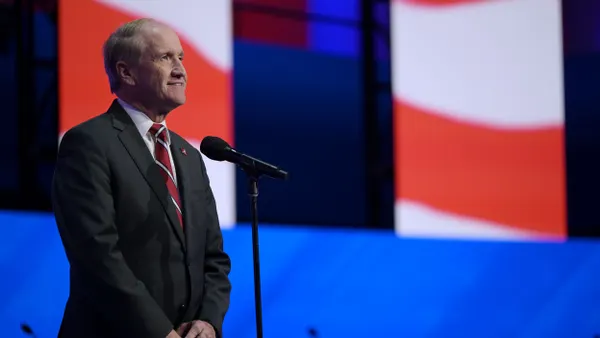
The search for a new University of Florida president has taken a decisive step forward. On Wednesday, the school’s board voted unanimously to back Stuart R. Bell for the role, moving the institution closer to ending a chaotic two-year stretch that began with the sudden departure of former Nebraska senator Ben Sasse.
The decision signals Florida’s interest in returning to the kind of seasoned academic leader the university had stepped away from during the Sasse era. But the choice has not come without friction.
One More Hurdle Remains
Bell’s selection isn’t final just yet. The state university system’s board still has to sign off on the appointment, a step that is usually routine but has proven unpredictable before. Just last year, that same board derailed a candidate who appeared to have the job locked up.
That history hangs over Bell’s nomination, even as he carries strong political backing into the final stage.
A Track Record Built at Alabama
Bell arrives with a substantial résumé. He spent a decade as president of the University of Alabama, where he earned praise for growing enrollment, strengthening the school’s reputation as a research powerhouse, and playing an active role in Southeastern Conference athletics.
His career before Tuscaloosa was firmly rooted in academia. A Texas native who earned three degrees from Texas A&M, Bell served as dean of engineering at the University of Kansas, provost at Louisiana State University, and a professor at Alabama before taking the top job there.
That traditional background stands in sharp contrast to his predecessor at Florida.
Big Ambitions for Florida’s Ranking
Speaking to the board, Bell made his priorities clear. He vowed to push the university into the top three of the U.S. News & World Report rankings, aligning himself with a long-held goal of board president Mori Hosseini.
“Your vision is my vision,” Bell told the board, calling it their shared “North Star” to become the best public university in the country. Florida currently sits seventh among public universities, leaving plenty of ground to cover.
That focus on rankings is notable. The very same issue had created tension between the board and Sasse, who openly questioned how much the rankings really mattered.
The Road That Led Here
The path to Bell’s nomination was anything but smooth. Sasse, a Republican who came to Florida after eight years in the Senate, lacked the conventional credentials typically expected of a major university president. After he stepped down, the university tried to bring in Santa Ono, the former president of the University of Michigan.
That effort collapsed. The state board blocked Ono’s appointment after conservatives criticized his past support for diversity, equity, and inclusion programs, along with what they viewed as a soft approach toward pro-Palestinian protests.
Last month, Florida named Bell as its sole finalist, hoping for a cleaner outcome this time.
Conservatives Take Aim Again
Bell did not escape scrutiny. Critics in Florida and across the country quickly argued that he, much like Ono, had leaned too heavily into DEI initiatives during his time at Alabama.
The complaints have some basis in his record. While leading Alabama, Bell openly supported diversity efforts, including a committee he created in 2019 to expand the university’s DEI work. After the murder of George Floyd in 2020, he wrote that the school needed to stand as a beacon of hope, equality, and inclusivity.
His position later shifted. In 2024, citing the need to comply with state law, Bell announced that Alabama would dismantle its DEI division, replacing it with a newly named division focused on opportunities, connections, and success.
He addressed the controversy head-on Wednesday, telling the board plainly that he was not coming to Florida to bring DEI or “woke” politics back.
Questions Over the Search Process
Beyond the DEI debate, the search itself drew fire. Senator Rick Scott, a Republican and former Florida governor, criticized the process for lacking transparency. Board members pushed back, noting that they had followed a state law that keeps presidential searches shielded from public view.
The criticism adds another layer of political complexity to an already contentious appointment.
Powerful Backing From DeSantis
Despite the pushback, Bell holds a significant advantage: the support of Governor Ron DeSantis, who wields enormous influence over the state board that will make the final call.
DeSantis praised Bell publicly, writing on social media that Bell had done much to elevate the University of Alabama and expressing confidence that he would help Florida reach new heights in Gainesville. That endorsement could prove decisive given the board’s deference to the governor.
A Surprise Over the Interim Leader
Bell’s selection caught many off guard. A number of observers had assumed that Donald W. Landry, the interim president and former chairman of medicine at Columbia University, would land the permanent role.
Landry’s situation comes with an unusual financial wrinkle. His contract requires the university to pay him a $2 million severance if he is passed over for the permanent presidency. Judith Wilde, a George Mason University research professor who studies presidential pay, called the provision highly unusual. Scott went further, describing the clause as “crazy” in a letter to the state university system’s chancellor.
The Trump Connection
Bell’s tenure at Alabama also brought the university closer to Donald Trump. The former and current president appeared at football games and delivered a commencement address in 2025, ending Alabama’s long pause on hosting outside graduation speakers. In that speech, Trump called Bell “highly respected.”
Bell’s record on campus controversies was more nuanced. In 2018, he firmly distanced himself and the university from a planned event featuring an avowed white nationalist. The event never took place after Alabama withdrew recognition from the student group behind it.
Growth, Championships, and Hope for the Gators
By most measures, Bell’s leadership at Alabama delivered results. Enrollment climbed from roughly 37,000 students in his first semester in 2015 to more than 42,000 a decade later when he stepped down.
He also held a prominent role in college sports as president of the SEC’s executive committee. During his years at Alabama, the football program captured three national championships, and the Crimson Tide emerged as a serious force in men’s basketball.
For supporters of the Florida Gators, whose football team has stumbled in recent seasons, that athletic pedigree may be one of the most welcome parts of Bell’s arrival.
At 69, Stuart Bell now stands one approval away from leading one of the nation’s flagship public universities, carrying both impressive credentials and the political baggage that has defined Florida’s long search for stability at the top.
Author