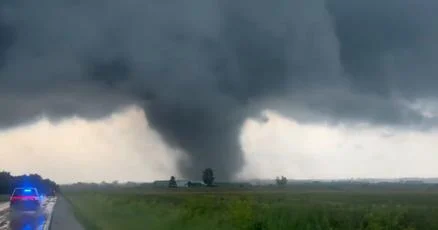
A wave of Midwest severe storms tore across the region this week, spawning suspected tornadoes, cutting power to hundreds of thousands of homes, damaging buildings, grounding flights, and leaving at least one person dead. By late Thursday, fresh tornadoes were touching down in communities just outside Chicago.
A Region Under Siege
By Thursday evening, roughly 11 cities across Illinois and Wisconsin had reported tornadoes, according to CBS News meteorologist Nikki Nolan. Powerful wind gusts battered central Illinois, reaching 75 miles per hour in Mason City and 70 mph in Morton and Washington.
The storms also crippled the power grid. According to PowerOutage.us, more than 243,000 customers in Illinois were without electricity as of Thursday evening.
A Rare and Serious Warning for Chicago
The threat around Chicago was severe enough that the National Weather Service’s Storm Prediction Center upgraded the area to a level 4 out of 5 on its risk scale, signaling that widespread severe storms were likely.
It was the first time Chicago had faced a level 4 risk since July 15, 2024, when the region endured a record-breaking outbreak of 32 tornado touchdowns. A risk of this magnitude is typically seen only about once every two years.
Tornadoes were confirmed largely in rural areas southwest of the city. In Streator, a manufacturing and farming community roughly 100 miles away, officials confirmed a tornado had torn through town. Despite the destruction, Mayor Tara Bedei reported no fatalities there as of Thursday evening.
A Dramatic Rescue in the Rubble
Storm chaser and video journalist Scott Lasker was in Streator during the outbreak when he heard a woman screaming for help about 100 yards away. Rushing over, he discovered her husband trapped beneath debris and helped pull him from the wreckage.
The Storm’s Deadly Toll
The danger had been building since Wednesday, when the weather service received more than a dozen tornado reports across northern Missouri, Iowa, Kansas, and Illinois, along with widespread reports of downed trees and power lines.
In Des Moines, Iowa, the storms turned deadly. Police said a 54-year-old man was killed at a homeless encampment in a park after a tree broke apart and fell on him during the violent weather. He was found critically injured Thursday morning and died at the scene.
Stories of Survival
The storms produced harrowing escapes across the region.
In Maple Park, Illinois, winery owner Joe Brandonisio told CBS News that one of his workers tied himself to a water trailer to avoid being blown away. Brandonisio described watching debris spin into the air before he rushed his staff into the basement for cover.
In Unionville, Missouri, Shane Tipton came home from his factory job unaware of the danger. As he stepped out of his truck, he spotted a twister bearing down and raced inside his mobile home to get his 87-year-old father, Jimmie, to safety. The two made it back to the truck and drove just far enough away to watch the tornado destroy the home entirely. His daughter, Kylie Rouse, said the wreckage was scattered for miles and that her grandfather would not have survived had he stayed inside. The family also fears they lost one of their hunting dogs in the storm.
In Springfield, Illinois, residents believe a tornado struck late Wednesday. Two buildings at the Animal Protective League shelter were heavily damaged, with roofs torn off both structures. Remarkably, none of the nearly 150 cats and 28 dogs housed there were hurt. Executive director Deana Corbin called it a miracle, and the community quickly stepped up, with animal control, veterinarians, and local residents taking in the animals.
Widespread Disruption
The storms rippled far beyond the hardest-hit towns. Intense downpours, hail, and thunderstorms continued Thursday, prompting tornado watches and warnings across parts of Illinois, Indiana, Iowa, Missouri, and Wisconsin.
Air travel took a major hit. Ground stops were issued at Chicago’s O’Hare and Midway airports, as well as New York’s JFK. More than 1,000 flights into and out of Chicago were delayed or canceled, according to FlightAware. Storms also disrupted flights in Philadelphia and Newark.
Damage was reported at Abraham Lincoln Capital Airport in Springfield. Strong winds peeled part of the roof off a Chicago-area apartment building, forcing residents out, while barns collapsed in Wisconsin and buildings were flattened in rural northern Missouri.
A Dangerous Heat Wave Follows
As the storm system pushed eastward, fueled by cool Canadian air colliding with warm, humid air from the South, a new threat emerged. Potentially dangerous heat and humidity moved into the East Coast on Thursday and were expected to persist Friday, stretching from the mid-Atlantic to the Northeast.
Temperatures in the mid-90s Fahrenheit were forecast, but with the humidity it could feel like 100 degrees or more. Numerous daily heat records were at risk of falling.
Cities responded quickly. Philadelphia declared a heat health emergency for Thursday and Friday, opening cooling centers and dispatching outreach teams to vulnerable residents. New York City officials urged people to stay hydrated and find cool spaces if they lacked air conditioning.
Recovery Begins
Utility crews now face a major cleanup. Commonwealth Edison, which serves northern Illinois, said the storms had toppled poles and wires, and the company estimated about 80 percent of service would be restored by late Saturday, June 13.
For now, communities across the Midwest are left sorting through shattered homes, damaged shelters, and scattered debris, bracing for recovery even as the broader weather system shifts its punishing reach toward the East Coast.
Author