The National Mall 86 47 vandalism has drawn national attention after U.S. Park Police discovered large stains spelling out the numbers “86 47” across the iconic stretch of grass near the Washington Monument, the latest in a string of demonstrations involving a phrase the Trump administration has characterized as a call to assassinate the president.
A Striking Act in a Prominent Place
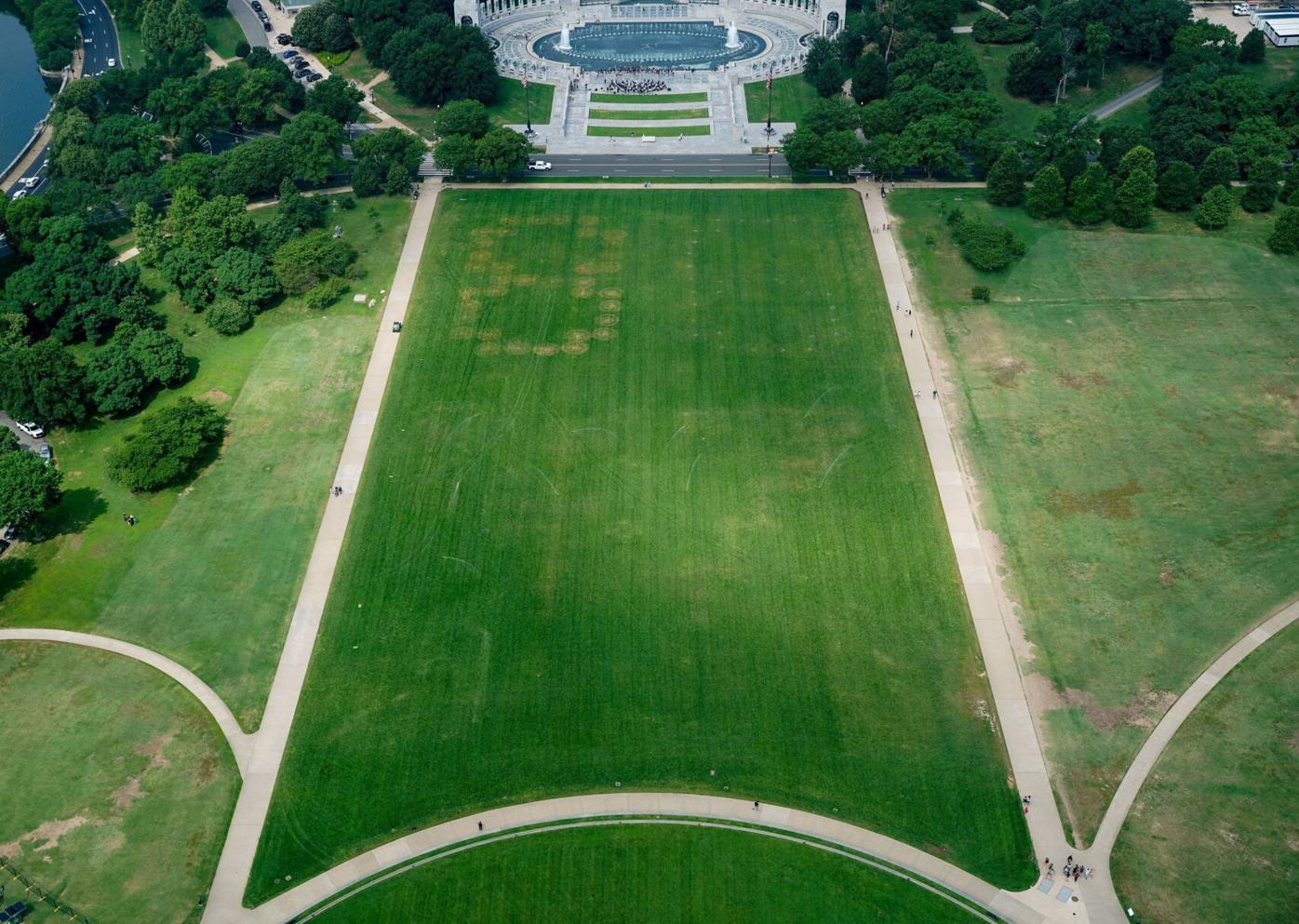
The grassy expanse running from the Washington Monument to the World War II Memorial is among the most visible and revered public spaces in the country. Yet even that high-profile ground proved vulnerable to vandalism on Thursday, when officials found browned patches of grass forming the numbers “86 47.”
The stains were so large they could be seen from a web camera mounted atop the Washington Monument.
Decoding the Numbers
The phrase carries layered meaning. “86” is an old slang term that can mean to dismiss, remove, or in some contexts, eliminate. Trump, who has survived multiple assassination attempts, is both the 45th and 47th president. The administration has previously interpreted “86 47” as a call for the president’s assassination.
It remained unclear exactly what caused the discoloration, but whoever was responsible appeared to go to considerable lengths to mark the grass, doing so just days before Trump is scheduled to host an Ultimate Fighting Championship event near the White House on Sunday, which is also his 80th birthday.
The Investigation
The U.S. Park Police said it was investigating the vandalism, which was reported around 11:30 a.m. on the west lawn of the Washington Monument. The agency noted that grass samples had been collected for testing.
The White House condemned the act in strong terms. Spokesman Davis Ingle said anyone who engages in or endorses political violence or assassination culture must be condemned in the harshest possible terms.
Part of a Broader Pattern
The vandalism is the latest in a series of similar displays by Trump’s critics. Among the most prominent was former FBI Director James B. Comey, who last year posted an Instagram photo of seashells arranged on a beach to form the numbers “86 47,” prompting a Secret Service inquiry.
The Justice Department has aggressively pursued the matter. In April, it persuaded a federal grand jury in North Carolina to charge Comey with making a threat against the president and transmitting a threat across state lines. Comey has pledged to fight the case, and an earlier government attempt to prosecute him had already failed.
The National Mall has hosted other anti-Trump demonstrations as well, including a statue briefly erected last year depicting the president and convicted sex trafficker Jeffrey Epstein holding hands.
A Capital Being Reshaped
The incident unfolds against the backdrop of sweeping changes Trump has brought to Washington. No modern president has tried to leave a bigger mark on the look of the nation’s capital than Trump, a real estate mogul known for fixating on aesthetics.
Since returning to office last year, he has overseen a string of dramatic projects, including:
- Tearing down the East Wing of the White House
- Paving over the Rose Garden with stone tiles
- Resealing the National Mall’s Reflecting Pool with blue-tinted paint
- Pursuing plans for a 250-foot triumphal arch
These efforts have stirred significant controversy and opposition.
Frustration Beneath the Surface
The lawns around the Washington Monument were themselves overhauled and regraded after the September 11, 2001, attacks, with sunken stone retaining walls added as security barriers, according to Judy Scott Feldman, chairwoman of the National Mall Coalition’s board.
Feldman said she was actually more troubled by some of the permanent changes reshaping the city than by the grass stains themselves. In her view, much of the public’s frustration stems from a sense that the Mall, and the capital more broadly, is being remade.
For now, the “86 47” stains stand as both an act of vandalism and a symbol of the deepening tensions surrounding Trump’s presidency and his reshaping of Washington’s most cherished spaces.
Author
-
Lucienne Albrecht is Luxe Chronicle’s wealth and lifestyle editor, celebrated for her elegant perspective on finance, legacy, and global luxury culture. With a flair for blending sophistication with insight, she brings a distinctly feminine voice to the world of high society and wealth.


, a Brussels-based politics and policy news organisation, citing an unnamed senior Ukrainian defence official and sources familiar with the negotiations Details: Sources said the request for US$20 billion will be presented on 18 June at the next meeting of the Ukraine Defence Contact Group (also known as the Ramstein format). "Everyone sees that Russia is burning, and we want it to burn even more, but we need financing to do it," the Ukrainian official said. The issue has been raised by Ukrainian Defence Minister Mykhailo Fedorov and other government officials during a series of meetings with representatives of Norway, Sweden, Germany and Canada. To secure the required amount, Ukraine plans to ask each partner for between US$2 billion and US$6 billion in financial assistance or loans. Support for Ukraine is also expected to be a key topic at the NATO leaders' summit in Ankara in July, where President Volodymyr Zelenskyy is expected to attend on the sidelines. If the funding is secured, Ukraine intends to allocate it to air defence systems, drones, ammunition, electronic warfare capabilities and long-range weapons. The money would also be used for direct procurement from Ukrainian defence companies and for expanding contributions under Ukraine's Priority Requirements List (PURL), a programme that enables Kyiv's allies to procure US weapons for Ukraine. "The window of opportunity tends to close. Russia is fast and innovative. And if we give them time to adapt again, we might lose the only real chance to end this war with real negotiations. And if Russia invents its own mid-strike drones, it will be a catastrophe for us," the senior official warned. The funding would come in addition to Ukraine's defence budget for this year, which stands at UAH 4.4 trillion (US$98 billion). Ukraine is currently spending around 40% of its GDP on defence, the highest proportion in the world. Ukraine's partners have committed US$38 billion in military assistance for this year. An additional US$20 billion would bring Ukraine closer to the US$60 billion target for bilateral aid set by NATO Secretary General Mark Rutte. Show more 6:12 PM Ukraine Seeks $20 Billion More From Allies to Tighten Pressure on Russia Focus Keyword: Ukraine $20 billion defense aid SEO Tags: Ukraine $20 billion defense aid, Ramstein format meeting, Ukraine military funding, Russia war news, NATO summit Ankara, Ukraine air defence systems, PURL programme, Zelenskyy NATO, Ukraine defence budget 2026, Russia Ukraine war update Ukraine Seeks $20 Billion More From Allies to Tighten Pressure on Russia Ukraine $20 billion defense aid is once again at the center of international attention, as Kyiv prepares to ask its allies for a substantial new injection of funds. According to a report by Politico, a Brussels-based politics and policy outlet, Ukraine wants to lock in its current battlefield momentum and step up strikes on targets located deep inside Russian territory. The publication cited an unnamed senior Ukrainian defence official along with sources close to the ongoing talks. A Bold Request at the Ramstein Meeting The push for additional Ukraine $20 billion defense aid is scheduled to be formally raised on 18 June, during the upcoming gathering of the Ukraine Defence Contact Group, widely known as the Ramstein format. This coalition of partner nations regularly coordinates military support for Kyiv, making it the natural venue for such a high-stakes appeal. One Ukrainian official summed up the motivation behind the request in blunt terms, saying that everyone can see Russia is under serious strain, and that Kyiv wants to keep up the pressure but cannot do so without the necessary financing. Quiet Diplomacy Behind the Scenes The matter hasn't appeared out of nowhere. Ukrainian Defence Minister Mykhailo Fedorov, together with other senior government figures, has reportedly been discussing the funding need in a string of meetings with representatives from Norway, Sweden, Germany, and Canada. Rather than seeking the full sum from a single source, Ukraine plans to spread the request across several partners. The strategy involves asking each country for somewhere between US$2 billion and US$6 billion, delivered either as direct financial assistance or as loans. By dividing the total this way, Kyiv hopes to make the contribution more manageable for individual nations while still reaching its overall goal. Eyes on the NATO Summit in Ankara Support for Ukraine is also expected to feature prominently at the NATO leaders' summit set to take place in Ankara in July. President Volodymyr Zelenskyy is anticipated to attend on the sidelines, where he will likely use the opportunity to reinforce Kyiv's case for sustained backing. With major allied leaders gathered in one place, the summit offers a valuable platform to keep funding discussions moving forward. Where the Money Would Go If the funding comes through, Ukraine has clear plans for how it intends to spend it. The priorities reflect lessons learned over a long and grinding conflict, with an emphasis on both defence and offensive reach. The allocated funds would be directed toward: Air defence systems to protect cities and critical infrastructure Drones for surveillance and combat operations Ammunition to sustain ongoing fighting Electronic warfare capabilities to counter Russian technology Long-range weapons capable of striking distant targets Beyond hardware, part of the money would support direct purchases from Ukrainian defence manufacturers, strengthening the country's domestic industry. Funds would also expand contributions under the Priority Requirements List, or PURL, a programme that allows Kyiv's partners to buy American weapons specifically for Ukraine's use. A Narrow Window of Opportunity The urgency in Ukraine's request is hard to miss. The senior official warned that openings like this don't stay open for long. They described Russia as both fast-moving and inventive, cautioning that giving Moscow time to adjust could mean losing the best chance to bring the war toward genuine negotiations. The official also raised a specific technological fear, suggesting that if Russia manages to develop its own advanced mid-strike drones, the consequences for Ukraine could be severe. The message was clear: acting now, while the advantage holds, matters far more than waiting. The Staggering Cost of War These figures sit on top of an already enormous defence commitment. Ukraine's defence budget for the year stands at UAH 4.4 trillion, roughly US$98 billion. Perhaps even more striking is the share of national resources being devoted to the war effort. The country is currently spending around 40% of its GDP on defence, a proportion higher than any other nation in the world. That level of spending underscores just how all-consuming the conflict has become for Ukraine's economy and society alike. Sustaining it without continued outside help would be extraordinarily difficult. How the Numbers Add Up To put the request in context, Ukraine's partners have already pledged US$38 billion in military assistance for this year. Adding another US$20 billion on top would push the total significantly higher, bringing Kyiv much closer to the US$60 billion goal for bilateral aid that NATO Secretary General Mark Rutte has set as a benchmark. In other words, this latest appeal isn't just about plugging a gap. It represents a deliberate effort to reach a target that allied leaders themselves have identified as meaningful for keeping Ukraine in a strong position. The Bigger Picture The Ukraine $20 billion defense aid request reflects a moment of both opportunity and risk. Kyiv believes it currently holds an edge and wants to press that advantage before circumstances shift. At the same time, the appeal highlights Ukraine's deep reliance on foreign support to maintain the pace of its operations. Whether allies will agree to the full amount remains to be seen. The decisions made at the Ramstein meeting in June, and later at the Ankara summit in July, could shape the direction of the conflict in the months ahead. For Ukraine, the hope is straightforward: secure the resources needed to keep the pressure on while the window remains open. China warns of risk of 'extreme floods' in desert regions Summary Xinjiang's Taklamakan Desert sees first flood of the year in early June Temperatures have peaked earlier causing the rapid melt of snow and glaciers Officials warn floods threaten roads, railways, and energy facilities HONG KONG, June 12 - China warned communities in its northwestern Xinjiang and nearby regions on Friday to prepare for "extreme floods" this summer, driven by abnormally high temperatures, heavy rainfall, and rapid glacier melt. Xinjiang's Taklamakan Desert, China's largest, experienced its first flood of the year in early June, state broadcaster CCTV reported on Friday, showing footage of water filling the typically arid dunes. While the Taklamakan has experienced similar floods since 2021, they typically occur in August, when temperatures peak. However, temperatures have surged much earlier this year. On June 12, Xinjiang was 7.3 degrees hotter than average for this time of year, reaching 38 degrees Celsius (100 degrees Fahrenheit), according to [Reuters Climate Monitor](https://www.reuters.com/graphics/CLIMATE-AUTOMATED/MONITOR/akpeykqqapr/). Western and southern Xinjiang have also seen more frequent rainfall recently. Precipitation in some areas has been double or even triple the historical average for early June, CCTV reported. GLACIERS AND SNOW MELTING The combination of intense heat and rainfall has triggered the desert floods. Large swathes of glaciers and snowpack in the Tianshan and Kunlun mountains have melted, sending runoff rushing into the Tarim River, China's longest inland waterway. The influx caused the river to burst its banks, spilling water into low-lying areas of the desert, the broadcaster said. While the seasonal floods can temporarily create short-lived oases, experts say they are unlikely to last because the Taklamakan Desert is situated far inland and surrounded by high mountains, so low moisture levels and extreme evaporation will quickly dry out the terrain. Though the water provides vital irrigation for local forests, officials warned of severe infrastructure risks. "Extreme floods can destroy roads, railways, and oil and gas facilities, posing a significant disaster risk," Sun Qianqian, an analyst at the China Meteorological Administration, told CCTV. "During the flood season, residents and travellers in these regions should monitor official warnings closely, adjust their travel plans, and prioritise safety," Sun added. Show more 6:23 PM China Warns of 'Extreme Floods' Hitting Its Vast Desert Regions This Summer 5 China Warns of 'Extreme Floods'](https://luxechronicle.com/wp-content/uploads/2026/06/The-desert-is-drowning-China-warns-extreme-floods-are-coming-to-its-most-arid-regions-thegem-news-carousel.webp)