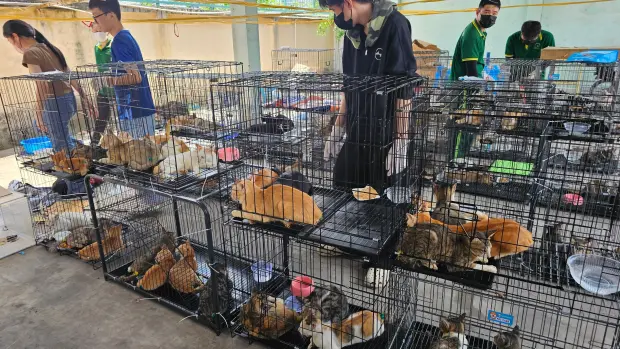
The Vietnam cat meat ring rescue has shed light on the disturbing scale of a trade that sees thousands of pets stolen and slaughtered each month. In a major operation in Ho Chi Minh City, police rescued more than 400 cats from a criminal network, offering a rare moment of hope amid a heartbreaking reality, while also exposing the suffering endured by countless animals.
A Large-Scale Rescue Operation
The breakthrough came after a multiday police operation last week, prompted by a troubling pattern of pet thefts.
Animal welfare groups and local media reported that authorities uncovered a sprawling cat meat crime ring operating in the city. The investigation into the recent wave of disappearances ultimately led officers to the network and resulted in the detention of nine individuals.
What police discovered upon raiding the operation was staggering in scale.
The Grim Discovery
The conditions in which the animals were found painted a horrifying picture.
According to police, the operation uncovered:
- 45 cages holding roughly 400 live cats
- Four ice-filled foam containers concealing about 80 dead cats
- An additional 21 cats found alive at a separate location
In total, more than 500 cats were seized, making this one of Vietnam’s largest cat welfare cases in recent memory. The suspects reportedly admitted to trapping and collecting cats across southern Vietnam over the past three years, operating in Ho Chi Minh City as well as the cities of Tay Ninh and An Giang.
Bittersweet Reunions
For some families, the operation brought relief and joy. For many others, it brought only sorrow.
More than 40 cats were successfully reunited with their owners following the rescue. Yet the celebration was tempered by tragedy, as several dozen of the rescued animals died due to the harsh and cruel conditions in which they had been kept.
Chris Gindelhumer of Vietnam Cat Welfare, who is helping care for the survivors, described the emotional scenes with raw honesty. He spoke of witnessing “quite a lot of tears” in recent days, noting how beautiful it was to see Vietnamese families arriving in search of their pets. But the moment was bittersweet, as many of those families left without finding the cats they loved.
A Sobering Reminder of a Larger Crisis
Animal welfare advocates were quick to frame the rescue within a much broader and troubling context.
Karanvir Kukreja, who leads a campaign against dog and cat meat consumption for the nonprofit Humane World for Animals, called the operation “a sobering reminder of the enormous scale of Vietnam’s cat meat trade.”
That sentiment was echoed by Phuong Pham, the organization’s director in Vietnam, who laid bare the grim reality behind the trade. She explained that thousands of cats are stolen, trafficked, and slaughtered for meat across the country every single month, expressing gratitude that at least these survivors had managed to escape.
Signs of Life Amid the Suffering
Even within this dark story, there were small glimmers of hope.
Phuong Pham revealed that several of the rescued cats were pregnant, leading to kittens being born while in police custody. Caring for these vulnerable animals has demanded enormous effort, with many veterinarians and volunteers working around the clock to nurse the survivors back to health.
These tireless efforts reflect a growing community of people determined to protect Vietnam’s pets.
The Legal Landscape
The case also highlights the complicated legal status of the cat meat trade in Vietnam.
Consuming dog and cat meat remains legal in the country, though vendors are required to hold permits verifying the animals’ origins. However, attitudes and policies are gradually shifting:
- Cities like Hoi An in central Vietnam are partnering with global animal welfare groups to end dog and cat meat consumption locally.
- Following South Korea’s 2024 ban on dog meat, Vietnamese officials signaled plans to rebuild parts of the legal system to better protect pets and the rights of their owners.
These developments suggest a slow but meaningful movement toward stronger animal protections.
A Catalyst for Change
Beyond the immediate rescue, the operation appears to be shifting public sentiment.
An Pham, a student and cat lover in Ho Chi Minh City, captured the broader impact of the event. She noted that the case had surprised many people and helped raise awareness, encouraging more individuals to stop consuming cat meat.
In that sense, the rescue may serve as more than a single law enforcement victory, it could become a turning point in how the public views the trade.
The Bottom Line
The Vietnam cat meat ring rescue stands as both a triumph and a tragedy. While more than 400 cats were saved and dozens reunited with grateful families, the deaths of many others and the sheer scale of the operation reveal the immense suffering still embedded in the country’s cat meat trade.
As volunteers and veterinarians continue caring for the survivors, and as public awareness grows, this case may help fuel momentum toward reform. For now, it serves as a powerful reminder of both the cruelty of the trade and the compassion of those fighting to end it.
Author