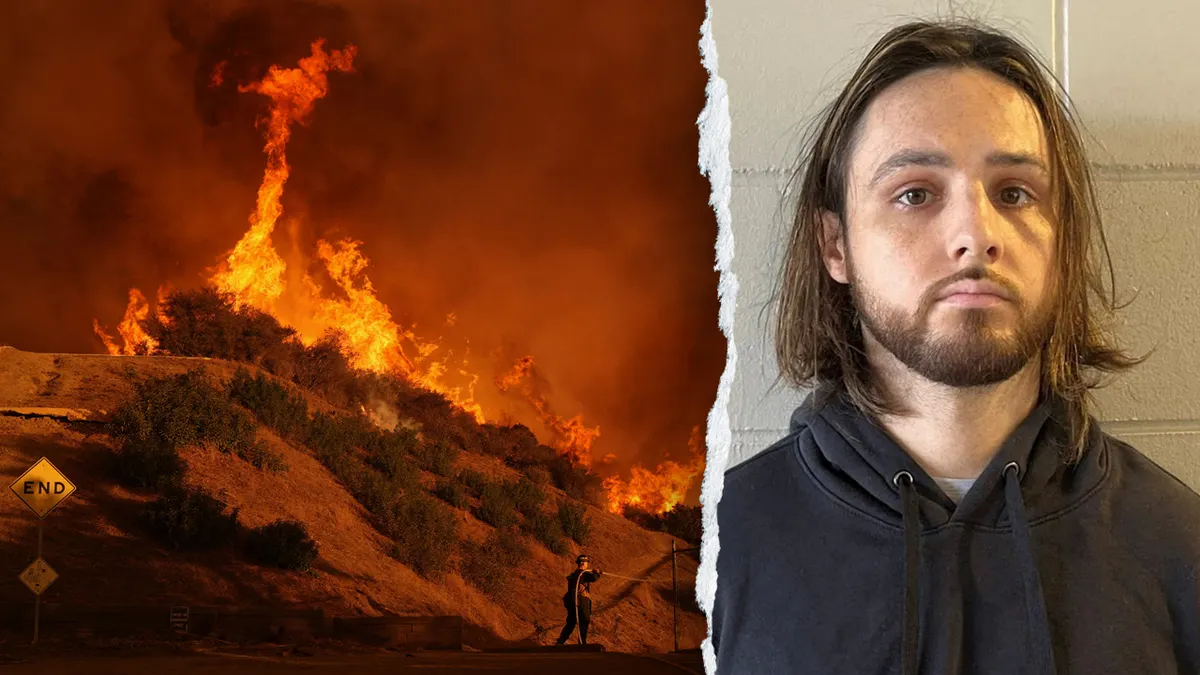
Palisades Fire trial reached a tense standstill this week as jurors told a federal court they could not agree on a verdict for the man accused of sparking one of the most destructive wildfires in California history. After two days of deliberation, the panel signaled it was hopelessly split, setting the stage for a possible mistrial in a case that has gripped Los Angeles.
A Jury at an Impasse
On Thursday afternoon, jurors sent a note to U.S. District Judge Anne Hwang explaining that they could not reach a unanimous decision on all the counts facing the defendant. The message was blunt: jurors on both sides refused to budge, leaving them at a complete standstill with no clear path forward.
Rather than declare a mistrial immediately, the judge instructed the panel to return on Friday for further deliberation. The defense, meanwhile, requested what is known as an Allen charge, a set of instructions a judge can give to nudge a deadlocked jury toward agreement. The tactic is often called the “dynamite charge” or “hammer charge” because it functions as a final, high-pressure push to break an impasse and avoid a mistrial.
The Charges and What’s at Stake
At the center of the case is Jonathan Rinderknecht, a 30-year-old former Uber driver who faces three federal charges tied to the January 2025 Palisades Fire:
- Destruction of property by means of fire
- Arson affecting property used in interstate commerce
- Setting timber afire
He pleaded not guilty in October and could face up to 45 years in prison if convicted. The scale of the disaster underscores why the trial carries such weight: the fire destroyed roughly 6,800 homes, businesses, and structures, making it one of the largest and most expensive catastrophes in California’s history.
The Prosecution’s Theory
Prosecutors built their case around the idea that the devastation began days before the Palisades Fire itself. They argued that Rinderknecht deliberately ignited an earlier blaze, called the Lachman Fire, on January 1 near a popular hiking spot known as Skull Rock. According to their account, that fire smoldered quietly for days before erupting into the massive Palisades Fire six days later.
To paint a picture of motive, prosecutors described a man consumed by anger and resentment toward the wealthy, portraying him as someone who felt trapped and embittered by those at the top of the economic ladder.
The evidence they presented was largely digital. Using security video, cellphone data, and his online activity, prosecutors placed Rinderknecht near the ignition point shortly before the Lachman Fire was reported. They noted he had been driving for Uber that night and lingered in the neighborhood after dropping off his final passenger, an area he knew well from having once lived nearby. Prosecutors also pointed to his digital trail, including searches asking ChatGPT whether cigarettes could start wildfires.
Investigators played recordings of his interviews, during which he reportedly sounded defensive, rambling, and at times manic. In one striking moment, he asked why there were no cameras on the trail where people could light things up.
Adding to the portrait, a passenger who rode with him on New Year’s Eve testified that he seemed erratic and unsettled. She described the trip as the most frightening Uber ride she had ever taken, saying she feared he might drive them straight into the ocean.
The Defense Pushes Back
Defense attorney Steve Haney mounted an aggressive challenge, framing the prosecution’s case as long on suspicion but short on proof. His central argument was that no physical evidence directly linked his client to the fire.
He emphasized several gaps in the investigation:
- Arson investigators found no accelerants at the scene.
- No witnesses actually saw the Lachman Fire start.
- The scene was left unsecured for days after the burn, raising the possibility that crucial evidence was lost or contaminated.
Haney offered an alternative explanation, arguing that fireworks, not his client, sparked the Lachman Fire on New Year’s Day. Prosecutors countered that the later Palisades Fire was a holdover from that earlier blaze, which had continued smoldering underground even after firefighters believed it was out.
The defense also leaned on Rinderknecht’s own behavior to argue innocence. Haney pointed to multiple frantic 911 calls his client made shortly after the Lachman Fire began, and the fact that he stayed at the scene. Questioning an arson expert, Haney asked whether arsonists typically call 911 repeatedly and remain on site; the expert agreed that such behavior runs counter to the common myth about how arsonists act.
Haney framed the larger stakes plainly, telling jurors the case was not about whether a fire occurred but about its cause and the integrity of the investigation. He cautioned them not to convict simply because they might dislike the defendant, reminding them that personal distaste is not the same as guilt. He also suggested his client was being scapegoated for the city’s broader failure to protect the Pacific Palisades neighborhood.
A Competing Account From the Scene
The defense introduced testimony that complicated the prosecution’s narrative. A retired electrical engineer who lives near the ignition site told the court that he and his wife felt what seemed like an explosion behind their home on January 1.
After waiting a few minutes, he went to investigate and said he saw smoke along with four men leaving the area near the blast. He described them as appearing boastful, as though they had just done something they considered daring.
Earlier Legal Maneuvering
The trial also saw procedural battles before reaching the jury. The defense moved to dismiss the case on Monday, arguing the government had failed to present enough evidence to support a conviction and noting that several witnesses had described the Lachman and Palisades fires as two separate events.
The judge rejected that motion after prosecutors argued that expert testimony repeatedly undercut the defense’s theory.
What Happens Now
With the jury deadlocked and ordered back for another round of deliberation, the outcome remains uncertain. If the panel cannot break its impasse, the case could end in a mistrial, leaving open the question of whether prosecutors would seek to try Rinderknecht again.
For a community still recovering from staggering losses, the lack of resolution adds another layer of frustration to a tragedy whose origins remain fiercely contested.
Author