Hezbollah disarmament has emerged as the central sticking point in a newly signed agreement between Israel and Lebanon, casting immediate doubt over whether the deal can actually end months of bloodshed. While the framework offers a roadmap to peace, the militant group’s flat rejection of its core demand suggests the path forward will be anything but smooth.
A Deal Met With Immediate Pushback
The agreement, signed Friday in Washington, ties Israel’s withdrawal from Lebanon directly to the disarmament of Hezbollah, a condition the Iran-backed group refuses to accept. Within a day, Hezbollah’s leader publicly criticized the framework, raising serious questions about how effective it could ever be.
Naim Kassem, who heads the group, made his position unmistakable in a statement on Saturday. He declared that Hezbollah would continue fighting until Israel was forced out of Lebanon entirely. His remarks were echoed in the streets of Beirut, where supporters protested following news of the agreement.
The skepticism is not unfounded. Lebanon has reached multiple ceasefire agreements with Israel since the latest round of war erupted, yet none of those deals were ever carried out on the ground. The human cost has been staggering, with more than 4,000 people in Lebanon killed in Israeli strikes since March, when Hezbollah opened fire on Israel two days after the Iran war began.
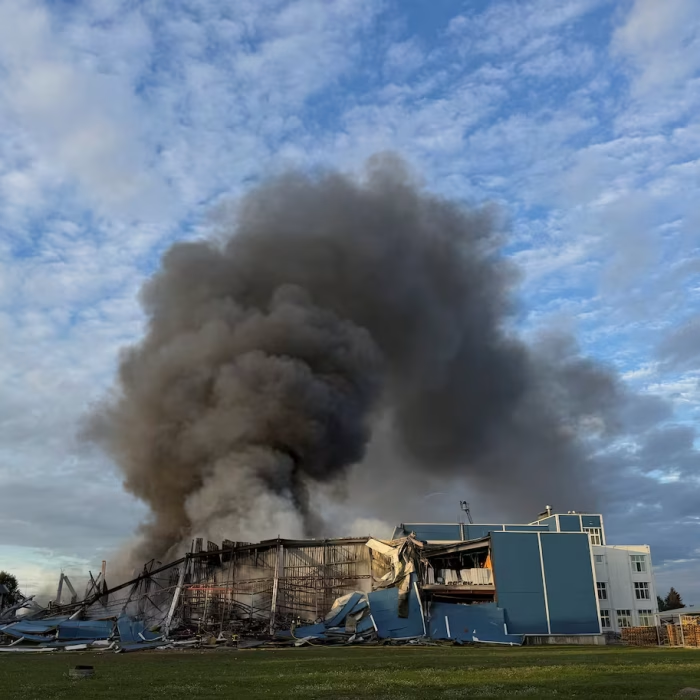
Even as the ink dried, violence continued. Lebanon’s state news agency reported an Israeli drone strike near the southern city of Nabatiyeh. The same source noted that Israel’s military had released several Lebanese and Syrian workers detained near a southern village the day before.
How the Agreement Is Structured
The negotiations between Israel and Lebanon ran separately from the interim deal signed earlier this month by the United States and Iran. According to details released by the U.S. State Department, the two countries hope to eventually bring a formal end to the state of war that has existed since Israel’s creation in 1948.
The deal lays out a conditional and gradual process:
- Israel will withdraw from Lebanon only if Hezbollah agrees to disarm.
- The initial pullback covers two small areas, referred to as pilot zones, though their locations were not disclosed.
- The Lebanese army will progressively take over full security responsibility in those areas.
- Future pilot zones for additional Israeli withdrawals will be agreed upon down the line.
A security annex accompanying the deal details how the Lebanese army would deploy and how Israeli troops would reposition, but that portion was kept private. Israel maintains that full Hezbollah disarmament across Lebanon, paired with further security arrangements, would remove any future need for Israeli military action or presence in the country.
Israel Signals a Long Stay
Despite the language of withdrawal, Israeli leaders made clear they are not leaving anytime soon. Prime Minister Benjamin Netanyahu stated that Israeli forces would remain in southern Lebanon until Hezbollah and other groups he labeled as terrorist organizations were disarmed and no threat to Israel remained.
Netanyahu described the two designated zones as a pilot program for disarming Hezbollah and handing territory over to the Lebanese army, noting that Israel had already pulled out of one. Defense Minister Israel Katz reinforced that posture, saying the military had been instructed to prepare for an extended presence.
Hezbollah Calls It a Humiliation
From Hezbollah’s perspective, the agreement simply does not exist. Kassem dismissed it outright, branding it a humiliation and calling the link between Israel’s withdrawal and the group’s disarmament a deeply dangerous proposition.
The reaction grew more alarming when Hassan Fadlallah, an official within the group, warned that the deal could spark civil war. He insisted Hezbollah would never surrender its weapons and would resist any moves the Lebanese army might take. The danger of internal unrest prompted Lebanon’s top public prosecutor, Judge Ahmed Rami al-Hajj, to instruct the heads of the country’s security agencies to take steps to prevent riots.
Doubts on Both Sides of the Border
Many ordinary people in both countries question whether the deal can hold. The agreement acknowledges that lasting stability depends on restoring security in southern Lebanon through the Lebanese army’s deployment, the safe return of civilians, and protection for Israel’s northern communities.
Even so, faith in those outcomes runs thin. An Israeli citizen visiting the border town of Metula expressed doubt that the arrangement would last, arguing that the Lebanese military stands little chance against Hezbollah.
In Lebanon, opinion was split. One resident of Sidon voiced support for the Lebanese authorities, saying people simply wanted lasting peace. Another resident of the same city took the opposite view, claiming the deal effectively legitimized Israel’s occupation.
Cutting Off the Money
The agreement also takes aim at the financial lifelines that have sustained Hezbollah for decades. In what appears to be a clear reference to Iran, which has funneled billions of dollars to the group over the past forty years, the deal commits both Lebanon and the United States to blocking funds from reaching any entity, organization, or individual tied to non-state armed groups.
Beyond that, the Lebanese government explicitly pledged to prevent reconstruction money from flowing to such groups and their affiliated networks. Whether these commitments can be enforced, and whether Hezbollah will ever lay down its arms, remains the great unanswered question hanging over the entire agreement.
Author