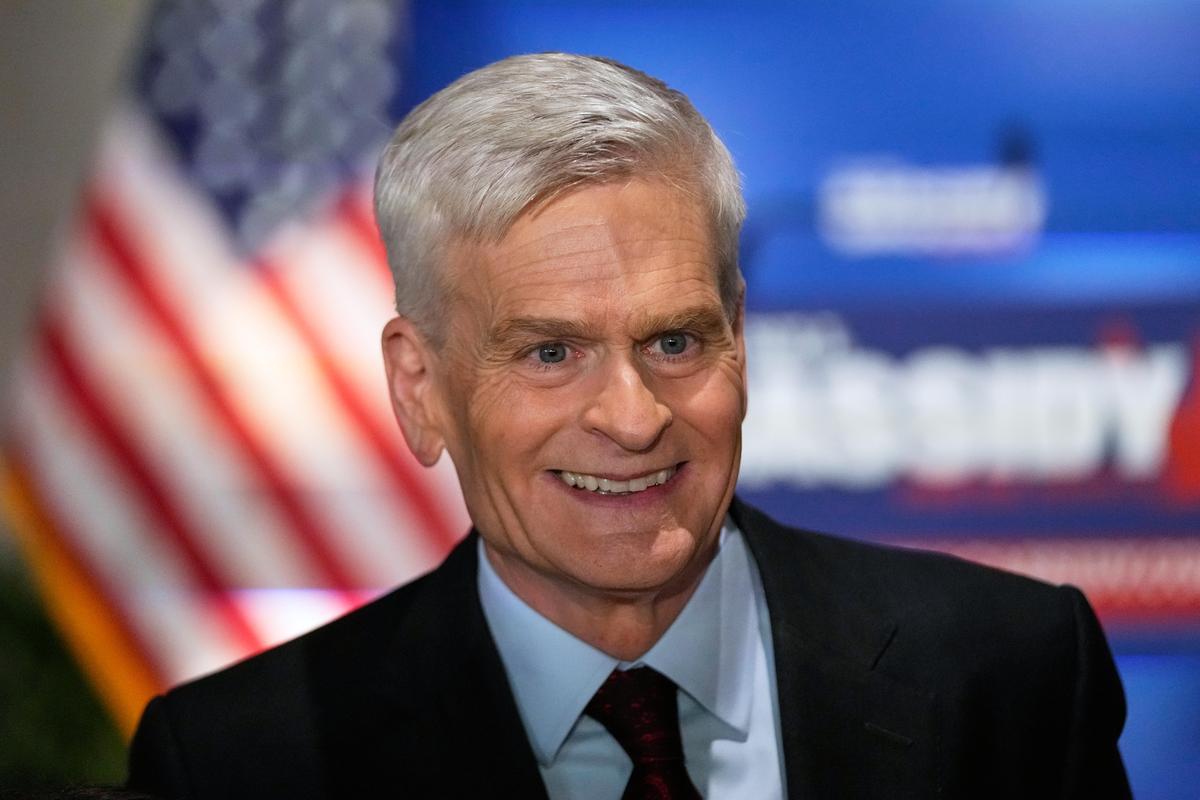
In a rare break from party loyalty, the moment Cassidy criticizes Trump over the Iran war has drawn national attention, spotlighting growing tension between the White House and members of his own party. Outgoing Louisiana Senator Bill Cassidy has accused President Donald Trump of treating Congress as little more than an afterthought when it comes to the ongoing conflict with Iran. His pointed remarks signal an unusual willingness among Republicans to push back against the president’s handling of military affairs.
A Public Rebuke of the President
Speaking on CBS News’s Face the Nation, Cassidy didn’t mince words. He accused Trump of treating the legislative branch as “merely an appendage” rather than a coequal partner in decisions about going to war. The criticism centered on what Cassidy described as a troubling absence of congressional briefings about U.S. military operations against Tehran.
For a sitting Republican to challenge Trump this directly is uncommon, which is part of what made the senator’s comments so notable. Cassidy framed his frustration not as personal grievance but as a defense of constitutional principle.
Behind the Closed-Door Clash
The disagreement reportedly came to a head during a luncheon on Capitol Hill. Cassidy had backed a war powers resolution, a move widely seen as a symbolic slap at the White House for keeping lawmakers in the dark.
That support didn’t sit well with the president. According to accounts of the meeting, Trump sharply criticized Cassidy and the other Republican senators who voted for the measure. Rather than back down, Cassidy raised his own voice to match the president’s, insisting that the Constitution requires Congress to be kept informed about military action.
His argument leaned heavily on the intentions of the nation’s founders, who, he said, deliberately gave Congress a meaningful role in overseeing presidential war powers. In Cassidy’s view, sidelining lawmakers undermines that carefully designed system of checks and balances.
A Briefing Secured, a Stance Softened
Despite the fiery exchange, the confrontation produced results. Cassidy said he eventually obtained a briefing on the conflict from Vice President JD Vance and special envoy Steve Witkoff.
With that information finally in hand, the senator stepped back from his earlier position and withdrew his support for the war powers resolution. The episode illustrates how the dispute was less about opposing the war outright and more about demanding that Congress be treated as a genuine participant in the process.
Questioning the President’s Priorities
Cassidy’s criticism didn’t stop at the Iran conflict. He also raised doubts about Trump’s emphasis on the Save America Act, legislation aimed at introducing new federal voting restrictions.
In Cassidy’s estimation, the president would be better served focusing on the everyday struggles ordinary Americans face. He pressed the point by asking how such measures actually improve people’s lives, summing up his concern with a simple question: “How do you make their life better?” The remark reflected a belief that economic worries weighing on families deserve more attention than political battles over voting rules.
Counting the Cost of the Conflict
Looking at the bigger picture, Cassidy underscored just how steep the price of the Iran war has become. He pointed to staggering figures tied to the campaign, including:
- Roughly $29 billion in spending
- 13 American lives lost
For Cassidy, those numbers reinforced the need for serious congressional scrutiny rather than blind deference to the executive branch.
Not every Republican shares his sense of alarm. Senator Roger Marshall struck a far more hopeful tone, suggesting the war is progressing and urging Americans to be patient as events unfold. The contrast between the two senators highlights the divisions running through the party over how to view the conflict.
A Parting Push for Accountability
As his time in the Senate winds down, Cassidy appears determined to keep speaking his mind, especially on questions of government accountability. One of his sharpest objections concerns a proposed Justice Department fund of $1.8 billion that he says is designed to benefit Trump’s allies.
Cassidy has made clear he finds the idea deeply troubling, arguing that those in power should be held to a higher standard, not shielded from one. His message boils down to a principle he clearly takes seriously: no leader, regardless of office, should be above the law.
A Final Stand on Principle
Cassidy’s outspoken stretch in his closing months carries a certain weight precisely because he has little left to lose politically. By challenging the president on war powers, voting legislation, and questions of accountability all at once, he is staking out a position rooted in institutional responsibility rather than partisan calculation.
Whether his warnings gain traction within the Republican ranks remains to be seen. For now, his willingness to confront Trump directly stands as a reminder that debates over the balance of power between Congress and the presidency are far from settled, even within the president’s own party.
Author