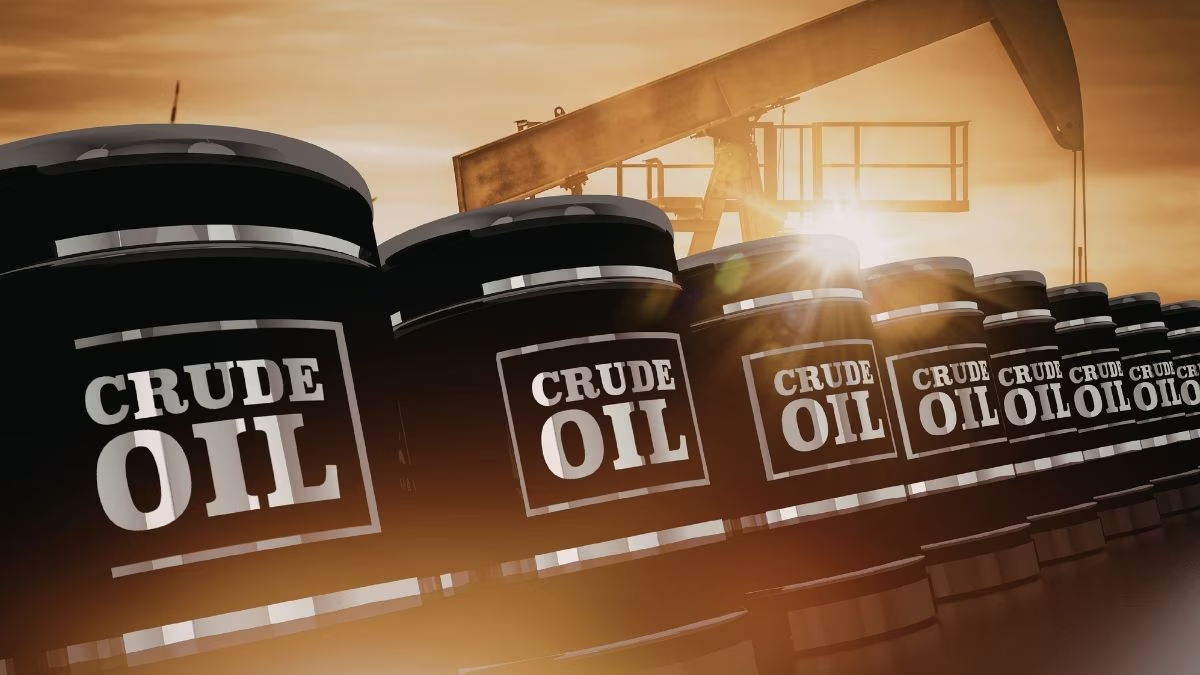
Brent crude oil price climbed sharply on Thursday, touching its highest level in four years before easing slightly later in the session. The surge came after fresh reports surfaced suggesting that the U.S. military is preparing to brief President Donald Trump on possible action against Iran. The development has reignited fears of a wider armed conflict in the Middle East and added new pressure on already strained global oil supplies.
Why Oil Prices Jumped Sharply
The latest spike in the Brent crude oil price was triggered by an Axios report claiming that the U.S. Central Command is preparing to present Trump with several options for potential military strikes against Iran. The report, which cited two sources familiar with the discussions, instantly rattled energy markets and sent traders scrambling to reassess geopolitical risk.
Tensions had already been running high after Trump reportedly turned down Tehran’s offer to reopen the Strait of Hormuz. By rejecting the proposal, the U.S. signaled that its naval blockade against Iranian oil exports would remain firmly in place until a wider nuclear agreement could be finalized.
Brent and WTI Movement
June futures for Brent briefly crossed the $126 per barrel mark before pulling back to around $121.84, marking a 3.4% gain on the day. Meanwhile, U.S. West Texas Intermediate (WTI) crude rose by about 1%, trading near $107.98 per barrel during early morning hours in New York.
The fluctuations reflect just how sensitive the market has become to every new headline involving Iran, the Strait of Hormuz, or U.S. policy moves.
Tight Supply and the Hormuz Bottleneck
According to Goldman Sachs, oil exports through the critical Hormuz chokepoint have collapsed to roughly 4% of normal levels. With U.S.–Iran talks effectively stalled and the American blockade still active, global supply has tightened significantly.
Analysts at the bank noted that the squeeze could intensify if the blockade continues, especially given limited storage capacity worldwide. They also pointed out that any production boost from the UAE, following its decision to leave OPEC, is likely to come gradually and may not be enough to balance near-term shortages.
In simple terms: less Iranian oil is reaching the global market, and replacement barrels aren’t arriving fast enough.
Trump Turns Up the Heat
Trump appeared to escalate tensions further on Wednesday with a sharp post on Truth Social, warning that Iran “better get smart soon.” He criticized Tehran’s leadership for failing to reach a non-nuclear agreement, accompanying the message with an AI-generated image showing him holding a gun against a backdrop of explosions and the bold caption: “NO MORE MR. NICE GUY!”
The provocative post added another layer of uncertainty for energy markets, where investors are already on edge about the direction of U.S. foreign policy.
Markets React to a Mix of Fear and Speculation
Bill Perkins, Chief Investment Officer at Skylar Capital Management, summed up the current mood by saying that oil markets are being shaped by a combination of physical supply disruptions, political signals, and investor psychology. Traders, he noted, are closely watching tanker movements, sanctions enforcement, and any hint of diplomatic progress.
According to Perkins, both sides appear far from a workable deal, and additional pressure—or perhaps more time—may be required before the Strait of Hormuz can be reopened.
Strategic Reserves Offer Limited Cushion
While strategic reserves and oil already in transit have helped soften the immediate impact on crude prices, refined product markets are showing signs of severe stress. Diesel prices, in particular, have risen sharply, and logistical bottlenecks remain a major concern.
Perkins warned that even if a ceasefire is announced, the disruption to refined products could persist for weeks, keeping fuel prices elevated for consumers and businesses.
Demand Risks Loom in the Background
Despite the bullish supply story, Goldman Sachs has flagged emerging signs of weakness on the demand side. Global oil consumption in April is estimated to be about 3.6 million barrels per day lower than February levels. Most of the slowdown is concentrated in jet fuel usage and petrochemical feedstocks—two sectors that are highly sensitive to global economic conditions.
In other words, while geopolitical tensions are pushing prices up, softening demand could eventually act as a counterweight.
Where Could Oil Prices Go Next?
Looking ahead, Perkins believes the Brent crude oil price could surge to between $140 and $150 per barrel if the standoff with Iran continues and physical disruptions worsen. However, he also cautioned that prices at such extreme levels typically lead to “demand destruction,” where consumers and industries cut back on usage.
This natural balancing mechanism could eventually pull prices back down, but only after a period of significant volatility.
Final Thoughts
The current rally in the Brent crude oil price highlights how deeply geopolitical risks are tied to global energy markets. With the U.S. weighing potential military action, the Strait of Hormuz partially blocked, and Iranian exports drastically reduced, traders are bracing for further turbulence.
For now, oil markets remain caught in a delicate balance—where every political tweet, military rumor, and supply update has the power to shift prices dramatically. Whether crude eventually cools off or surges to new highs will largely depend on what happens next between Washington and Tehran.
Author