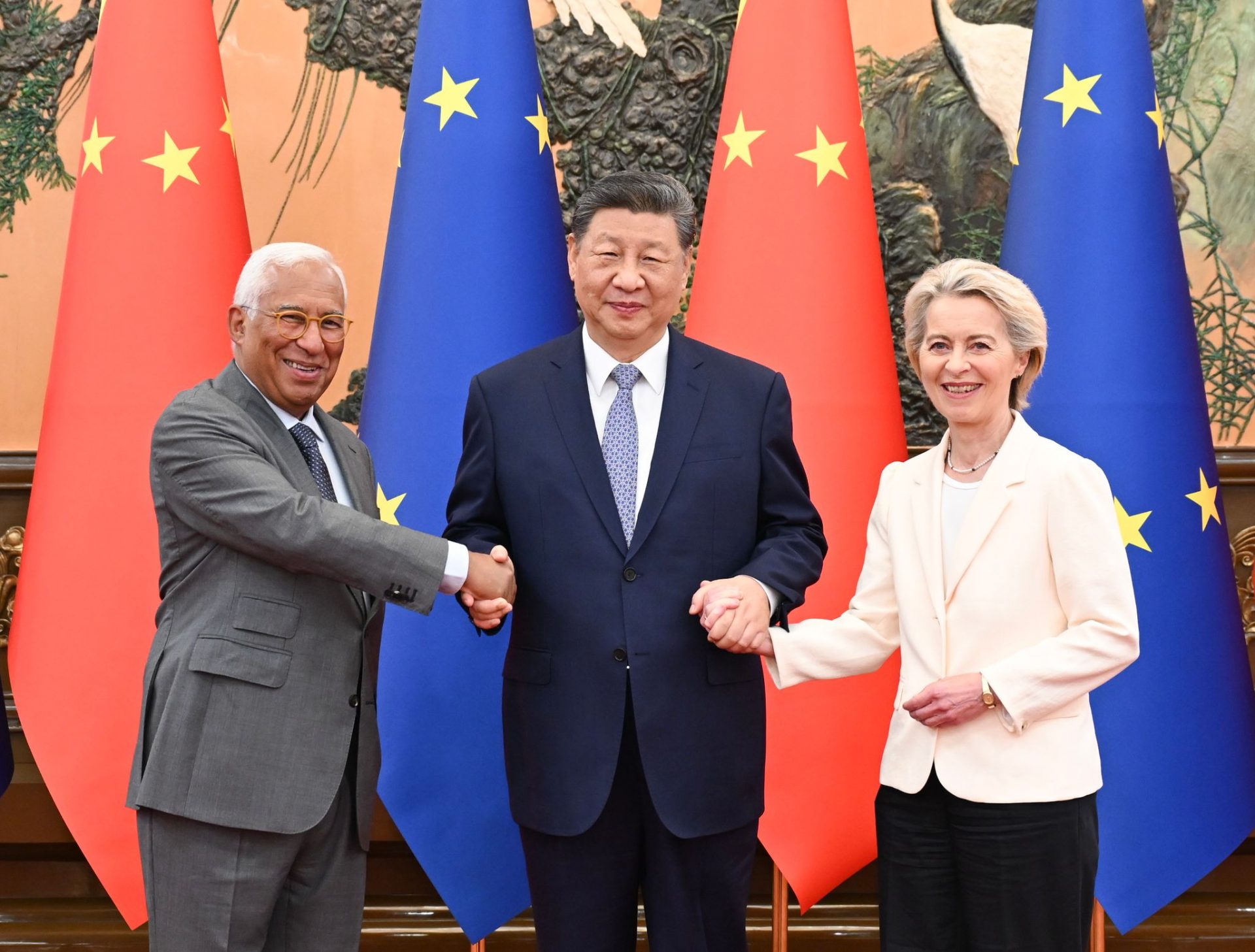
When European Union trade commissioner Maros Sefcovic welcomed Chinese Commerce Minister Wang Wentao to Brussels on Monday, the diplomatic smiles masked a far blunter message. Behind the cordial exchanges, the EU made clear it has run out of patience with a trade relationship that increasingly tilts in China’s favor.
A Message Loud and Clear
Speaking to reporters after a marathon day of talks, Sefcovic stopped short of declaring that enough was enough, but he hardly needed to. He pointed out that China’s exports to the EU keep climbing while Europe’s share of the Chinese market continues to shrink, calling the trend unsustainable and insisting that the status quo was no longer an option.
That sharp tone marks a notable shift. For years, Europe positioned itself as the transatlantic defender of free trade, a counterweight to U.S. President Donald Trump’s protectionism. That image now feels like a relic of the past.
A ‘New China Shock’
The rapid expansion of Chinese firms across Europe, powered by massive state subsidies and enormous economies of scale, has rattled European companies and jolted the bloc’s leaders into action. In a speech to the G7 last year, European Commission President Ursula von der Leyen described China’s growing industrial dominance abroad as a new China shock.
While EU member states differ on how aggressively to respond to the flood of Chinese goods, there is broad consensus on the need to protect domestic industry. Philippe Le Corre, a professor of international relations and Asian studies at ESSEC Business School in France, told Al Jazeera that the mood had shifted because European companies now face real danger and everyone is beginning to recognize it. He called this the new normal, arguing that the EU cannot simply wait on the sidelines for Washington and Beijing to strike their own deals and instead needs its own policies toward China.
The Scale of the Imbalance
The numbers behind Europe’s alarm are stark. China’s trade surplus with the EU reached 360.6 billion euros, or about $411 billion, in 2025, the equivalent of roughly 1 billion euros a day and a 15 percent jump from the previous year.
Chinese firms now dominate Europe’s supply in a range of critical sectors, including solar panels, rare earths, chemicals, and industrial robots. Increasingly, they are also challenging some of Europe’s most cherished legacy companies on their own turf, with carmakers feeling the pressure most acutely.
The Auto Industry Under Siege
EU tariffs of up to 35.3 percent on Chinese electric vehicles have done little to slow the momentum of popular brands like BYD, Geely, and Chery. In May, Chinese models surpassed 10 percent of total auto sales in the bloc for the first time, according to Dataforce.
The consequences for Europe’s storied automakers, long-standing symbols of the continent’s industrial innovation, have been severe. German media reported last week that Volkswagen was preparing to cut as many as 100,000 jobs, roughly 15 percent of its workforce, in what would be the largest restructuring in the history of the global auto industry. BMW has announced plans to trim about 5 percent of its workforce by the end of 2026, while Mercedes-Benz has paused employee bonuses and offered thousands of workers voluntary redundancy.
Beijing Pushes Back
China has firmly rejected accusations that it fuels industrial overcapacity to flood global markets, and it has warned of retaliation if the EU moves to correct the perceived imbalance. Ahead of the Brussels talks, Yuyuantantian, a social media account linked to Chinese state media, struck a defiant tone, warning that China could cope even if relations with the EU deteriorated to the freezing point. China does not want to go that far, the account said, but it is not afraid to.
Europe’s Countermeasures
The EU is weighing a series of measures aimed at curbing Chinese influence. Among them, the bloc has proposed overhauling the Cyber Security Act to bar Chinese firms from critical infrastructure, drafted an Industrial Accelerator Act to prioritize EU-made goods in public procurement, and floated plans to require European companies in sensitive industries to source components from at least three different suppliers.
Several additional measures targeting Chinese imports are set to take effect on July 1, including a reduction in the duty-free quota for imported steel and a 3-euro customs charge on small parcels.
Walking a Fine Line
Even as member states rally around a tougher approach, the EU remains eager to avoid a full-blown trade war with the world’s second-largest economy. After Monday’s discussions, Sefcovic praised the constructive dialogue and voiced optimism that Brussels and Beijing were starting to understand each other better, noting that such talks help both sides avoid unnecessary tension.
In a joint statement, Sefcovic and Wang said they had identified four workstreams for their next round of negotiations in October, including export controls and trade and investment balancing. They also agreed to set up a joint trade monitoring mechanism intended to improve transparency, build mutual trust, and manage trade frictions.
What’s at Stake
For Europe, the hope is that China will accept meaningful concessions to preserve its access to the lucrative European market, heading off a damaging trade war. Yet while EU leaders worry about Chinese retaliation, the stakes for European industry make it unlikely they will accept merely symbolic gestures.
Alicia Garcia-Herrero, chief economist for the Asia Pacific at Natixis in Hong Kong, told Al Jazeera that the sheer scale of potential job losses made a hollow agreement hard to imagine. Given how much is on the line, she said, it would be surprising if Europe settled for anything less than substantive action.
As the two sides prepare for their next round of talks, Europe finds itself navigating a delicate balance, determined to defend its industrial base while trying to avoid a rupture with a trading partner it cannot afford to alienate.
Author