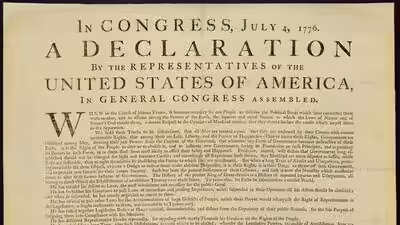
A Declaration of Independence found in U.K. archives has stunned historians, offering a remarkable connection to one of the most pivotal moments in American history. This rare 1776 printing turned up not on American soil, but tucked away in Britain’s National Archives, where a sharp-eyed volunteer stumbled upon it while sorting through old records.
An Extraordinary Discovery
The document in question is known as an “Exeter Declaration,” a name that reflects where it is believed to have been printed. What makes it so special is its scarcity. According to the National Archives, this copy is one of only 11 of its kind known to still exist anywhere in the world.
Even more striking, experts believe it is the only surviving example located outside the United States. That distinction elevates the find from a simple archival curiosity to a genuinely significant piece of transatlantic history.
Saul Nassé, Chief Executive of The National Archives and Keeper of Public Records, did not hold back his enthusiasm. He described the find as extraordinary, marveling at the fact that such a vanishingly rare survivor of the Declaration had been uncovered in Britain rather than in America.
The Story Behind the Printing
To understand why this copy matters, it helps to know how it came to exist in the first place. The document is thought to have been printed in Exeter, New Hampshire, in 1776. These printings were not created as keepsakes or treasured artifacts. Instead, they served a practical purpose.
Copies like this were produced quickly to spread the news that the Declaration had been signed. Because information traveled slowly in that era, printed versions were distributed widely and frequently carried aboard ships to reach distant audiences. Their value lay in communication, not preservation.
A Dramatic Capture at Sea
The journey of this particular copy reads almost like an adventure novel. According to the National Archives, the document was seized from an American vessel named the Dalton on Christmas Eve in 1776.
The capture was no simple affair. The British Royal Navy ship HMS Raisonable ran down the Dalton following a tense seven-hour pursuit off the coast of Portugal. Once the chase ended and the ship was brought under British control, its papers were confiscated.
Among the seized materials were several notable items, including:
- The privateer’s commission
- Printed instructions from the Continental Congress
- The Declaration itself
Interestingly, when the documents were archived, the Declaration was recorded in an almost dismissive manner, simply logged as “another paper.” No one at the time seemed to grasp the historical weight of what they were filing away.
Found After 250 Years
For two and a half centuries, the document sat quietly among other correspondence, its importance overlooked. That changed thanks to Michael Scurry, a volunteer working at the National Archives in London.
While cataloguing a box of old letters, Scurry realized he was looking at something unusual. As he recounted to the BBC, his instinct told him this was no ordinary paper. He immediately called over his supervisor, telling them they needed to come take a look at what he had found.
That moment of recognition transformed a routine cataloguing task into a headline-making discovery, proving that important pieces of history can still be waiting to be found in unexpected places.
Careful Restoration
Once the document’s identity was confirmed, the National Archives took steps to protect it. Given its age and fragile condition, the copy required expert attention.
Conservators carried out what the archives described as careful conservation work. This involved repairing a slight tear and stabilizing the delicate paper to ensure the document could survive for generations to come. Such meticulous care reflects the reverence now afforded to an item that was once treated as an afterthought.
Why This Copy Is So Significant
Dr. Graham Moore, a curator at The National Archives, emphasized just how uncommon this form of the Declaration truly is. He pointed out that it represents one of the rarest versions historians are aware of.
Part of what makes it remarkable is its very nature. These copies were never intended to last. As Dr. Moore explained, the document was printed hastily and circulated broadly, meaning few would have been expected to survive the passage of time.
The circumstances of its discovery add another layer of meaning. According to Dr. Moore, the fact that this copy was aboard the Dalton speaks volumes about its importance and the role such documents played in spreading revolutionary ideas across the seas.
A Fitting Find for a Historic Moment
The timing of this discovery could hardly be more appropriate. As the United States marks 250 years since declaring independence, the emergence of this long-forgotten copy offers a tangible link to the events of 1776.
There is something poignant about a document created to announce American independence resurfacing in Britain, the very nation from which the colonies sought to separate. It serves as a reminder of how deeply intertwined the histories of the two countries remain.
Connecting Past and Present
Discoveries like this one do more than fill gaps in the historical record. They breathe life into stories that might otherwise feel distant or abstract. Holding, studying, and preserving an original printing allows people today to connect directly with a defining chapter of the past.
The find also highlights the ongoing value of archival work. Countless boxes of documents sit in institutions around the world, and as this case demonstrates, treasures can still be hiding in plain sight, waiting for a curious volunteer to recognize their worth.
A Lasting Legacy
For historians, collectors, and anyone fascinated by the American Revolution, the Exeter Declaration found in London represents a genuine treasure. Its survival against the odds, its dramatic capture at sea, and its quiet centuries in an archive combine to create a story as compelling as the document itself.
As it takes its place among the world’s known copies of the Declaration, this rare find stands as a powerful symbol of history’s ability to surprise us. Even after 250 years, the story of American independence continues to reveal new chapters, reminding us that the past is never quite as settled as it seems.
Author