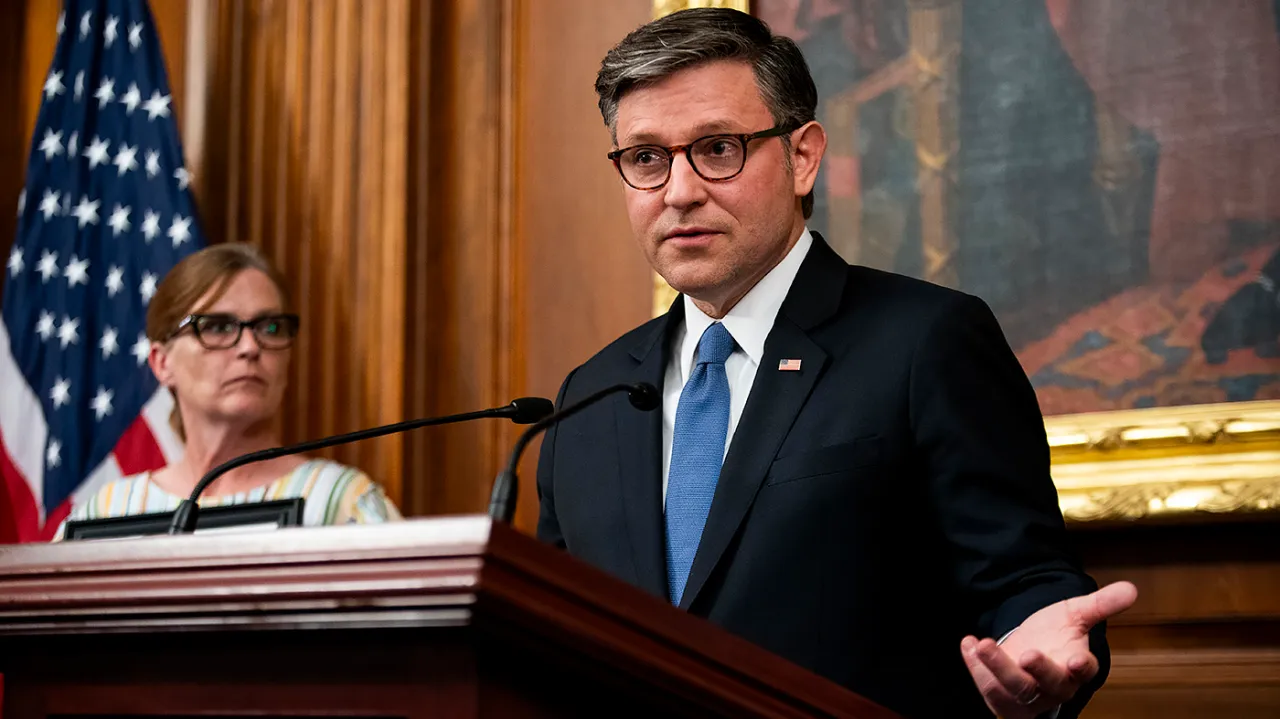
The debate over birthright citizenship has surged back into the national spotlight, and House Speaker Mike Johnson is now urging Congress to take direct action. Following a recent Supreme Court decision that dealt a blow to the Trump administration’s efforts, Johnson made it clear he believes lawmakers should step in where the executive branch could not.
Johnson Calls for Legislative Action
Speaking during a July 5 appearance on “Fox News Sunday,” the Louisiana Republican argued that Congress should pursue a legislative path to scale back automatic citizenship for children born on American soil. His comments came shortly after the nation’s highest court rejected an executive order from President Donald Trump that had attempted to reshape the definition of who qualifies as an American.
Johnson didn’t hold back in his assessment of the current system. He contended that immigration rules are being exploited through what critics call “birthright tourism,” a practice he claims has diminished the value of citizenship itself.
He framed the issue as far more than a policy disagreement, describing it as a danger to both the rule of law and national security. In his words, the matter demands attention and cannot simply be ignored.
While Johnson stopped short of naming a specific bill to tackle the problem, he indicated that Republicans are exploring every possible option. If a viable piece of legislation emerges, he promised to move it forward without delay.
The President Weighs In
President Trump has echoed this call for congressional action. After his defeat at the Supreme Court, he publicly encouraged lawmakers to pass legislation addressing the issue.
Notably, Trump pushed back against the idea that a constitutional amendment would be required. He insisted that no lengthy or cumbersome amendment process was necessary to achieve the desired changes, suggesting a simpler legislative fix could suffice.
What the Supreme Court Actually Decided
At the heart of this controversy lies the Supreme Court’s interpretation of the 14th Amendment. Writing for the majority, Chief Justice John G. Roberts Jr. concluded that children born to parents who are in the country unlawfully or on a temporary basis still meet the requirements of the amendment’s citizenship clause.
That clause states that anyone born or naturalized in the United States, and subject to its jurisdiction, is a citizen of both the nation and the state where they live.
The majority of justices determined that birthright citizenship enjoys constitutional protection under this amendment. This ruling carries significant weight, because altering the Constitution is no small feat. Doing so would require:
- Approval from two-thirds of both chambers of Congress
- Ratification by three-fourths of all state legislatures
Those steep thresholds explain why Trump and his allies are searching for alternatives that don’t involve amending the Constitution.
A Possible Legislative Opening
Despite the ruling, one justice left the door open for a different approach. In a concurring opinion, Justice Brett Kavanaugh suggested that Congress retains the ability to carve out exceptions to birthright citizenship, specifically for children born to individuals residing in the country illegally.
This distinction has become a rallying point for those hoping to change the status quo. It implies that while the courts have upheld the broad principle, legislative refinement might still be possible.
In fact, some lawmakers have already tried. Senator Lindsey Graham of South Carolina and Representative Brian Babin of Texas, both close allies of Trump, introduced a bill last year aimed at restricting birthright citizenship. Rather than denying the right outright, their proposal acknowledges the 14th Amendment’s guarantee but seeks to narrow the definition of who counts as being “subject to the jurisdiction” of the United States.
Understanding “Birth Tourism”
A central term in this entire discussion is “birth tourism.” So what does it actually mean?
The phrase refers to the practice of expectant parents traveling briefly to the United States specifically to give birth, ensuring their child automatically receives American citizenship. Authorities use this label to describe what they see as a deliberate exploitation of immigration rules.
However, pinning down the scale of this practice is surprisingly difficult. The government does not officially track these numbers, which leaves plenty of room for dispute. Researchers have offered wildly different estimates, ranging from as many as 39,000 births annually to as few as 2,000.
Adding another perspective, a group of 140 university professors submitted a written argument to the Supreme Court. They asserted that birth tourism represents an extremely tiny fraction of all children born in the country, challenging the notion that it constitutes a widespread crisis.
A Deep Political Divide
Unsurprisingly, opinions on this topic split sharply along party lines. Republicans and Democrats fundamentally disagree about whether curbing birth tourism deserves urgent attention.
On one side, Senator Ted Cruz of Texas has condemned the practice, calling it a flagrant abuse of the country’s immigration laws. On the other, Senator Peter Welch of Vermont dismissed it as a relatively minor concern, describing it as a fairly marginal issue in the broader immigration landscape.
This disagreement underscores why any legislative effort will likely face fierce resistance and heated debate in the months ahead.
The SAVE America Act and Other Priorities
Birthright citizenship wasn’t the only item on Johnson’s agenda during the interview. He also discussed his plans for the SAVE America Act, an election reform measure backed by Trump.
Johnson revealed that he intends to advance the bill through budget reconciliation, a legislative maneuver that could help it clear the Senate. He expressed optimism that this approach would finally carry the measure to the president’s desk, calling it a top priority for both himself and Trump.
However, the path forward has been anything but smooth. The bill, along with other House business, stalled after a faction of Republicans led by Representative Anna Paulina Luna staged a revolt on a procedural motion. That rebellion ultimately forced the chamber into recess.
Johnson explained his decision to pause proceedings, saying he felt it was best to let members return home to celebrate the Fourth of July in their districts before regrouping. He reaffirmed that passing the SAVE America Act remains a pressing goal.
Complicating matters further, the Senate’s strict reconciliation rules have already blocked the bill from previous budget packages. Senate parliamentarian Elizabeth MacDonough ruled earlier this year that the measure violated guidelines preventing unrelated legislation from being folded into the budget process.
Looking Ahead
As Congress reconvenes, the twin battles over birthright citizenship and election reform promise to dominate the political conversation. With the Supreme Court having settled the constitutional question for now, the fight shifts squarely to Capitol Hill, where deep divisions and procedural hurdles await. Whether Johnson and his allies can turn their ambitions into law remains an open and closely watched question.
Author