AI Companies Pentagon Deal Reshapes the Future of Defense Technology
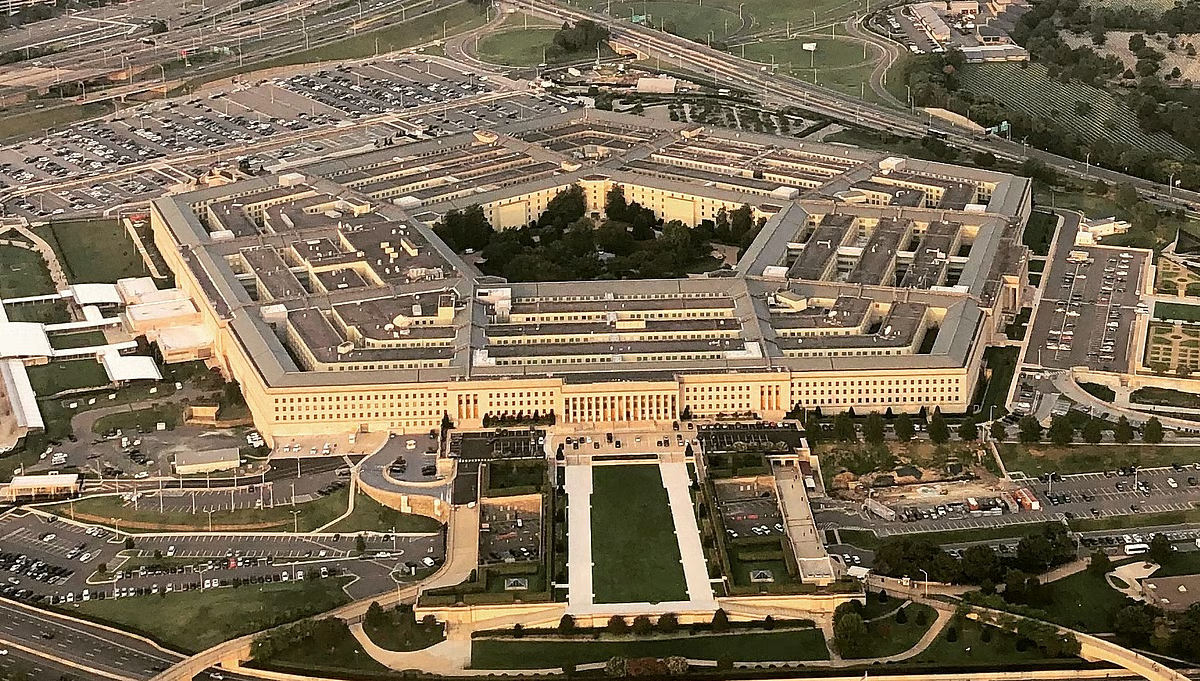
The latest AI companies Pentagon deal marks a major turning point in how the U.S. government plans to use artificial intelligence for national security. Seven leading AI firms have officially agreed to deploy their technology inside classified Defense Department computer networks, the Pentagon announced Friday. The development signals a deeper, more institutional embrace of AI in military operations — and at the same time leaves industry heavyweight Anthropic visibly isolated as it continues to clash with the Trump administration in court.
The shift represents one of the clearest examples yet of how Washington and Silicon Valley are recalibrating their relationship around AI, surveillance, and the future of warfare.
Pentagon Diversifies Its AI Partnerships
According to Pentagon officials, the new agreements are part of a broader strategy to avoid being dependent on any single AI provider. Emil Michael, the department’s chief technology officer, told CNBC that relying on one partner is irresponsible, especially when working on sensitive national security matters.
When one of the department’s previous partners — widely understood to be Anthropic — pushed back against certain conditions, the Pentagon decided to expand its roster of providers. The result: a strategic move to bring multiple major AI companies into the fold, ensuring redundancy, flexibility, and competition among contractors.
While the financial terms of the new contracts have not been disclosed, the scope is significant. The Defense Department says it plans to use AI technology to:
- Analyze massive amounts of classified data
- Improve battlefield decision-making
- Support intelligence operations
- Enhance logistics and operational planning
- Strengthen cybersecurity capabilities
These efforts reflect how AI is increasingly viewed as a foundational layer for modern military operations, not just a niche tool.
The Anthropic Standoff
The new agreements come against the backdrop of a tense and very public fight between the Pentagon and Anthropic. Earlier this year, the two clashed over how the company’s Claude AI model could be used. Anthropic pushed back against potential applications related to:
- Mass domestic surveillance
- Fully autonomous weapons systems
- Use cases lacking human oversight
Pentagon officials, in response, argued that accepting such restrictions would effectively give a private company veto power over critical national security decisions. The department instead insisted on the freedom to use AI technology for “all lawful purposes.”
That standoff escalated to the point where defense officials moved to blacklist Anthropic, branding the firm a national security risk. The two sides remain locked in a court battle over that designation.
New Deals Quietly Include Limits on Surveillance and Weapons
While the Pentagon publicly emphasized flexibility in its new agreements, the actual contracts include some of the very restrictions Anthropic had originally fought for. According to a defense official and portions of the text reviewed by The Washington Post, the new deals incorporate:
- Adherence to a Biden-era policy ensuring human oversight of weapons systems
- Compliance with laws preventing unlawful or unauthorized domestic surveillance
- Commitments to respect Americans’ constitutional rights
- Constraints on autonomous weapons use
In other words, the limits Anthropic championed have not vanished. Instead, they appear to have been quietly integrated into the new partnerships, just under different conditions and with different companies.
Who’s Joining the Pentagon’s AI Push
The new deals represent a who’s who of the modern AI industry. Among the companies signed on are:
- Microsoft
- Amazon (via Amazon Web Services)
- Several other leading AI firms
OpenAI, which makes the GPT family of models, previously inked a separate agreement with the Pentagon that reportedly includes safeguards similar to those Anthropic had pushed for.
Each of these companies brings a different strength to the table — from cloud infrastructure to advanced foundation models — and together they form a powerful coalition aimed at modernizing defense operations.
Inside the Companies’ Statements
Several of the companies have publicly addressed their participation, though most have stopped short of providing detailed information about the safeguards involved.
Microsoft spokeswoman Kate Frischmann said the company had “constructive conversations” with officials to ensure the deal protects human oversight of autonomous weapons and respects public privacy.
Amazon Web Services spokesman Tim Barrett emphasized that the company has been committed to working with the military for more than a decade, expressing enthusiasm for continuing to support the Department of War’s modernization efforts and helping deliver mission-critical AI solutions.
Google’s response has been more reserved. The company declined to share specific safeguards or implementation details, even as internal pressure mounts.
Internal Pushback at Google
Not everyone inside these companies is comfortable with the direction the industry is taking. Just this week, hundreds of Google employees sent a letter to leadership urging them to refuse to allow the Pentagon to use Google’s AI on classified data.
The employees’ message was simple: AI should benefit humanity, not be used in ways they consider inhumane or harmful. The letter is the latest example of growing tension within tech companies over the ethical boundaries of AI in military and surveillance contexts.
This kind of internal dissent isn’t new. Google itself faced similar resistance years ago over its participation in Project Maven, a military AI initiative that ultimately led the company to scale back some defense work — though that stance has clearly evolved over time.
Anthropic’s Unique Position
What makes Anthropic’s situation particularly interesting is that despite the Pentagon’s blacklisting effort, the company continues to play a role elsewhere in government AI work. The White House has been working with Anthropic on cybersecurity initiatives, and the company has developed a new system called Mythos.
According to reports, Mythos is highly capable when it comes to penetrating computer networks, raising both interest and concern in Washington. The U.S. government is currently evaluating the system and has hosted talks with Anthropic to better understand its broader implications.
This shows that even amid public conflict, Anthropic still occupies a unique and influential space in U.S. AI policy — particularly in cybersecurity, where its technical capabilities are being taken seriously.
What This Means for the AI Industry
The expanded AI companies Pentagon deal carries broad implications for both the technology and defense sectors. Some of the most significant takeaways include:
- AI is becoming central to U.S. national security strategy
- Tech companies face mounting pressure to balance ethics, employee values, and government contracts
- The line between commercial AI and military AI continues to blur
- Internal dissent inside major tech firms is gaining traction
- Companies that decline certain government partnerships may face legal and financial consequences
The deals also signal a broader policy direction in Washington. Rather than relying on any single provider or model, the government is positioning itself to leverage AI from multiple sources, ensuring resilience and reducing risk in mission-critical applications.
The Road Ahead
As AI systems become more capable and more deeply integrated into national security operations, the debates surrounding them will only grow louder. Questions around oversight, accountability, surveillance, and autonomous weapons aren’t going to be resolved in a single round of contracts.
What’s clear is that the Pentagon is moving fast, and the AI industry is largely moving with it. Anthropic, despite its court battle, hasn’t disappeared from the equation — but its more cautious stance now stands in sharp contrast to the path being taken by its competitors.
Whether this new approach proves to be a model for responsible AI in defense or a slippery slope toward unchecked use of advanced technology will depend on how transparently and ethically these partnerships unfold in the years to come. For now, one thing is certain: the era of AI in national security has officially entered a much more aggressive and defining phase.
Author