Asian Shares Wall Street Gains Oil Prices Rise as Iran War Tensions Linger
Asian shares Wall Street gains oil prices climbed on Friday as global markets reacted to a mixed bag of economic and geopolitical signals. While stocks moved higher across Asia following modest gains in the U.S., oil prices jumped again as ongoing efforts to end the Iran war have so far failed to produce a breakthrough.
Investors continued to weigh how prolonged uncertainty around the Strait of Hormuz, rising bond yields, and stubborn inflation pressures could shape the months ahead. Yet for now, optimism is winning out, at least in equities.
A Positive Day Across Asian Markets
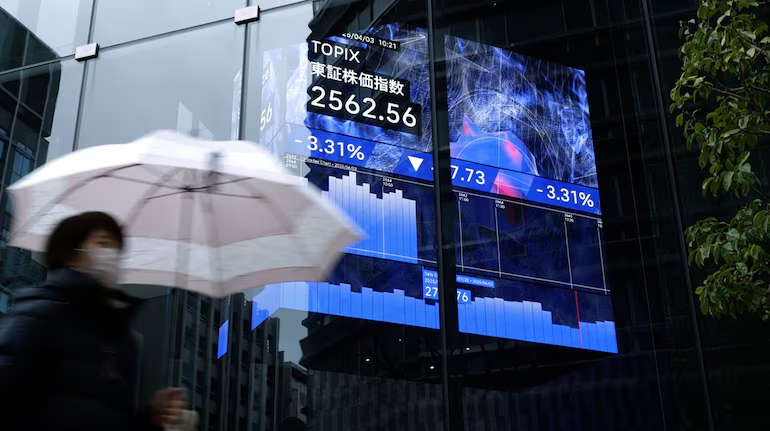
Markets across Asia opened on a strong note Friday, with several major indexes registering noticeable gains. Investors took cues from Wall Street’s modest rally on Thursday, while also responding to easing pressure in the bond market and a calmer near-term outlook for inflation.
Key performances across Asia included:
- Japan’s Nikkei 225 jumped 2.7 percent to 63,339.07, helped by an inflation reading that fell to a four-year low of 1.4 percent in April
- South Korea’s Kospi gained 0.4 percent to close at 7,847.71
- Hong Kong’s Hang Seng picked up 0.9 percent to reach 25,612.40
- Shanghai Composite climbed 0.9 percent to 4,112.90
- Australia’s S&P/ASX 200 added 0.4 percent to 8,657.00
- Taiwan’s Taiex surged 2.2 percent
- India’s Sensex rose 0.6 percent
The broad-based rally reflects growing confidence that central banks may not need to keep tightening monetary policy aggressively, especially if inflation continues to ease.
Oil Prices Climb Again on War Uncertainty
Despite the cheerful tone in equities, oil markets told a different story. Crude prices climbed again Friday, driven mainly by ongoing concerns about the war between the United States and Iran.
Although oil eased slightly during U.S. trading on Thursday, the broader picture remains tense:
- Brent crude rose 2.3 percent to $104.97 a barrel
- U.S. benchmark crude traded 1.8 percent higher at $98.10 a barrel
- Brent was just around $70 per barrel before the war began in late February
- Shipping activity through the Strait of Hormuz remains well below pre-war levels
The Strait of Hormuz is one of the most critical chokepoints in global energy markets, and any disruption there has a powerful ripple effect on prices, supply chains, and inflation worldwide.
Why the Iran War Still Matters So Much
Talks between Washington and Tehran have continued, but progress has been slow, leaving global markets without the clarity they need.
ING commodities strategists Warren Patterson and Ewa Manthey summed up the mood in a Friday note, saying that while markets are showing some signs of optimism, uncertainty still dominates the picture. They emphasized that investors are actively searching for signs of progress on a potential U.S.-Iran deal.
The political environment in Washington has only complicated things. Republicans in Congress delayed planned votes into June on legislation that would force President Donald Trump to withdraw from the conflict. The House initially had a war powers resolution scheduled for Thursday, but GOP leaders pulled it once it became clear they did not have enough support to defeat it.
This combination of military tension, political stalemate, and energy market disruption keeps oil traders on edge and prices elevated.
Wall Street’s Slow but Steady Climb
U.S. markets ended Thursday with modest but meaningful gains, helping set the tone for Asia’s Friday rally. The day’s biggest highlights from Wall Street included:
- S&P 500 climbed 0.2 percent to close at 7,445.72
- Dow Jones Industrial Average rose 0.6 percent to 50,285.66
- Nasdaq Composite ticked up 0.1 percent to 26,293.10
Stocks moved higher as bond yields eased and oil prices briefly retreated. The improved sentiment helped airlines and consumer brands rebound, while corporate earnings continued to attract close attention.
Standout Movers in U.S. Markets
Several individual stocks made waves on Thursday, capturing investor interest for different reasons:
- Nvidia dropped 1.8 percent despite reporting better-than-expected quarterly results, with some analysts arguing its valuation still underestimates its long-term AI potential
- Southwest Airlines climbed 2.7 percent
- American Airlines surged 4.9 percent, lifted by easing oil prices
- Ralph Lauren jumped a notable 13.9 percent following stronger-than-expected earnings
The mixed reaction to Nvidia is particularly interesting. Even strong results aren’t always enough to push the stock higher when expectations are sky-high. Yet many on Wall Street still see the company as deeply undervalued relative to the AI revolution it powers.
Yields Cool After a Volatile Stretch
Treasury yields, which had recently surged to multi-year highs over inflation fears, started to cool down on Friday. The yield on the U.S. 10-year Treasury fell to 4.57 percent, down from over 4.67 percent earlier in the week.
This easing was a major relief for markets because rising yields can:
- Slow economic growth
- Increase borrowing costs for businesses and households
- Pressure equity valuations
- Hurt riskier assets like crypto and emerging markets
By stabilizing this week, yields helped restore some calm and supported the broader rally across stocks.
Currency Markets Adjust Slightly
Currency markets remained relatively steady on Friday with a few small moves worth noting:
- The U.S. dollar rose to 159.12 Japanese yen, up from 158.98 yen
- The euro slipped to $1.1605 from $1.1619
While the dollar’s continued strength is partly tied to elevated U.S. yields and global uncertainty, the moves were modest compared to recent volatility.
A Market Caught Between Hope and Fear
The current global picture is complicated. On one hand, equity investors are showing optimism about easing inflation, strong earnings, and the possibility of progress in U.S.-Iran talks. On the other, oil prices remain stubbornly elevated due to geopolitical risks, and uncertainty around the Strait of Hormuz keeps pressure on global supply chains.
Key themes investors are watching closely include:
- Whether the U.S. and Iran can make any real diplomatic progress
- The trajectory of oil and energy prices
- Inflation data from major economies
- Movements in long-term Treasury yields
- Central bank signals on monetary policy
Until clearer answers emerge, markets are likely to continue swinging between cautious optimism and sharp pullbacks.
What Could Move Markets Next
The next few weeks will likely be shaped by several major factors. Analysts and investors will be looking for signs of progress, including:
- Concrete steps in U.S.-Iran negotiations
- Stabilization of shipping through the Strait of Hormuz
- New inflation reports across major economies
- Earnings updates from key global companies
- Statements from major central banks like the Federal Reserve, Bank of Japan, and European Central Bank
Whether markets continue their cautious climb or face another period of turbulence will depend heavily on how these factors evolve.
Final Thoughts
Asian shares Wall Street gains oil prices reflect the current state of global markets in 2026, balancing fragile optimism with real geopolitical risk. Stocks are pushing higher on hopes of easing inflation and progress on global tensions, while oil prices serve as a constant reminder that the Iran war continues to weigh on the world economy. For investors, the message is clear: stay alert, stay diversified, and keep a close eye on both Wall Street and the Strait of Hormuz, because the next big market move could come from either direction.
Author