Banksy New London Statue Sparks Buzz Near Buckingham Palace
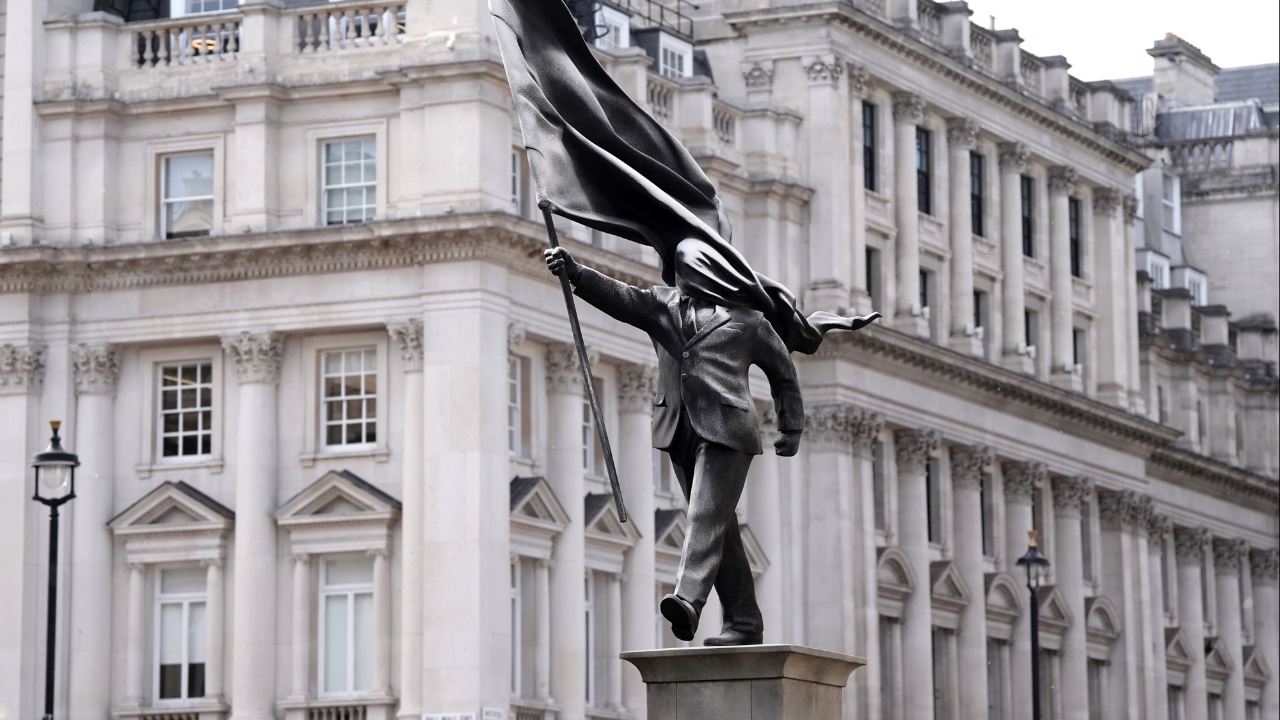
Banksy new London statue news has taken the city by storm, after the elusive street artist claimed responsibility on Thursday for a striking new sculpture that quietly appeared in central London. The piece — a man striding forward off a plinth, his face completely covered by a billowing flag — has already drawn crowds of locals and tourists eager to see the latest work from one of the world’s most secretive artists.
Located in a high-profile spot near some of London’s most famous monuments, the sculpture is yet another reminder that Banksy continues to use public space to provoke conversation, curiosity, and a fair amount of confusion.
How the Statue Quietly Appeared
The sculpture seems to have been installed in the dead of night, with its presence becoming clear in the early hours of Wednesday morning. It now stands on a plinth on a traffic island in Waterloo Place, putting it within walking distance of Buckingham Palace.
Key facts about the installation:
- The statue appeared overnight, without any official announcement.
- It was placed on a traffic island plinth in Waterloo Place.
- A signature reading “Banksy” was scrawled at the base of the plinth.
- Crowds quickly gathered, suspecting it was a Banksy long before he confirmed it.
The signature alone was enough to send rumors flying. Even before Banksy publicly claimed it, the placement, style, and tone of the work felt unmistakably his.
Banksy Confirms It on Instagram — In True Banksy Style
Banksy himself confirmed the piece in his trademark fashion: a humorous Instagram video that gave fans a behind-the-scenes glimpse at how the statue was set up.
The video included:
- Snippets of the statue being installed late at night.
- Subtle nods to the secrecy of the operation.
- Characteristic dry humor and visual playfulness.
- Confirmation that the work belongs to him.
For Banksy fans, the social media drop has become its own art form. Each new project is followed by a video or photo that not only confirms authorship but also adds a wry layer of context to the piece itself.
A Powerful Image: A Man Blinded by a Flag
The visual concept of the statue is doing a lot of heavy lifting. It depicts a man stepping forward off the plinth — frozen mid-stride — with his face completely obscured by a billowing flag.
It’s an image rich with potential interpretation:
- A figure marching forward, but unable to see where he’s going.
- A symbol of patriotism, blocking rather than guiding vision.
- A commentary on nationalism, ideology, and political identity.
- A nod to how flags can both unite and blind.
While Banksy has not publicly explained the meaning, that ambiguity is very much his style. His work tends to leave just enough room for viewers to project their own political, social, or cultural readings onto it.
A Loaded Location
Part of what makes this sculpture so striking is where it sits. Waterloo Place is far from a random traffic island — it’s a deeply historic part of central London, surrounded by powerful symbolic figures.
The new Banksy statue stands near:
- A statue of King Edward VII, who reigned from 1901 to 1910.
- A monument to legendary nurse Florence Nightingale.
- The Crimean War Memorial, honoring British soldiers from that 19th-century conflict.
By inserting an anonymous, blindfolded figure into this lineup of established historical icons, Banksy has effectively created a visual conversation between past and present. It poses an unspoken question: in a place dedicated to memory, leadership, and sacrifice, what does it mean for a modern figure to march forward unable to see?
A Surprising Format for a Familiar Artist
While Banksy is one of the most globally recognized artists working today, statues are not what he’s primarily known for. His style is rooted in spray paint, stencils, and clever wall art that turns city surfaces into commentary on politics, war, surveillance, capitalism, and class.
His career has spanned:
- Early creations in his hometown of Bristol in southwest England in the early 1990s.
- A rapid rise through the international street art scene.
- Iconic works that have appeared in cities across Europe, the U.S., the Middle East, and beyond.
- Auction sales reaching millions of dollars, despite his refusal to play by traditional art-world rules.
This new sculpture is different — quite literally three-dimensional — and that shift carries its own meaning. Where his murals usually live on walls and buildings, a statue feels like a deliberate intervention into how cities choose to memorialize people and ideas.
Why Banksy Keeps Getting Targeted
With Banksy’s growing fame and skyrocketing market value, his street art has also become a target. Many of his pieces have been:
- Stolen by individuals hoping to resell them.
- Damaged or vandalized by people with their own agendas.
- Boarded up, fenced off, or relocated by authorities for “protection.”
- Surrounded by intense media coverage that brings both visitors and risks.
The history of his outdoor work is filled with stories of pieces appearing one day, becoming global news within hours, and being damaged or removed soon after. The very fact that street art exists in public — accessible to everyone — is also what makes it so vulnerable.
It will be interesting to see how London authorities and the public choose to handle this new sculpture going forward.
A Tradition of Anonymous Subversion
Banksy has never publicly revealed his identity, and that anonymity is core to his role as an artist. He stands within a long tradition of street artists who view secret, unauthorized public art as a subversive form of expression.
That approach allows him to:
- Comment on politics and power without facing personal repercussions.
- Place his work in public spaces without seeking permission.
- Maintain artistic freedom independent of galleries or institutions.
- Force conversations about who controls public visual space.
In a media landscape where most public figures rely on personal branding, his refusal to attach his work to a face is itself a powerful artistic statement.
What the New Statue Says About Banksy in 2026
This latest Banksy new London statue arrives at a politically tense moment, both in the UK and globally. Conversations about national identity, political leadership, ideology, and the meaning of patriotism are all running hot.
A statue of a man marching forward, fully blinded by a flag, lands squarely in that conversation. Possible readings include:
- A critique of leaders who push forward without seeing the consequences.
- A commentary on the dangers of ideological blindness.
- A reflection on how patriotism can be wielded as a tool of distraction.
- A more universal meditation on how symbols can obscure reality.
Whatever interpretation viewers settle on, the work clearly invites discussion — exactly what Banksy’s pieces are designed to do.
Crowds Already Flocking to See It
Even before Banksy confirmed the work as his own, locals and tourists had begun gathering around the statue, drawn by the signature and the unmistakable sense that this was something more than a routine installation.
That kind of attention typically comes with consequences, including:
- Heavy foot traffic in the surrounding area.
- Increased press coverage and social media buzz.
- Potential safety and crowd-control measures from authorities.
- Possible attempts at vandalism or theft, given Banksy’s history.
For now, however, the sculpture stands as one of London’s newest and most talked-about pieces of public art.
A Reminder of the Power of Public Art
Beyond the specific themes of this statue, the moment also highlights how rare and powerful unsanctioned public art can be. In an age dominated by curated feeds, polished campaigns, and carefully approved messaging, a sudden, unannounced sculpture in a major capital feels almost radical.
Banksy’s approach reminds people that:
- Public space can still surprise.
- Art can show up uninvited and reshape a city’s mood overnight.
- Anonymous expression can cut through media noise.
- Symbols matter, and where you put them matters even more.
Few artists today can match the cultural impact of an unannounced Banksy installation, and this latest piece reinforces just how much pull he still has over the conversation.
What Could Happen Next
There are several possible paths forward for this new sculpture, and all of them will be fascinating to watch.
Likely developments include:
- Continued media coverage and online debate over the meaning of the work.
- Possible protective measures by local authorities.
- Discussions about whether the statue should be preserved long-term or treated as temporary.
- Potential attempts to remove, damage, or relocate it.
- Further hints or follow-ups from Banksy on his platforms.
Banksy’s pieces often spark a small storm before settling into the public imagination as part of his broader body of work. This latest sculpture seems poised to do the same.
Final Thoughts: Banksy’s Bold New Mark on London
The Banksy new London statue is more than just another piece of street art. It’s a sharp, unsettling image planted in the heart of one of the world’s most history-laden capitals, surrounded by traditional monuments dedicated to power, service, and sacrifice.
By depicting a figure striding forward but blinded by a flag, Banksy has placed a question — rather than an answer — into central London’s public space. Whether viewers see it as a political warning, a symbolic critique, or simply a haunting image, one thing is clear: it has people talking, looking, and thinking. Which, ultimately, has always been the point.
Author