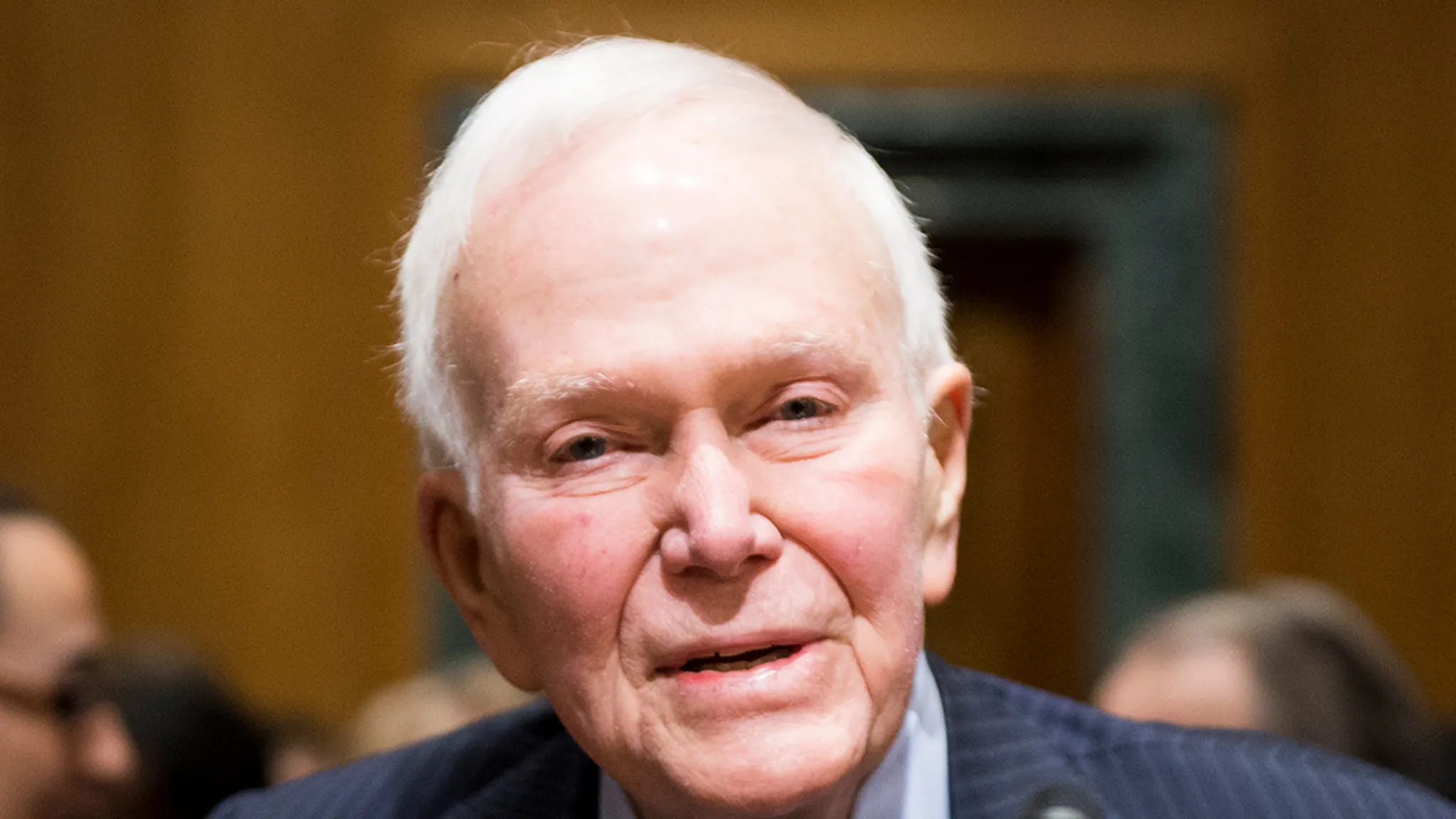
Bob Packwood dies at 93, closing the final chapter on one of the most complicated legacies in modern American politics. The powerful Oregon Republican — once a rising star and a self-styled champion of women’s rights — left the Senate in disgrace in 1995, forced out by a scandal involving serial sexual misconduct and the destruction of evidence. He died on June 6 in Rancho Mirage, California, with a family representative confirming his death but not specifying a cause.
His story is one of striking contradictions: a skilled legislator who reshaped major national policy, and a man whose predatory behavior ultimately overshadowed everything he had built.
A Liberal Republican With National Ambitions
For much of his career, Packwood looked like a politician destined for the highest tiers of American government.
A liberal Republican from Oregon, he was once seen as having genuine national prospects. Over a 26-year Senate career, he developed a reputation for working effectively across the aisle, finding common ground with both conservative members of his own party and Democrats.
What set him apart in his era was his advocacy on issues affecting women. He:
- Championed women’s reproductive rights
- Spoke out in favor of the Equal Rights Amendment
- Advanced the careers of female staffers, both on Capitol Hill and within his campaigns
That record earned him real admiration. In 1979, Planned Parenthood honored his support for reproductive health with the Margaret Sanger Award. For a time, women’s groups celebrated him as an ally.
The Scandal That Ended a Career
The admiration would not last. In November 1992, shortly after Packwood won election to his fifth Senate term, The Washington Post published a front-page investigation that changed everything.
The story detailed unwanted sexual advances toward 10 women, most of them former staff members and lobbyists. The accounts were strikingly consistent, describing sudden, clumsy physical advances — groping and forced kisses. The very women’s groups that had once lionized him now turned to denounce him.
Rumors had actually circulated for years. Even back in 1979, word had spread that younger women should avoid being alone with him. But in that era, sensitivity to such abuse was almost nonexistent, and the warnings stayed in the shadows until the Post brought them into public view.
A Mild Apology That Backfired
Packwood’s initial response did little to help him. He offered only mild contrition, brushing off his conduct as “stolen kisses” that resulted from binge drinking. He admitted his actions were wrong, checked into an anti-addiction clinic, became sober, and then tried to treat the matter as closed.
For a moment, his allies thought the strategy might work. He hadn’t traded rewards for sexual favors or threatened retaliation. But the political climate had shifted dramatically. After Anita Hill’s 1991 accusations of sexual harassment against Supreme Court nominee Clarence Thomas, the standard for acceptable behavior had been raised — and Packwood’s explanations no longer sufficed.
The Investigation and a Damaging Cover-Up
The Senate Select Committee on Ethics opened a slow-moving investigation. At Packwood’s request, the early hearings were kept private. But rather than show contrition, he began attacking the motives of his accusers and questioning the committee’s procedures.
By the summer of 1995, with the report looming, he alienated his colleagues by demanding public hearings and accusing the committee — chaired by Senator Mitch McConnell — of ignoring his side of the story.
Then came the cover-up that often proves worse than the original offense. Investigators discovered that the diaries they had subpoenaed had been altered to hide damaging information. The committee also learned that Packwood had asked lobbyists to put his ex-wife, Georgie Packwood, on retainer in order to reduce his alimony obligations after their 1991 divorce.
The committee’s lengthy report, released in September 1995, concluded that Packwood had committed at least 18 separate unwanted and unwelcome sexual advances between 1969 and 1990. It also accused him of obstructing the investigation by withholding, altering, and destroying evidence.
When Packwood called the recommendation to expel him “outrageous,” McConnell delivered a sharp rebuke, accusing him of trying to claim the mantle of victim after deliberately abusing the process himself.
Resignation Under Threat of Expulsion
Facing a losing battle, Packwood ran out of options. His allies warned him he would lose a floor vote, and that expulsion would cost him his $83,000 annual pension.
So he gave in. On the Senate floor in September 1995, he declared, “It is my duty to resign.” With that, he became only the second senator since the end of the Civil War to leave under the threat of removal. The other, Harrison “Pete” Williams Jr. of New Jersey, had resigned in 1982 after a bribery conviction.
The man once hailed as the wunderkind of Oregon politics — a candidate who went nine for nine in elections during his lifetime — was finished in public office.
The Legislative Triumphs That Defined His Peak
Lost in the scandal is just how consequential a legislator Packwood was. Before his fall, he was defined by major policy achievements.
He played a decisive role in the 1980 deregulation of the trucking industry. But his signature accomplishment came six years later, when the Finance Committee he chaired voted 20-0 in favor of a sweeping tax reform measure that became the defining domestic achievement of Ronald Reagan’s second term. The bill dramatically lowered rates while eliminating or reducing loopholes in the tax code.
That victory nearly didn’t happen. With interest groups fighting to protect their favorite preferences, the bill teetered on the edge of collapse, and even Packwood considered abandoning it. The turning point reportedly came over pitchers of beer at a Capitol Hill saloon, where he and a senior aide resolved to push forward.
His philosophy was simple, as he summarized in a 2010 interview: “Compromise. What a concept.” Much of the work happened in private breakfasts with key members before the full committee convened. He believed people would give things up for the good of the country, as long as they weren’t immediately punished for it. Journalist Hedrick Smith, in his 1988 book “The Power Game,” credited Packwood with reviving a dying tax reform bill through astonishing legislative skill.
From Portland to the Senate
Robert William Packwood was born in Portland, Oregon, on September 11, 1932. His father was a professional lobbyist for big businesses and, by one account, a heavy drinker.
Packwood showed organizational talent early. At Willamette University, he became president of both his fraternity and the campus Republican club, graduating in 1954 before earning a law degree from New York University, where classmates elected him class president.
After practicing law in Portland, he won a seat in the state legislature in 1962 as its youngest member. There he honed the skill that would define his rise: organizing volunteers — heavily female — to boost his name recognition. By the 1968 election, his volunteers rallied around the motto “EPS,” short for “elect Packwood somehow,” as he chased the seemingly impossible goal of unseating veteran Democratic Senator Wayne Morse.
A weary Morse, battered by a bruising primary, and a fractured Democratic Party gave Packwood his opening. He won by roughly 3,400 votes out of 814,000 cast — one of the closest margins in Oregon history — and at 36 became the Senate’s youngest member.
A Maverick in the Senate
Packwood quickly built a reputation as an independent thinker. In 1970, three years before Roe v. Wade, he introduced a bill to legalize abortion. He voted against Republican Supreme Court nominees he viewed as too conservative, including Robert Bork and Clarence Thomas. Yet on major fiscal matters, he stayed loyal to Republican policy and enjoyed strong rapport with GOP leaders — right up until the ethics investigation soured those relationships.
His personal life was turbulent. His first marriage, to Georgie Oberteuffer, ended after years of strain. By her account, he resisted her pleas to stop drinking and later refused to distance himself from his campaign manager, Elaine Franklin, who became his Senate chief of staff. He filed for divorce in 1990 and married Franklin eight years later. His survivors include Franklin, two children from his first marriage, two stepchildren, and three grandchildren.
Life After the Senate
Nearly broke when he left office, Packwood launched a boutique lobbying practice that, for a time, grossed more than $1 million a year as he represented large clients on technical financial matters. He split his time between Washington and Portland.
Reflecting on his downfall in a 2009 interview, he showed a measure of acceptance. He acknowledged that in politics, once you violate what people perceive to be the rules, even friends will turn on you. “I really can’t complain about it,” he said.
A Complicated Legacy
The death of Bob Packwood at 93 leaves behind a legacy that resists easy summary. He was a gifted legislator who helped reshape the American tax code and championed causes ahead of his time, yet he was also a man whose predatory conduct and attempts to conceal it ended his career in disgrace.
His story remains a striking reminder of how quickly accomplishment can be eclipsed by misconduct — and how the standards a society is willing to enforce can shift, sometimes catching even the most powerful figures in their wake.
Author