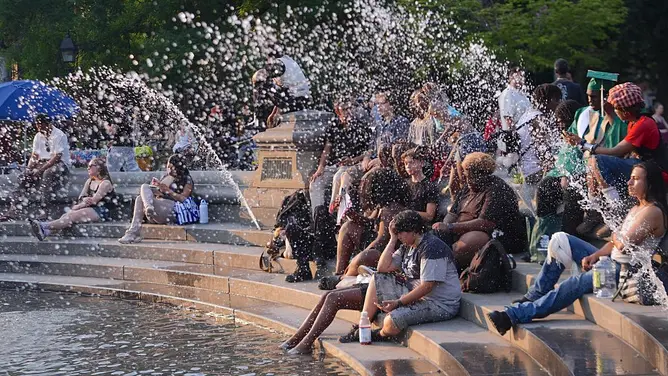
Extreme heat in the Northeast has arrived at one of the busiest moments of the year, colliding head-on with Fourth of July celebrations across a region that takes deep pride in its ties to American independence. On Wednesday, forecasters issued multiday warnings for New York, Boston, and Philadelphia as a wave of oppressive, sticky weather pushed eastward, threatening to turn holiday festivities into a sweaty ordeal.
How Hot It Will Get
The numbers alone are enough to make anyone reach for a cold drink. Temperatures across the region were expected to climb into the high 90s Fahrenheit, and both Philadelphia and Boston could break the 100-degree mark by Thursday. Once humidity enters the picture, the situation grows worse. The National Weather Service warned that the real-feel heat index would push well beyond the actual air temperature at times, making conditions feel even more punishing.
Behind the misery sits a familiar culprit: a heat dome. These high-pressure systems park themselves over a region and act like a lid, trapping heat and moisture underneath. This particular dome has been sprawling across a huge swath of the country, stretching from the Midwest all the way to the East Coast.
The timing could hardly be worse. The heat lands right as communities prepare for a full slate of outdoor events tied to the nation’s 250th anniversary, including parades, ship flotillas, open-air concerts, and a beloved public reading of the Declaration of Independence from a historic balcony in Boston this weekend.
Officials Urge Caution
Public leaders wasted no time sounding the alarm. New York Mayor Zohran Mamdani encouraged residents to stay indoors and steer clear of what he called extraordinary temperatures. He voiced particular worry about the days ahead, noting that people too often underestimate how dangerous heat can be, especially as readings threaten to break into triple digits.
The risks are not hypothetical. In Hamptonburgh, New York, the air conditioning gave out on a bus carrying Junior ROTC cadets, leading to several heat-related illnesses. According to Orange County authorities, some of the cadets were taken to hospitals as a precaution.
Why Cities Feel the Heat Most
Humid summers are nothing new in the Northeast, but medical experts caution that pairing high temperatures with heavy humidity creates a genuinely hazardous mix.
Dr. Alexander Azan of NYU Langone Health explained that people in the region simply are not acclimated to this kind of heat the way residents of the South tend to be. As a result, their bodies struggle to cope, and conditions like heat exhaustion, or in severe cases heat stroke, can strike at lower temperatures than one might expect.
Cities face an added burden. Climate scientist Vijay Limaye of the Natural Resources Defense Council pointed out that dense concentrations of concrete, asphalt, and steel soak up and hold heat, intensifying the effect. He warned that the temperature displayed on a phone may not reflect the far harsher reality of stepping onto a sun-baked city street.
To help vulnerable residents, New York City deployed more than 200 teams of government workers and volunteers to check on homeless individuals and urge them indoors. The city also opened hundreds of cooling centers, ranging from the massive Javits Center to vans and outdoor spots equipped with misting fans.
Turning the Heat Into Opportunity
Not everyone is dreading the swelter. For some businesses, a heat wave is a windfall.
At Acme Ice Co. in Cambridge, Massachusetts, the phone barely stopped ringing as bars and restaurants scrambled for deliveries. Owner Marc Savenor described the stretch of scorching days as an ice man’s dream. To keep up with demand, he brought on extra drivers, added more trucks to his fleet, and stashed ice across different freezers to avoid running dry. Once one load runs out, he explained, they simply grab another and keep the deliveries rolling.
Others found gentler ways to cope. The American Kennel Club’s Museum of the Dog in New York invited visitors to bring their pets inside to cool off through the weekend. Executive Director Christopher Bromson said the idea came to him after watching his own Newfoundland stretch out contentedly on the museum’s cool floor.
Down in Washington, D.C., where temperatures reached 95 degrees, children waiting in line for the Ferris wheel on the National Mall gratefully accepted cold water handed out by U.S. Park Police.
The Midwest Isn’t Off the Hook
The danger extended well beyond the coast. In the Midwest, the heat remained a serious threat, particularly for those working outdoors. Taylor Harnist, who runs an air conditioning installation and repair business in Cincinnati, said he was doing everything possible to keep his crew safe with frequent breaks, plenty of water, and electrolyte drinks.
The work, he admitted, becomes grueling in these conditions. Attic jobs are especially brutal, he noted, since those cramped spaces can soar to a staggering 145 degrees.
A Warming World
For scientists, this kind of event fits a larger and increasingly familiar pattern. Jeff Schlegelmilch, an associate professor at the Columbia University Climate School, said heat ranks among the easiest phenomena to link directly to climate change.
He described a steady trend toward longer summers, higher temperatures arriving earlier in the season, greater evaporation, and rising humidity. Taken together, these shifts suggest that punishing heat waves like this one may become a regular feature of American summers rather than a rare disruption.
For now, though, millions of people across the Northeast face a simple challenge: finding a way to celebrate the holiday while staying safe under a relentless sun.
Author