Concourses Out, AeroTrain In: Inside the $22.5 Billion Plan to Rebuild Dulles
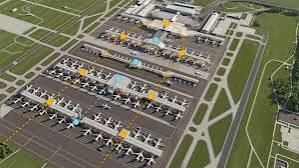
The Dulles airport overhaul that President Donald Trump laid out in the Oval Office on Wednesday is, by dollar figure alone, among the most ambitious airport rebuilds ever proposed in the United States. Working from a three-dimensional model and a laser pointer, he walked reporters through renderings of new concourses, a vast parking structure and glass walkways, framing the effort as long overdue.
His assessment of the current facility was characteristically unsparing. He described Dulles as widely considered one of the world’s worst airports and said the goal was to make it perhaps the best. He also argued the experience is bad enough that partisan affiliation is irrelevant to how travelers feel about it.
What Is Actually Being Built
The plan covers more than five million square feet of new or renovated space, phased in over roughly a decade while the airport continues operating.
The core elements:
- Four new concourses, with the two most criticized existing ones slated for replacement
- A parking structure holding around 32,000 vehicles, positioned far closer to the terminal than current lots
- An expanded AeroTrain system connecting concourses
- The permanent retirement of the mobile lounges, the wheeled vehicles that ferry passengers across the tarmac
- An enlarged main terminal with a new check-in area, faster baggage handling and upgraded ticketing
- Additional restaurants and retail, plus what United says will be one of its largest premium lounges anywhere
Trump described travelers walking a short distance from their cars to the terminal through glass tunnels — a substantial change from a layout where parking has long meant a shuttle ride.
The Building That Stays
One piece is not going anywhere. The main terminal designed by Finnish architect Eero Saarinen, with its dramatic upswept roofline, will be preserved. Trump has consistently drawn this distinction, praising the architecture while criticizing nearly everything around it, and he called Saarinen one of the world’s great architects.
That separation between a celebrated building and a frustrating passenger experience has been the through-line of his complaints about Dulles for months.
The Case for Modernization
The criticism did not originate with this administration. The Transportation Department flagged specific problems in December, including the smell of jet fuel in concourses and what it described as an inadequate number of gates in the main terminal. The mobile lounges have drawn complaints for decades, and two separate collisions involving them in November brought fresh scrutiny.
Duffy has said replacing that system is a priority, and it is now formally part of the plan.
There is a counterpoint worth noting, though. Whatever travelers think of it, Dulles was the fastest-growing large airport in the country last year by passenger volume. It handled a record 29 million passengers in 2025, a gain of 6.4 percent, and it currently operates about 130 gates.
Momentum was already building before Wednesday. The airport authority had previously approved a separate $7 billion capital program, and a 435,000-square-foot, 14-gate concourse serving United customers is scheduled to open this fall.
Who Pays
Duffy was direct on this point: the cost will not fall to federal taxpayers. The project will be bonded, with the Metropolitan Washington Airports Authority issuing predominantly low-interest municipal debt, and the airlines operating at Dulles covering the repayment.
Trump said United would contribute a share. Duffy framed it more broadly, saying the carriers participating in the project will fund it. Portions of the wider development could also involve public-private partnership investment.
The airline did not immediately respond to questions about the scale of its financial commitment. Trump also indicated some congressional approval will be required, and said he believes support for it crosses party lines.
The financing structure raises a question the announcement did not resolve: airport debt service is typically recovered through fees that ultimately show up in airfares. Whether passengers eventually help pay for a better Dulles through ticket prices remains an open issue.
United’s Central Role
United handles roughly 70 percent of traffic at Dulles, and the airline has been working behind the scenes on design details. Chief executive Scott Kirby appeared alongside Trump and Duffy at the White House.
Kirby’s remarks carried a note of personal history. He pointed out that the terminal most United passengers use dates to the mid-1980s and was built as a temporary structure, extended by a renovation two decades later. He said he had spent his entire career at the airline waiting for this.
Kirby has been a recurring participant in these conversations. At a February meeting on the airport’s future, he floated a merger with American Airlines — a pursuit he publicly abandoned in April.
Timeline and Unsettled Details
The Transportation Department expects construction to begin in spring 2027, starting with one concourse. Duffy said the team is trying to move quickly.
Estimates of duration diverge noticeably. Trump floated a two-year window. United’s own announcement described a transformation running several years, and officials elsewhere described a ten-year phased schedule. That gap is unresolved.
The naming question is also unsettled. Some Republicans have introduced legislation to rename the airport, currently honoring John Foster Dulles, secretary of state under President Eisenhower. One early design concept from the airport authority labeled the main terminal for Trump. Whether that survives into final plans is unclear.
The Broader Pattern
Dulles sits about 25 miles outside Washington in Chantilly, Virginia, and opened in 1962. It is operated by the airports authority under a 50-year lease approved by Congress — a structure that means the federal government’s role here is more persuasive than directive.
The announcement fits a pattern of large-scale construction projects Trump has championed across the capital region. The Transportation Department’s earlier call for redesign proposals drew responses from firms around the world, and the airport authority has said publicly it welcomes the administration’s interest and wants to build on work already underway.
For now, the renderings are ambitious and the funding mechanism is identified. The harder part — congressional sign-off, bond issuance, and a decade of construction at a facility that cannot close — starts next spring.
Author
-
Lucienne Albrecht is Luxe Chronicle’s wealth and lifestyle editor, celebrated for her elegant perspective on finance, legacy, and global luxury culture. With a flair for blending sophistication with insight, she brings a distinctly feminine voice to the world of high society and wealth.