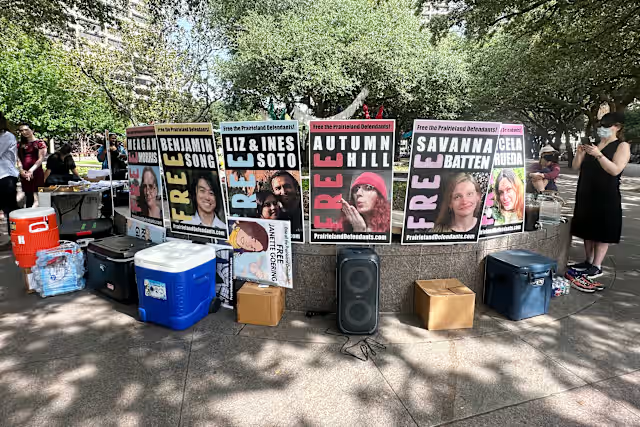
The Texas immigration center shooting sentencing concluded Tuesday with a former U.S. Marine reservist and seven other defendants receiving prison terms stretching across decades. The sentences stem from a shooting last year that wounded a police officer during a demonstration outside a Texas immigration detention facility.
A Case Framed as Terrorism
Prosecutors described the incident as an act of terrorism and argued that the eight defendants had ties to antifa, the umbrella term for far-left militant activists. The defense pushed back hard against that characterization. Attorneys denied any antifa connection, and family members reacted to the lengthy sentences with disbelief and outrage.
At the center of the case was Benjamin Song, the Marine reservist convicted of opening fire during the July 4 protest outside the Prairieland Detention Center near Dallas. Song received the harshest possible punishment: 100 years in prison. The seven others, sentenced in Fort Worth courtrooms, were handed terms ranging from 30 to 70 years.
Families React With Fury
For the loved ones of the convicted, the punishments felt staggering and disproportionate.
“I am livid,” said Lydia Koza, whose wife, Autumn Hill, received a 50-year sentence. She argued that the government was effectively erasing her wife’s entire future over attendance at a protest where, she emphasized, no one was killed.
The presiding judges saw the matter very differently. U.S. District Judge Reed O’Connor, one of two judges overseeing the proceedings, rejected the notion that this was a simple protest. He called it “an assault on democracy” and stressed the importance of deterring such conduct. All but one of the eight defendants were convicted on terrorism charges.
National Attention and Free-Speech Concerns
The case reverberated well beyond Texas. Critics warned that the prosecutions could carry far-reaching consequences for protest activity and First Amendment protections across the country.
The Justice Department billed it as the first sentencing of defendants described as affiliated with antifa, following an executive order signed last fall designating the movement as a domestic terrorist organization. That designation is itself unusual, since no formal domestic equivalent exists to the State Department’s list of foreign terrorist groups. Antifa, importantly, is not a single organization but a loose label for far-left activists who confront neo-Nazis and white supremacists at demonstrations.
Acting Attorney General Todd Blanche framed the outcome as a warning, declaring that those who attack law enforcement and federal facilities would face swift and uncompromising consequences.
Competing Accounts of That Night
The two sides offered sharply different versions of what unfolded at Prairieland.
Prosecutors pointed to several details as evidence of premeditation, including the group’s decision to bring firearms, first aid kits, and body armor. They told jurors these were signs of harmful intent. According to the prosecution, Song shouted “get to the rifles” before firing and striking a police officer who had just arrived at the facility.
The defense told a far different story. They insisted there was no planned ambush and that anyone who brought a firearm did so purely for self-protection. By their account, the event was organized as a late-night demonstration complete with fireworks, meant to show solidarity with immigrants detained at Prairieland, before gunfire erupted unexpectedly.
Defendants Plead Their Cases
Several defendants and their attorneys argued they had little or no role in any planning or violence.
Phillip Hayes, who represents Song, rejected the idea that the protesters were extremists and confirmed his client would appeal the 100-year sentence. He described the group as young people with big hearts who simply wanted their voices heard, insisting no one ever intended for shots to be fired or anyone to be harmed.
Prosecutor Frank Gatto took the opposite stance, urging stiff penalties and arguing that people holding extremist beliefs and viewing violence as justified deserved extended time behind bars.
Others described their involvement as minimal or nonexistent:
- Autumn Hill characterized the gathering as feeling more like a party than anything threatening. Her attorney, Cody Cofer, noted there was no evidence she carried a gun or endorsed violence, adding that she was conscientious enough to pick up trash before leaving. She received 50 years.
- Savanna Batten, according to her attorney Chris Tolbert, brought no firearm, spray paint, or fireworks and played no role in planning the event. She also received a 50-year sentence.
- Daniel Sanchez Estrada was not even present the night of the shooting, his attorney Christopher Weinbel said. Convicted only of concealing documents, Sanchez Estrada had reportedly moved a box of his own artwork, poetry, journals, and zines after the incident, none of it illegal. He was sentenced to 30 years.
Some other defendants chose to plead guilty to providing material support to terrorists rather than face trial.
Part of a Broader Crackdown
The Prairieland case does not stand alone. Just last week, federal prosecutors charged 15 people with obstructing the administration’s immigration enforcement efforts in Minnesota. Authorities alleged those demonstrators were antifa members who conspired against the federal government, setting up blockades around government buildings and hurling chunks of ice at federal vehicles, among other acts.
Together, these prosecutions point to an intensifying federal effort to confront protest activity tied to immigration enforcement, one that supporters call necessary law and order and critics warn could chill legitimate dissent.
Author