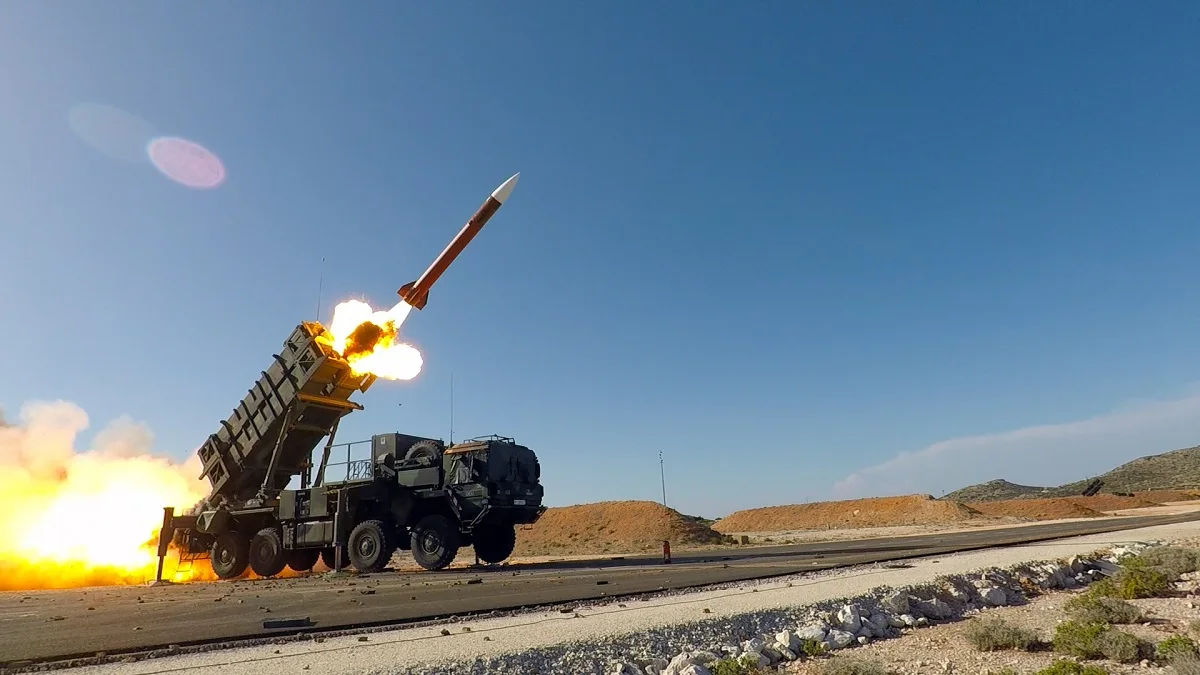
The PAC-3 ACE interceptor unveiled by Lockheed Martin on Monday is an attempt to solve a problem that has become impossible to ignore: shooting down $35,000 drones with $4 million missiles is not a sustainable way to fight a war.
The company announced the PAC-3 Adapted Capability Effector at London’s Farnborough Airshow, saying it will cost less than half what a PAC-3 Missile Segment Enhancement interceptor costs while remaining compatible with existing equipment.
The Math That Forced This
The economics driving the announcement are stark.
A PAC-3 interceptor runs an estimated $4 million. A typical Iranian Shahed drone costs around $35,000.
That ratio means an adversary can impose costs at roughly a hundred times what it spends, and can do so indefinitely if it has manufacturing capacity. No defense budget survives that exchange rate over time.
Stockpiles Under Strain
The problem stopped being theoretical during Operation Epic Fury.
American forces have burned through a finite interceptor inventory countering Iran’s relatively inexpensive drones, and experts have raised pointed questions about whether stockpiles can be replenished fast enough to sustain a prolonged campaign.
That concern is not confined to the Middle East. Patriot systems have become central to Ukraine’s defense against Russia, and as Kyiv’s supply ran down, the country appealed for more interceptors before joining nine other nations to develop Freyja, a Patriot alternative built specifically in response to the global shortage of anti-ballistic interceptors.
What the New Interceptor Does
The PAC-3 ACE is designed for a specific tier of threats rather than the full spectrum:
- Airbreathing threats, meaning weapons that use oxygen for propulsion
- Cruise missiles
- Close-range ballistic missiles
- Short-range ballistic missiles
That targeting profile is the key to the cost reduction. Building an interceptor that does not need to defeat the most demanding threats allows engineering compromises that a full-capability missile cannot make.
Compatibility as Strategy
Lockheed emphasized that the ACE will work with the existing Patriot weapon system and the Integrated Battle Command System.
That decision matters more than it might appear. Backward compatibility means no new launchers, no new radar, no retraining of crews on unfamiliar equipment, and no waiting for infrastructure to catch up with the missile.
The company said this approach lets it accelerate development, and that the effort will be coordinated jointly with American and European partners.
How Patriot Works
The system uses radar to detect and track incoming threats, calculates the trajectory, and guides an interceptor toward a predicted collision point.
It relies on hit-to-kill, meaning the interceptor destroys its target through direct impact rather than a proximity blast. That precision is part of why the missiles are expensive.
The Wider Defense Architecture
Patriot is one layer among several in American missile defense.
The Navy’s Aegis Combat System carries SM-3 and SM-6 interceptors. Terminal High Altitude Area Defense, or THAAD, covers another altitude band.
Those layers are increasingly converging. In April, Lockheed announced the Navy was preparing to take PAC-3 MSE interceptors to sea for use with Aegis, which uses advanced radars to identify, track and guide missiles. The company received a multimillion dollar contract without disclosing the amount or timeline.
The same month brought a considerably larger commitment, with the Pentagon agreeing to a $4.7 billion contract to accelerate PAC-3 MSE production.
Why This Announcement Landed Now
Farnborough this year has shifted attention from aircraft toward weapons, and the reason is visible in every recent conflict.
Mass-produced munitions have changed what air defense has to accomplish. The threat is no longer primarily a small number of sophisticated missiles but large volumes of cheap systems arriving together.
Defending against volume requires magazine depth, and magazine depth requires affordability. A superior interceptor that costs too much to use freely is not superior in a war of attrition.
The Open Questions
Several things remain unresolved.
Lockheed has not disclosed a specific unit price, only that it will fall below half the MSE cost. That still leaves a substantial figure against a $35,000 drone.
Production timelines are also unstated. Announcing a cheaper interceptor at an airshow is different from delivering it at volume, and the current shortage is a manufacturing problem as much as a design one.
There is also the question of whether cheaper means adequate. The ACE targets a narrower threat set, which works only if the threat sorting happens correctly in real time under attack conditions.
The Larger Shift
What the announcement really reflects is a change in how defense planners think about air defense.
For decades the goal was maximum capability per interceptor. The emerging goal is acceptable capability at a cost that permits enough interceptors to matter.
That is a different engineering problem and a different procurement philosophy. The PAC-3 ACE is one answer to it, and given how quickly interceptor stockpiles have depleted across two active conflicts, it will not be the last.
Author