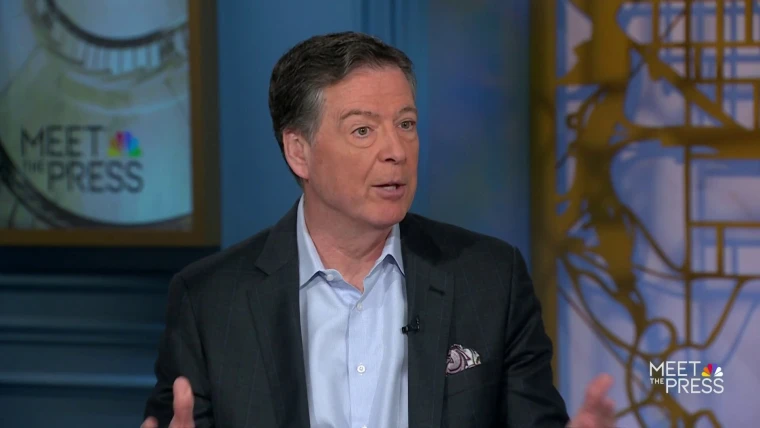
The James Comey seashells photo case has taken another striking turn, as the inexperienced federal prosecutor who first brought the charges has now removed himself from the proceedings. The case, which accuses former FBI Director James Comey of threatening President Donald Trump’s life through an Instagram photo of seashells, has drawn heavy criticism since its inception.
The Prosecutor Behind the Charges Steps Back
Matthew Petracca, who had only recently joined the Eastern District of North Carolina as an assistant U.S. attorney, is no longer involved in the Comey matter. A recent court filing confirmed his departure from the case.
Petracca did not stop there. In the days that followed, he also withdrew from several other criminal cases within the same district. His background adds an unusual political dimension to the story: before joining the Justice Department, he served as a Republican county committeeman in New Jersey. He was hired months ago by W. Ellis Boyle, the U.S. Attorney for the district, who personally oversaw the controversial prosecution.
According to two individuals familiar with the situation, Petracca had at one point considered leaving the Justice Department entirely. Instead, after taking a week away from work, he chose to remain a DOJ employee. He has not responded to requests for comment about his status, and the U.S. Attorney’s Office for the district did not immediately offer a statement either.
A New Face Takes Over
With Petracca stepping aside, Assistant U.S. Attorney Timothy Severo has assumed leadership of the Comey case. Notably, a recent exchange with Comey’s defense team was not handled by Petracca at all. That communication instead went through First Assistant U.S. Attorney Phil Aubart, signaling a shift in how the prosecution is being managed.
If the case clears the legal hurdles ahead of it, a trial is scheduled for October.
What the Indictment Actually Alleges
The charges stem from a two-count indictment filed late last month. At its core, the indictment argues that a reasonable observer would interpret an image of seashells, arranged to spell out “86 47,” as a genuine expression of intent to harm the President of the United States.
Curiously, the indictment itself never explains what those numbers are supposed to mean. The interpretation has been left largely to public speculation, and that ambiguity has become one of the case’s most debated features.
Here is what is widely understood about the numbers:
- The term “86” is commonly recognized as restaurant slang, used to indicate that a kitchen has run out of a particular item.
- The number “47” is generally thought to reference the 47th president.
Whether that combination amounts to a credible threat or simply an ambiguous bit of imagery lies at the heart of the dispute.
Not the First Attempt
This marks the second occasion on which the Justice Department has sought to indict the former FBI director, a figure who has long been a target of President Trump’s frustration.
The first effort centered on an allegation that Comey lied to Congress five years ago during remote Zoom testimony. That case, however, collapsed when a judge dismissed it after determining that the prosecutor involved had been improperly appointed.
Political Pressure in the Background
The broader context here is hard to ignore. Trump has openly expressed his desire for the Justice Department to pursue his political adversaries. Acting Attorney General Todd Blanche has framed the situation differently, suggesting that those now facing scrutiny had themselves previously used the legal system against the president.
This dynamic has fueled accusations that the prosecution is politically motivated rather than grounded in genuine criminal concern.
Legal Experts Express Deep Skepticism
Perhaps most telling is the reaction from the legal community. A range of experts, including several conservatives who typically defend the Trump administration, have criticized the case and predicted it will be dismissed well before reaching trial.
Legal scholar Jonathan Turley, a longtime and vocal Comey critic, captured the sentiment vividly. He suggested he would almost rather hide away than write about the matter, yet concluded that the indictment is unconstitutional and unlikely to survive a constitutional challenge.
The Reactions and the Fallout
Following the indictment, Trump did not hold back, branding Comey a dirty and crooked figure. Comey’s attorney, meanwhile, indicated plans to file a motion arguing that the prosecution is vindictive in nature.
The case has even spilled into popular culture. A wide assortment of merchandise bearing the “8647” phrase, including items crafted from seashells, has appeared for sale, turning the controversy into something of a cultural moment.
For his part, Blanche acknowledged uncertainty about whether earlier instances of the same post had ever been investigated or yielded different outcomes. He emphasized only that the investigation his team pursued produced the two-count indictment now in question.
What Comes Next
As the October trial date approaches, the James Comey seashells photo case stands on shaky legal ground. With the original prosecutor gone, skepticism mounting among legal scholars, and a defense team preparing to challenge the prosecution as vindictive, the path ahead appears uncertain at best.
Whether the case survives its looming constitutional challenges or unravels before a jury ever hears it, the controversy has already raised pointed questions about the intersection of politics, prosecution, and the rule of law in America today.
Author