The Corey Ruiz Madison police shooting has left a family grieving in public, a city divided over what a bystander’s video shows, and renewed pressure on a police department that still does not equip its officers with body cameras.
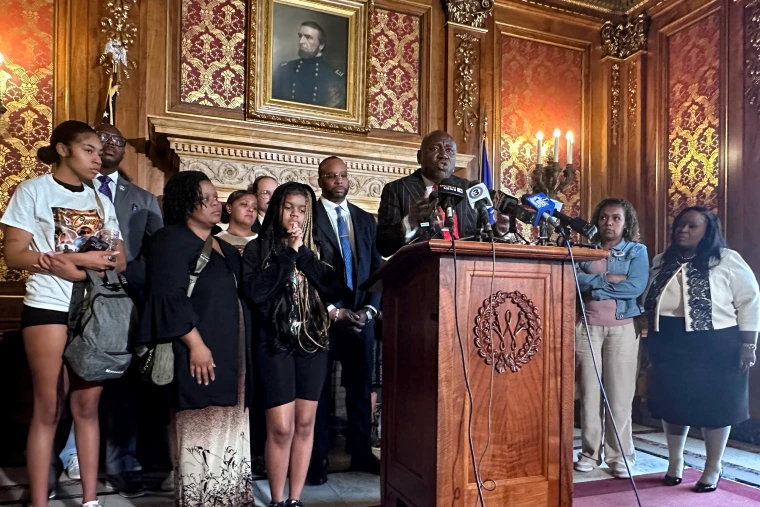
On Friday in Madison, relatives of Ruiz gathered before reporters for the first time since he was shot and killed by a Madison police officer on Wednesday afternoon at a busy intersection on the city’s near-east side. Alongside them were civil rights attorney Ben Crump and state Rep. Shelia Stubbs, a Madison Democrat.
A Mother and Daughter Speak
The most difficult moments of the news conference came from the two people closest to him.
His mother, Elsa Ruiz, struggled to hold herself together as she described her son. She called him exceptional, said he was her love, and spoke about how much he cared for his daughter and the rest of the family. He did not deserve to die the way he did, she said.
His daughter, Kah’liyah Ruiz, then recounted the moment she was told what had happened. She said that when she heard her father had been shot and killed, she broke down immediately. She had no words and no idea what to do. Her heart, she said, was simply shattered, and the pain of knowing she will never see him again has not eased.
Relatives painted a picture of a man they remember for warmth rather than headlines. They described him as kind and funny, someone drawn to music, devoted to his daughter and closely tied to the people around him.
What the Family Is Questioning
Beyond the grief, the family raised pointed questions about how the encounter unfolded. Their central complaint is that officers did not attempt to calm the situation before force was used. They want to know why lethal force became the outcome at all.
Crump, who has represented families in some of the most closely watched police shooting cases in the country, used far blunter language. He told reporters that what he and the family saw amounted to an execution, and that it shocked their conscience. He argued that people across Wisconsin, and across the United States, reacted with the same disbelief when they watched the footage, because to them the killing appeared entirely avoidable.
He also stressed the role the recording itself has played. Crump said the family is grateful the video exists, and suggested that without it, the public account of what happened might have looked very different.
The Police Account and the Video
Police have offered a different description of the encounter. According to their account, Ruiz produced a fixed-blade knife during the confrontation and an officer was injured in the struggle that followed.
The bystander footage that has circulated appears to show Ruiz going to the ground as the struggle unfolds. Shortly afterward, three gunshots can be heard while an officer is seen pointing a firearm from a standing position.
Those two versions of the same few seconds sit at the center of the dispute. Investigators will ultimately have to reconcile the department’s description of an armed threat with what the video appears to capture, and until that review is complete, both accounts remain claims rather than settled findings.
The Body Camera Question Returns
One detail has already sharpened the debate: Madison police officers do not wear body cameras. That means the only visual record of the shooting available so far came from a bystander who happened to be recording.
Ruiz’s family and Crump are now calling for the department to adopt body-worn cameras, framing the technology as basic protection for the public and for officers alike. Their argument is straightforward. When the only footage of a fatal encounter comes down to whether a stranger reached for a phone in time, accountability becomes a matter of luck.
Madison has debated body cameras for years without adopting them department-wide, making it an outlier among cities of comparable size. Supporters argue that recordings resolve disputed accounts quickly, protect officers from false accusations and build public confidence in investigations. Critics have raised concerns about surveillance, privacy in sensitive calls, storage costs and how footage would be released. Wednesday’s shooting has thrust that unresolved conversation back to the front of the city’s agenda.
What Comes Next
Officer-involved deaths in Wisconsin are reviewed by an outside agency rather than the department involved, a requirement designed to keep investigators independent from the officers whose actions are under scrutiny. Findings are then forwarded to prosecutors, who decide whether charges are warranted. That process typically takes weeks or months, a timeline that often frustrates grieving families looking for immediate answers.
For now, the Ruiz family’s demands are simple to state and far harder to deliver. They want cameras on Madison officers. They want a full accounting of why the encounter ended in gunfire. And they want what Crump repeatedly called justice for Corey.
The presence of Rep. Stubbs at the news conference signals that the case is unlikely to remain a purely local story. Lawmakers have previously pushed for statewide standards on recording equipment and use-of-force reporting, and a high-profile death in the state capital tends to move those conversations along.
What will not change is what Kah’liyah Ruiz described from the podium. Whatever an investigation eventually concludes, a daughter is left without her father, and a mother is left mourning a son she described simply as her love.
Author
-
Lucienne Albrecht is Luxe Chronicle’s wealth and lifestyle editor, celebrated for her elegant perspective on finance, legacy, and global luxury culture. With a flair for blending sophistication with insight, she brings a distinctly feminine voice to the world of high society and wealth.