Western Heat Dome Pushes Cities Toward Records and Fuels Growing Fire Danger
The Western US heat wave that settled over the region on Saturday sent thermometers climbing toward record territory from the desert Southwest to the northern Plains, sharpening wildfire danger in landscapes already parched or actively burning and prompting officials to urge people indoors.
The mechanism behind it is a ridge of high pressure trapping warm air near the surface, a pattern commonly called a heat dome. It currently stretches from Arizona all the way north into Montana. Forecasters with the National Weather Service offered one piece of encouraging news: this particular episode is not expected to linger long.
Cities Flirting With Record Highs
Las Vegas climbed to 115 degrees Fahrenheit by late afternoon, the warmest reading the city has logged this year and only a single degree shy of the daily record of 116. Phoenix was projected to reach 116, while El Centro, California, was forecast to set a record at 118.
Even locations far removed from the desert felt it. Great Falls, Montana, was expected to hit a record 104.
Meteorologist Morgan Stessman noted that Saturday’s high in Las Vegas ran 10 degrees above what is typical for the date, with dangerous conditions continuing into Sunday when the forecast called for 114.
The Overnight Problem
The daytime numbers grab attention, but the more serious hazard sits in the overnight hours. Lows across the Las Vegas area were projected to settle only into the upper 80s and low 90s, temperatures too warm to let the human body cool down and recover from the day’s stress.
Stessman put it plainly: there is no relief once the sun goes down. That absence of nighttime recovery is what turns a hot stretch into a genuine health emergency, particularly for older adults, people without air conditioning and anyone working outdoors.
For historical context, the August record in Las Vegas stands at 116, while the all-time mark is 120, set in July 2024 during what also ranked as the hottest summer on record.
Cooling Centers Under Strain
In Phoenix, the Justa Center normally serves seniors but opens to anyone during afternoon hours as a designated cooling location. Operations director Rudy Soliz said roughly 200 people pass through daily, and the toughest part of the job is simply keeping enough water and electrolyte drinks on hand.
He described the setup as deliberately low-barrier: anyone can walk in, receive a meal, complete a quick check-in, then sit down, rest and watch television before continuing to another cooling site or wherever they were headed.
Similar improvisation was happening farther north. The Montana Rescue Mission in Billings, which operates as a homeless shelter, unlocked its doors ahead of schedule Saturday so people could escape the heat. Staff anticipated dozens of visitors and planned to provide dinner, overnight beds and breakfast.
Montana Bakes, but It Has Seen Worse
The entire eastern half of Montana sat under an extreme heat warning Saturday. Meteorologist Jeff Kitsmiller said conditions would moderate sharply by Sunday, with much of the state dropping back into the 70s.
Kitsmiller also drew a distinction between this event and the mid-July heat wave, when several communities shattered all-time records. Billings reached 111 on July 12 during that stretch. He described that earlier episode as genuinely rare, while calling the current one more consistent with what the calendar would suggest for early August.
In Great Falls, residents responded the way people usually do. Katy Houseman, who works at one of the city’s recreation centers, said the four municipal pools and three splash pads were packed. People were alternating between water and air-conditioned indoor spaces, and she summed up the day as extraordinarily hot.
Heat Is Loading the Fire Dice
The more consequential concern is what this heat does to vegetation that has already been drying for weeks.
In Montana, where fires are already active and strong winds were forecast through the weekend, Kitsmiller said forecasters were watching closely. Most of the state fell under a red flag warning.
Nevada faced a related problem. Stessman explained that as the heat dome established itself, available moisture evaporated, with afternoon relative humidity dropping into single digits across numerous locations. Humidity that low means fine fuels ignite almost instantly.
The U.S. Forest Service flagged elevated wildfire risk through Sunday across most of Southern California, sparing only the coastal strip.
The Pacific Northwest Reaches a Breaking Point
Conditions in Washington deteriorated enough that Gov. Bob Ferguson declared a state of emergency Saturday, citing unusual heat and high winds driving record wildfire activity. He simultaneously prohibited most outdoor and agricultural burning through the end of September.
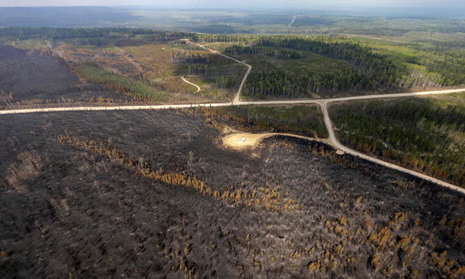
The proclamation was timed ahead of a National Weather Service Red Flag Alert carrying the rarely used “particularly dangerous situation” designation, with risk across Eastern Washington rated extreme. More than 312 square miles are burning in 12 large fires statewide.
Eastern Oregon received its own red flag alert. Crews there are working several major incidents, including the Rowe Creek Complex, which has expanded to 490 square miles at 57 percent containment.
The Larger Pattern
Scientists attribute the growing frequency and severity of heat waves to warming driven by the combustion of coal, oil and natural gas. Hotter, longer heat events intensify drought, and deeper drought produces fires that burn larger and hotter.
Layered on top of that trend is El Nino, the periodic warming of equatorial Pacific waters that reshuffles global weather patterns and pushes temperatures upward worldwide.
Experts indicate the current El Nino is on track to be among the strongest since tracking began in 1950. United Nations officials warned Friday that it has already set intensity records during its early phase, which suggests its influence on the remainder of the year could be substantial.
For now, residents across the affected states face a familiar set of instructions: remain indoors during peak hours, drink water consistently, check on vulnerable neighbors and avoid anything capable of throwing a spark.
Author
-
Lucienne Albrecht is Luxe Chronicle’s wealth and lifestyle editor, celebrated for her elegant perspective on finance, legacy, and global luxury culture. With a flair for blending sophistication with insight, she brings a distinctly feminine voice to the world of high society and wealth.