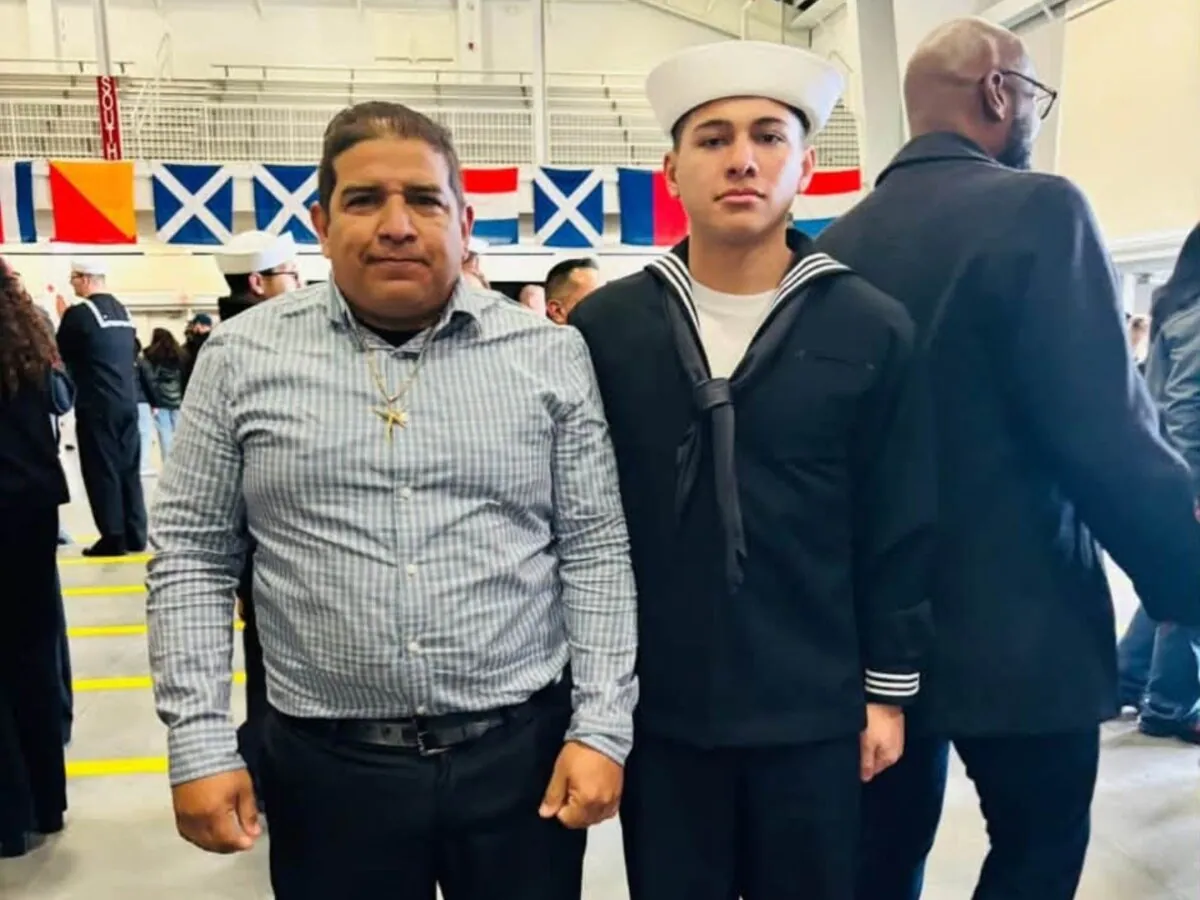
A military family immigration arrest in Key West, Florida, has drawn national attention after Luis Manuel Aviles was taken into custody by Border Patrol just as his son neared the end of a record-breaking Navy deployment.
Aviles, 48, was arrested Saturday while simply running an errand, dropping his car off at a mechanic. His wife, Argelia Aviles, said he holds a valid work permit and has lived in the United States for 19 years since arriving from Nicaragua.
A Father Waiting for His Son to Come Home
The timing carried a particular cruelty. Aviles’ son, Joshua, was approaching his ninth month aboard the USS Abraham Lincoln, a deployment that set a U.S. military record for continuous time at sea.
According to Argelia, her husband had been counting down to his son’s return. When six months passed and Joshua remained deployed, Aviles grew distraught. He told her he simply wanted to embrace his son again after so many months apart.
She described her husband in simple terms: a man devoted entirely to work and to providing for his family, and a father who loves his children completely.
Part of a Broader Pattern
Aviles’ detention fits into a wider trend documented by the Associated Press, which found that the current administration has scaled back immigration protections specifically covering military families as part of its larger deportation push.
The AP’s reporting, described as the first attempt to account for such cases since the government does not track them separately, identified at least dozens of parents and spouses of active-duty service members who have been detained. Of those, six family members have already been deported and one left the country voluntarily. In one instance, a soldier’s wife was pulled off a deportation flight to Brazil after the AP began reporting on her case.
A Protection Not Guaranteed to Everyone
One of the more widely publicized immigration benefits tied to military service is known as parole-in-place. It allows spouses, children and parents of active-duty troops and veterans to pursue legal status without leaving the country.
The protection has limits, however. People who overstayed a visa or who already filed for status while at the border, among other circumstances, may not qualify. Those exceptions leave some military family members exposed despite their connection to active service.
The Government’s Position
The Department of Homeland Security confirmed that Border Patrol agents arrested Aviles Saturday in Key West and said he will remain in ICE custody while removal proceedings move forward.
In a statement issued Sunday, the department was direct about its reasoning, stating that having a relative in the military does not exempt someone from immigration law, and that enforcement applies without exception.
A Son Learning the News at Sea
Joshua Aviles found out about his father’s arrest through a phone call Saturday morning while still aboard the Lincoln, which remains deployed in the Middle East.
In a Facebook post, he described working twelve-hour shifts without a break for more than 250 consecutive days. He wrote that the news left him heartbroken and questioned how he could continue enduring such demanding days at sea while unsure of his father’s treatment in custody.
Concerns About Conditions Aboard the Ship
The Lincoln’s extended deployment has already drawn scrutiny independent of this case. Reports have raised questions about food shortages, strain on the vessel and its equipment, and the psychological toll on sailors kept away from land for such an unusually long stretch.
Defense Secretary Pete Hegseth has previously pushed back on such characterizations, describing accounts of conditions aboard the ship as completely misrepresented. The Pentagon directed questions on the matter to the Navy, which did not immediately respond to a request for comment.
A Sister’s Long Wait for Word
Katherine Delgado, Joshua’s sister, said her brother enlisted partly in hopes that military service would improve their father’s path to citizenship and ease the family’s fear of arrest. The strategy, evidently, did not provide the protection they had hoped for.
Delgado described weeks without knowing her brother’s whereabouts during the deployment. Once she made contact and learned he wasn’t getting adequate food, she began sending care packages containing food and hygiene items, spending hundreds of dollars in the process. Some packages, she said, never arrived.
She called Joshua her best friend and said the separation has been devastating.
A Homecoming Overshadowed
Delgado said her brother is expected home soon, as the ship is set to be withdrawn from its Middle East deployment. But the return will not be what the family imagined.
He’s going to come home, she said, without his father there to greet him.
The Larger Question
Cases like this one highlight a tension between two policies operating simultaneously: an immigration system offering a formal pathway for military families, and an enforcement approach that has, in practice, swept up parents and spouses of the very service members that pathway was designed to protect.
For families like the Aviles household, the distinction between eligibility on paper and protection in practice has become the difference between a homecoming and a detention cell.
Author