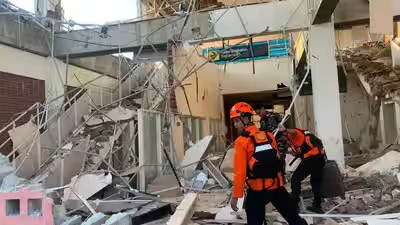
Indonesia earthquake death toll has risen to 53 as rescue crews work through a second day of operations, clearing landslides and reopening roads severed by a powerful tremor in the country’s east.
The magnitude-7.7 earthquake struck off Flores island on Saturday, according to the United States Geological Survey. It triggered a tsunami warning that was subsequently lifted, but the shaking itself caused damage that continues to complicate the response.
The Immediate Aftermath
The most pressing obstacle facing emergency teams is not the earthquake itself but what it dislodged.
Landslides blocked roads across affected areas, cutting off access to remote communities entirely. In mountainous terrain with limited road networks, a single blocked route can isolate villages for days.
That means the confirmed death toll should be treated as provisional. In disasters of this kind, casualty figures typically rise as crews reach areas that were unreachable in the first hours.
Why Access Determines Everything
The window for rescuing people trapped in collapsed structures is narrow, and it closes fastest for those in the hardest-to-reach places.
Several factors compound the difficulty:
- Heavy equipment cannot reach sites until roads are cleared
- Communication infrastructure often fails alongside power supply
- Aftershocks can trigger additional slides on already unstable slopes
- Medical evacuation requires functioning routes in both directions
- Assessment teams cannot count casualties in areas they cannot enter
Clearing landslides is therefore not preliminary work. It is the operation, because everything else depends on it.
The Tsunami Warning
A magnitude-7.7 offshore earthquake automatically raises the possibility of tsunami generation, and authorities issued a warning accordingly.
That warning was later lifted, meaning no significant wave materialised. The mechanics matter here: not every large offshore quake displaces enough water vertically to produce a destructive tsunami. The type of fault movement involved determines the outcome.
For Indonesia, the caution is well earned. The country’s experience with the 2004 Indian Ocean tsunami and the 2018 Palu disaster has shaped a warning system that errs firmly toward early alerts, even at the cost of occasional false alarms.
Why Indonesia Faces This Repeatedly
Indonesia sits along the Pacific Ring of Fire, one of the most seismically active zones on the planet.
The archipelago straddles the boundaries of several converging tectonic plates, producing a near-constant background of seismic activity and periodic major events. Thousands of earthquakes occur across the country annually, most too small to be felt.
Flores itself has a difficult history. A magnitude-7.8 earthquake struck the island in 1992, generating a tsunami that killed thousands of people. That event remains part of local memory and informs how communities respond to shaking today.
What Response Efforts Look Like Now
Priorities in the current phase typically include:
- Search and rescue at collapsed structures
- Clearing transport routes to isolated settlements
- Establishing temporary shelter for displaced residents
- Restoring water supply and basic medical services
- Assessing structural safety of remaining buildings
Aftershocks present an ongoing hazard throughout. Buildings weakened but still standing can fail during subsequent tremors, which is why residents are often advised to remain outside even when their homes appear intact.
The Days Ahead
The figure of 53 deaths reflects what is currently confirmed, not the final scale of the disaster. As roads reopen and teams reach previously inaccessible areas, that number is likely to change.
Attention will also shift toward displacement. Earthquakes of this magnitude typically leave far more people without habitable homes than they kill, and shelter needs frequently outlast media coverage by months.
For now, the work is physical and immediate: moving earth, opening roads, and reaching the people on the other side of them.
Author
-
Lucienne Albrecht is Luxe Chronicle’s wealth and lifestyle editor, celebrated for her elegant perspective on finance, legacy, and global luxury culture. With a flair for blending sophistication with insight, she brings a distinctly feminine voice to the world of high society and wealth.