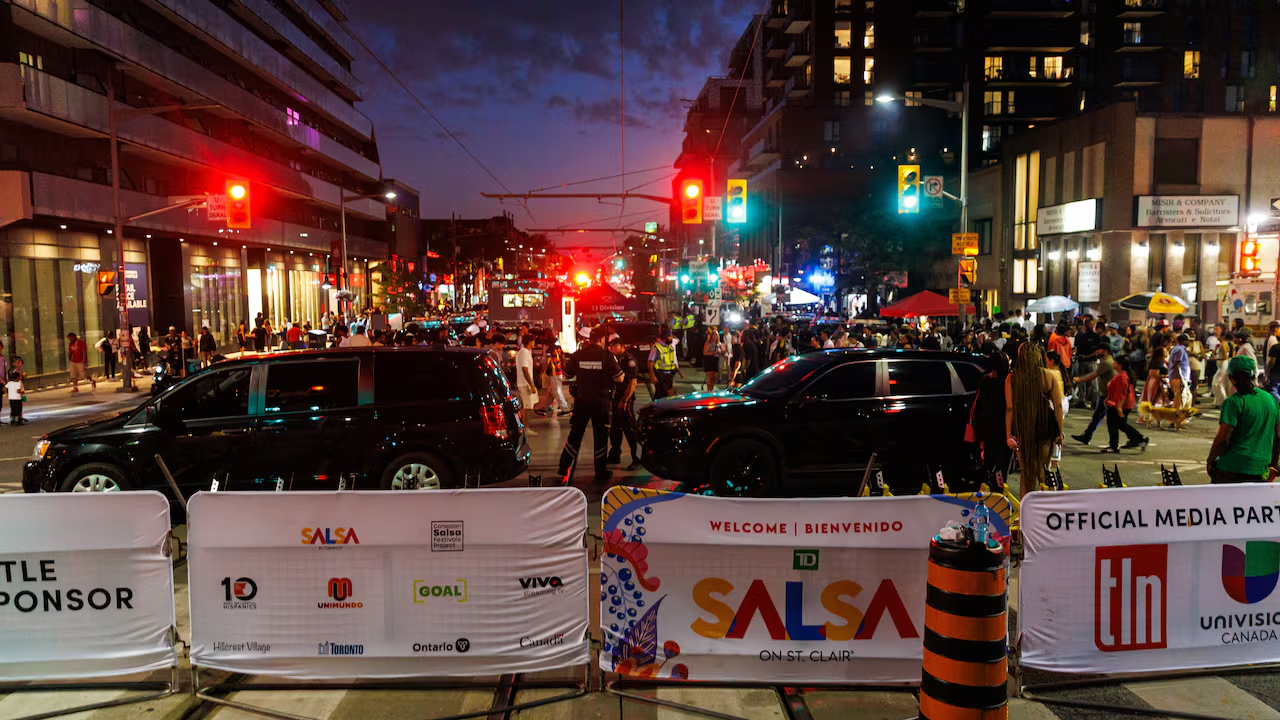
Thirteen thousand people were at Salsa on St. Clair on Saturday night, celebrating Latin culture at one of Toronto’s most beloved annual events.
Then two people started shooting at each other.
The Toronto festival shooting left at least two people dead and at least four injured. No arrests have been made.
What Police Say Happened
Toronto Police Service Deputy Chief Frank Barredo described the incident as an exchange of gunfire between two individuals.
His assessment was blunt about what that meant for everyone else present.
“This seemed to be an exchange of gunfire between individuals targeting each other — obviously, indiscriminately putting vast numbers of people in great danger,” Barredo told reporters.
Two firearms were recovered. Police are working through at least three separate crime scenes.
The Scale of the Danger
The detail that should stop anyone reading this is the crowd size.
Thirteen thousand people. A street festival. Families, dancers, vendors, children.
Into that, two people opened fire on each other.
The fact that the death toll is two rather than twenty is a matter of chance, not restraint.
The Festival Responds
Organizers of Salsa on St. Clair — an annual two-day celebration of Latin culture in Canada’s largest city — issued a statement expressing shock and deep sadness.
“Our thoughts and prayers are with the families of the two people who were killed, those who were injured, and everyone affected by this senseless violence,” they said.
They confirmed the event would not resume on Sunday, citing the complexity of the police investigation at the scene.
A festival built around joy ended as a crime scene.
The Prime Minister’s Reaction
Prime Minister Mark Carney said he was “horrified.”
“My prayers are with the families grieving their loved ones, those who are in critical condition, and everyone who has been affected by this horrific event,” he wrote on social media. “Police have my full support as they work to apprehend the perpetrators and bring them to justice.”
The perpetrators, notably, remain at large.
Why This Lands Differently in Canada
Context matters here, because a shooting like this carries a different weight north of the border.
Toronto is not a city accustomed to this. Canada maintains strict gun laws, and the country has historically seen far less gun crime than its neighbor.
Fatal shootings in the city remain relatively rare.
But that picture has been shifting.
Toronto has experienced an increase in gun violence in recent years, much of it linked to gang activity. According to Toronto police data as of July 5, at least 33 shootings have occurred in the city this year.
Thirty-three shootings would be an unremarkable figure in many American cities. In Toronto, it represents a trend that residents and officials find genuinely alarming.
The Investigation
Police face a difficult set of circumstances.
- Three crime scenes to process
- Thirteen thousand potential witnesses
- Two firearms recovered
- No suspects in custody
Crowd size cuts both ways in an investigation. It means an enormous number of people may have seen something. It also means the scene was chaotic, evidence may have been disturbed, and the shooters had an ideal environment in which to disappear.
Anyone who was present and saw anything relevant is likely to be of interest to investigators.
What This Costs
Beyond the immediate casualties, there is a subtler damage.
Salsa on St. Clair exists because a community wanted to celebrate itself in public — openly, on a city street, without fear.
That premise has now been violated.
Festivals of this kind depend entirely on the assumption that a crowd is a safe place to be. When that assumption breaks, it does not repair easily. Organizers will face security questions. Attendance will be affected. Some families will simply not come next year.
Two people brought a private dispute into a crowd of thirteen thousand. The dead and injured are the immediate cost. The erosion of a community’s sense of safety is the longer one.
What Comes Next
The investigation continues. The suspects remain unidentified publicly. The festival is cancelled.
And Toronto, a city that has long taken quiet pride in not being the kind of place where this happens, is being forced to reconsider that assumption.
Author