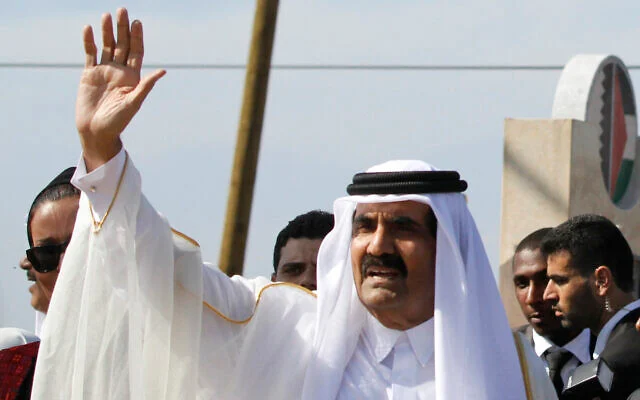
When Sheikh Hamad bin Khalifa Al Thani took power in 1995, Qatar was a modest Gulf economy leaning on oil. Its enormous gas reserves at the North Field were barely developed.
By the time he stepped aside, the country was the world’s largest exporter of liquefied natural gas, home to one of the planet’s biggest sovereign wealth funds, and among the wealthiest nations per capita on earth.
The Sheikh Hamad Qatar economy story is not simply one of energy prices rising. It is a story about what a government chooses to do with a windfall.
He died Sunday at 74, after an 18-year reign that fundamentally rewrote his country’s position in the world.
The Foundation Was Laid Before He Ruled
The transformation did not begin with his accession.
In 1989, Sheikh Hamad was appointed chairman of the Supreme Council for Planning — the body responsible for shaping Qatar’s economic and social policy at the time.
That role gave him six years to design development programs before he ever held ultimate authority. When power came, the plans were ready.
Gas: The Starting Point
Everything traces back to the North Field, the largest natural gas field in the world.
The decisive move came in the second half of the 1990s: accelerate investment, expand liquefaction capacity, and go big.
The results were extraordinary.
- 1996: Qatar exports its first LNG shipment
- Under 15 years later: It becomes the world’s largest LNG exporter
- By 2010: Production capacity reaches 77 million tons per year
Data from Qatar’s Amiri Diwan captures the scale. The added value of the hydrocarbons sector rose from 11 billion Qatari riyals — roughly $3 billion — to 403 billion riyals, about $110.4 billion, during his rule.
Beyond revenue, this made Qatar a strategic partner in global energy security, particularly for Asia and Europe.
The Growth Numbers
The macroeconomic effect was staggering.
World Bank figures cited by Bloomberg show Qatar’s economy grew more than twentyfold under Sheikh Hamad — from around $8 billion in GDP in 1995 to approximately $199 billion by 2013.
The IMF recorded the fastest growth rates in the world during that stretch: real growth of 18 percent in 2006, climbing to 26.2 percent in 2011 as LNG projects came online.
The Critical Decision: Don’t Just Spend It
Here is where Qatar diverged from the standard resource-curse trajectory.
Rather than simply consuming the revenue, Sheikh Hamad built institutions to convert it into permanent wealth.
In 2001, he established and chaired the Supreme Council for Economic Affairs and Investment, tasked with diversifying investments to develop financial reserves and broaden income sources.
Four years later came the Qatar Investment Authority — a sovereign wealth fund designed to manage surpluses from oil and gas exports.
The QIA’s Global Footprint
The fund moved aggressively and visibly.
It acquired stakes in Barclays and Volkswagen. It bought Harrods in 2010. It invested in football clubs, financial institutions, and London’s Shard skyscraper.
Today, its assets are estimated at more than $500 billion, according to the Sovereign Wealth Fund Institute — placing it among the largest government investors anywhere.
That is the mechanism by which finite gas revenue becomes an indefinite income stream.
What It Meant for Qataris
The gains were not confined to balance sheets.
Under Sheikh Hamad, Qatar became one of the highest GDP-per-capita nations in the world, exceeding $90,000 in purchasing power parity terms.
Spending expanded across housing, education and health. Unemployment fell to very low levels.
Analysts note this was not merely a function of energy prices. It reflected expanded government investment and job creation tied to energy and infrastructure projects.
Betting on People
Alongside the pipelines came something less obvious: a bet on knowledge.
One of the earliest decisions after taking power was establishing the Qatar Foundation for Education, Science and Community Development in August 1995.
The country subsequently attracted international universities including Georgetown, Texas A&M and Carnegie Mellon — an explicit strategy for the eventual post-hydrocarbon era.
Healthcare expanded through Hamad Medical Corporation and new specialized centers.
Doha, meanwhile, positioned itself as a regional financial and commercial hub, hosting an increasing share of international economic conferences.
Concrete and Steel
Gas money also went into physical transformation.
Major projects launched during his rule include:
- Hamad International Airport
- Hamad Port
- Lusail City
- Modern road networks
- Foundations for the Doha Metro
This infrastructure made something remarkable possible. Qatar became the first Arab and Middle Eastern country to host the FIFA World Cup, in 2022.
After winning the bid, the government approved spending plans exceeding $200 billion — stadiums, railways, roads, a new airport and port.
The Vision That Outlasted Him
In 2008, Qatar launched National Vision 2030, a strategic framework aimed at building a knowledge-based economy capable of sustaining prosperity for future generations.
It remains the governing document for Qatari economic policy.
The Real Legacy
If the North Field was the starting point, the durable achievement was something less tangible.
Sheikh Hamad converted exceptional but temporary energy revenues into permanent development instruments — institutions, investments, universities, infrastructure.
Many resource-rich nations get the boom. Few build the machinery to outlive it.
That blueprint continues under his son and successor, Emir Sheikh Tamim bin Hamad Al Thani, who inherited not just a fortune, but a system designed to keep generating one.
Author