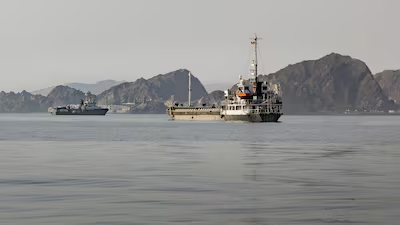
Only six vessels crossed the Strait of Hormuz on Sunday — the lowest count in five weeks.
That number tells you more about the state of the conflict than any official statement. Shipping companies vote with their hulls, and right now they are voting to stay away.
The Numbers
Ship-tracking data from Kpler recorded the collapse in traffic as renewed strikes between the United States and Iran, alongside attacks on vessels in the region, drove safety concerns sharply higher.
Among the ships that did move:
- The Humanity, a Very Large Crude Carrier, exited the strait laden with 2 million barrels of Iranian oil
- The Capetan Andreas, carrying roughly 500,000 barrels of Kuwaiti oil products
- Three empty tankers entering the Gulf to load
One additional tanker controlled by the Abu Dhabi National Oil Company exited between July 10 and July 12, bound for Dahej port in India.
Notably absent: liquefied natural gas tankers. Ship-tracking data showed none entering the strait over the weekend at all.
Going Dark
There is a detail in the data that reveals how afraid operators have become.
Most of the tankers that did transit switched off their transponders while crossing.
That is not a routine maneuver. Automatic Identification System transponders exist for safety — they prevent collisions and allow rescue in emergencies. Turning them off means a crew has calculated that being invisible is safer than being visible.
In the current environment, that calculation makes grim sense.
Two Governments, Two Realities
The confusion over the strait’s status is not incidental. It is being actively maintained by both sides.
President Trump said Sunday that the Strait of Hormuz is open to commercial traffic.
Iran had earlier declared the strait closed, after a vessel travelled on what Tehran called an unapproved route and was struck.
Then, on Monday, Iran’s Revolutionary Guards announced that its navy had stopped two ships in the strait the previous night by shutting down their systems. It did not identify the vessels.
So: Washington says open. Tehran says closed. And Iranian forces are physically disabling ships.
For a shipping company deciding whether to send a tanker and its crew through, that ambiguity is itself the answer.
The Military Backdrop
US Central Command confirmed that American forces completed another wave of strikes against Iran on Sunday, hitting dozens of targets across multiple locations with precision munitions.
This was the second consecutive night of American strikes.
Each round increases the risk calculus for anyone operating commercially in the region.
Why Six Ships Matters
The Strait of Hormuz has historically carried roughly a fifth of all globally traded oil and natural gas.
Six transits in a day is not a functioning corridor. It is a trickle.
The absence of LNG traffic is particularly consequential. Qatar is one of the world’s largest LNG exporters, and its entire output must pass through Hormuz. If those tankers are not moving, that supply is not reaching global markets.
The practical effects compound quickly:
- Cargoes sit undelivered
- Insurance premiums for the route become prohibitive
- Charter rates spike as owners demand compensation for risk
- Downstream buyers begin drawing on reserves
The Deeper Problem
What makes this situation unusually dangerous is that it does not require a formal closure to function as one.
Iran does not need to physically block the strait. It only needs to make it uncertain enough that commercial operators refuse to use it.
Strikes on vessels, systems being disabled, contradictory official claims — the cumulative effect is a waterway that is technically open and practically unusable.
That is leverage, and Tehran clearly understands it.
What to Watch
The traffic count is the single most useful indicator of where this is heading.
If transits recover toward normal levels, it means shipping companies believe the risk has stabilized, regardless of what either government says.
If the count stays near six — or falls further — the strait is closed in every sense that matters to the global economy, no matter who claims otherwise.
For now, the tankers are running dark, the LNG carriers are staying home, and the busiest energy corridor on earth has gone quiet.
Author