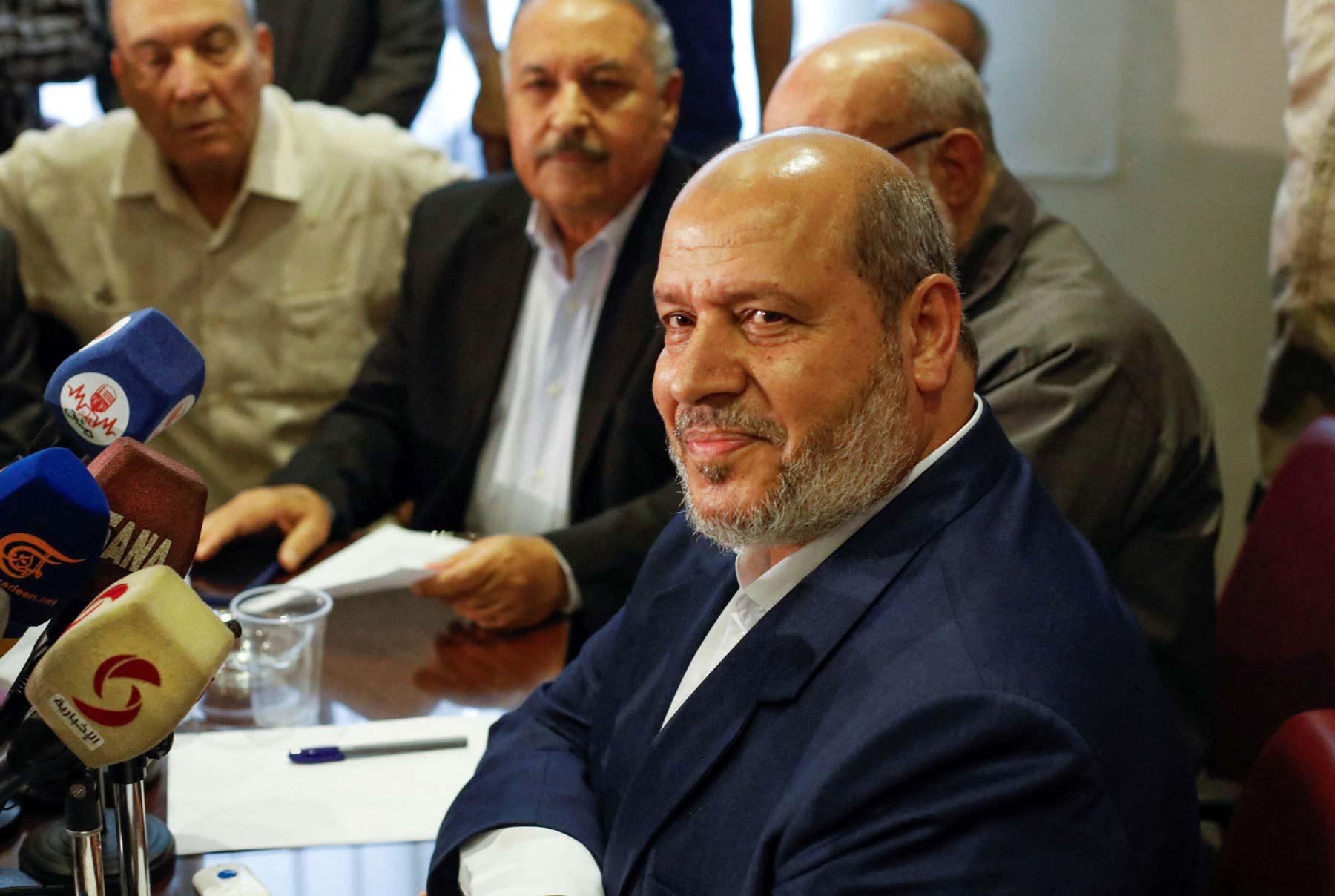
Board of Peace Gaza plan negotiations moved to Cairo this weekend, with a senior Hamas delegation arriving in the Egyptian capital to work through what sources describe as the most contentious elements of a 15-point framework for the territory.
The visit signals that discussions which appeared stalled are at least continuing, even as one of the key parties has already rejected the proposal outright.
Who Is in the Room
Al-Araby TV reported that the delegation is led by Khalil al-Hayya, elected head of Hamas’s political bureau on July 20.
According to sources cited in that reporting, the group also includes several other prominent figures: Mohammed Darwish, Khaled Meshaal, Zaher Jabarin and Basem Naim.
Saudi state-owned Al Hadath subsequently reported that the delegation met with Hassan Rashad, chief of Egypt’s General Intelligence Service, citing a Hamas source. Egypt’s intelligence apparatus has served as the primary conduit for negotiations involving Hamas for years, and Rashad’s involvement indicates the talks are being handled at a serious level.
Turkey’s state-run Anadolu Agency also confirmed the visit, describing the agenda as covering matters related to the Palestinian issue.
The American Track
Running parallel to the Cairo discussions is a separate diplomatic effort involving senior international figures.
Jared Kushner, Special Envoy for Peace and son-in-law of President Donald Trump, may travel to Israel and other regional states this week to address the situation in Gaza, according to a Board of Peace official who spoke to The Jerusalem Post.
The same official indicated Kushner would be accompanied by former British prime minister Tony Blair and Nikolay Mladenov, who heads the Gaza Board of Peace.
Axios reported earlier that Kushner also intends to meet mediators from Egypt, Qatar and Turkey in Cairo during the same period, placing multiple negotiating tracks in the same city at roughly the same time.
What the Framework Proposes
Trump announced at the end of July that the Board of Peace had secured what he called a historic agreement providing for the complete disarmament of Hamas and all other armed factions in Gaza.
He described the arrangement as a critical step toward Gaza being governed by a new Palestinian administration working in coordination with the Board of Peace on behalf of the Palestinian population.
He also framed the security dimension explicitly, stating that Israel would obtain the security it deserves and that Gaza would no longer function as a base for attacks.
Implementation, according to Trump, would proceed through carefully structured phases rather than as a single transition.
At the time, a Board of Peace official told The Jerusalem Post that Hamas retained numerous concerns about the deal, but that the group and other Palestinian factions had, for the first time, accepted the overall outline.
Israel’s Rejection
Roughly a week after that announcement, Prime Minister Benjamin Netanyahu formally rejected the plan during a cabinet meeting.
His stated position was unambiguous: the IDF will not carry out any withdrawal until Hamas has genuinely disarmed.
That creates a sequencing problem that has defeated numerous previous efforts. Hamas has historically treated disarmament as something that could only follow political and territorial guarantees. Israel’s position places disarmament first, as a precondition rather than an outcome.
Two parties can accept the same document while holding irreconcilable views about what happens first.
The Sticking Points
Several issues are likely dominating the Cairo agenda.
- The order in which disarmament and withdrawal occur
- What verification of disarmament would actually involve, and who conducts it
- The composition and authority of any new Palestinian governing body
- Whether Hamas figures would have any role in that structure
- Security arrangements during transitional phases
- Guarantees that any of the above will be honoured
Each of these has derailed previous negotiations. None has an obvious technical solution, because the disagreements are political rather than procedural.
Why Egypt Matters
Cairo’s role is not incidental. Egypt borders Gaza, controls the Rafah crossing, and maintains working channels with Hamas that Israel and the United States do not possess directly.
That position gives Egyptian intelligence unusual leverage as an intermediary, able to transmit positions between parties who will not speak to one another. It also gives Egypt a direct stake in any outcome, since instability in Gaza carries consequences for Egyptian security.
Realistic Expectations
The presence of senior Hamas leadership in Cairo alongside a high-level American delegation represents genuine diplomatic activity rather than mere posturing.
But activity is not agreement. With Israel having formally rejected the framework and Hamas holding significant reservations of its own, the current round is better understood as an attempt to determine whether any version of the plan can survive contact with both parties’ minimum requirements.
That question has not yet been answered.
Author
-
Lucienne Albrecht is Luxe Chronicle’s wealth and lifestyle editor, celebrated for her elegant perspective on finance, legacy, and global luxury culture. With a flair for blending sophistication with insight, she brings a distinctly feminine voice to the world of high society and wealth.