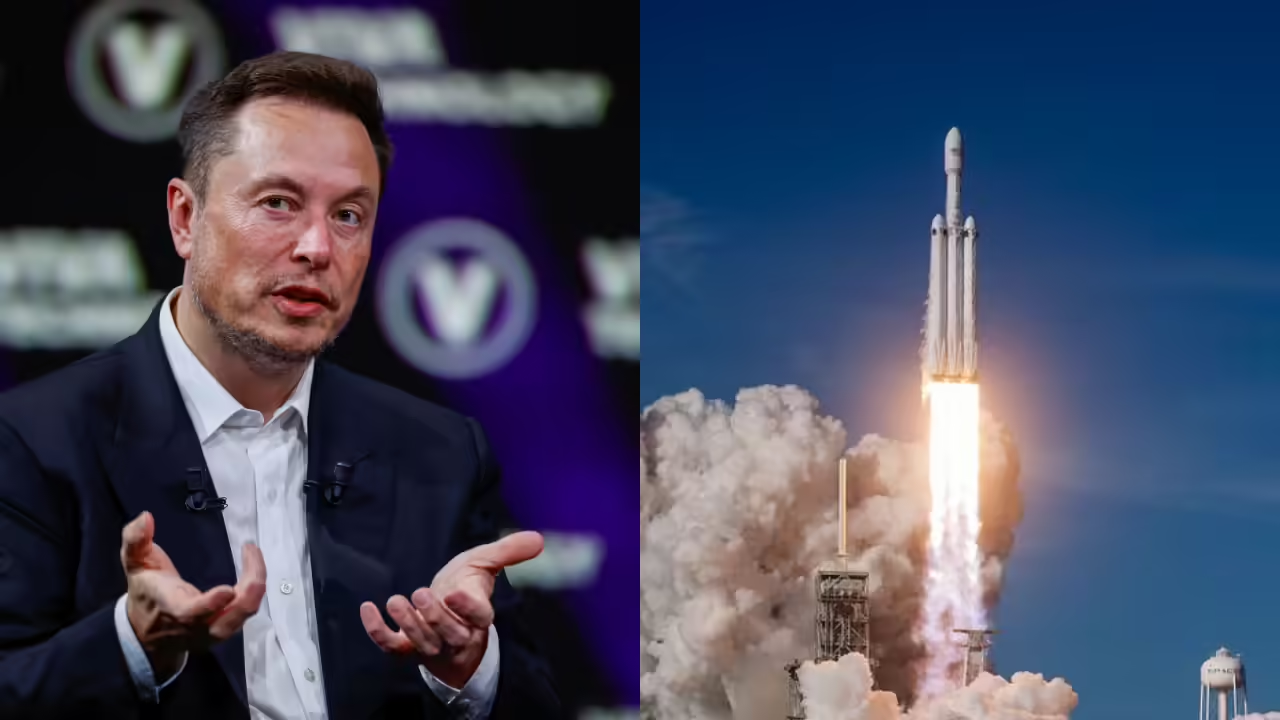
The SpaceX IPO didn’t just break records—it rewrote the entire story of what Elon Musk’s company is supposed to be. Only a few months ago, SpaceX was, at its core, a business that built rockets, ran launches, and operated a satellite constellation serving mobile and broadband providers. Then everything changed.
In February, Musk folded xAI—another piece of his sprawling empire—into SpaceX, and the narrative driving the company’s rise pivoted dramatically. Almost overnight, Musk was staking SpaceX’s future not on its two legacy franchises, but on artificial intelligence.
A Make-or-Break Debut
The June 12 IPO became the ultimate test of whether the world would buy Musk’s bold new vision.
The stakes were clear from the opening bell. A big jump above the $135 offer price would signal a ringing endorsement, while a slump would suggest investors simply weren’t sold on Musk’s futuristic promises—including ultra-low-cost, solar-powered orbital data centers.
The verdict arrived around noon, and it was emphatic. SpaceX shares surged at the open and closed at $160, a 19% gain. By the end of the day, the company had reached a staggering $2.2 trillion market cap, making it the largest US IPO of all time—eclipsing second-place Alibaba’s 2014 debut by roughly tenfold.
In other words, investors proved to be true believers. They went all-in on Musk’s claim that AI will be a colossal market, and that he’ll capture far more of it than a field of giants including Alphabet, Microsoft, Meta and a host of scrappy challengers.
The Numbers Behind the Bet
A key chart in the SpaceX prospectus reveals just how heavily Musk is leaning on AI over his other businesses. He forecasts a total addressable market of $28.5 trillion for the enterprise—and of that, AI alone accounts for $26.5 trillion, or 93%.
To put that in perspective, the AI share is nearly 14 times the combined $2.0 trillion projected for the satellite and rocket sides. The message couldn’t be clearer: rockets and Starlink will grow fast, but AI is the moonshot.
Where the Money Comes From Today
The current reality looks very different from Musk’s AI-driven projections. Last year, the Space segment generated just $4.1 billion in revenue—and posted losses.
For now, Starlink is the crown jewel. Consider its standing:
- Sales jumped 50% year-over-year in 2025 to $11.4 billion, more than half of SpaceX’s total revenue
- The network operates roughly 9,600 satellites, three-quarters of the entire fleet in orbit
- Over ten million users pay subscriptions for mobile and broadband service
That dominance gives Starlink a powerful moat as by far the biggest global player in commercial satellites, while throwing off steady, annuity-style cash flow.
Starlink’s Competitive Edge
During a June 6 interview hosted by J.P. Morgan CEO Jamie Dimon, Musk laid out a strong case for Starlink’s future—and its defenses.
He highlighted that the new Starship is the world’s first fully reusable rocket. Its main cost is simply what’s in the tank: a hydrogen-methane blend cheaper than jet fuel. Each launch can carry as many as 50 satellites at once.
Looking ahead, Musk projects expanding the network tenfold to 100,000 satellites, arguing that his superior capacity and rock-bottom costs lock in a dominant position for years to come.
The Catch: AI Has to Deliver
Here’s where Musk’s own math gets daunting. SpaceX doesn’t specify the time period its addressable-market forecasts cover, though they’re likely cumulative figures spanning at least a couple of decades.
The problem lies in the price of admission. SpaceX is entering public markets at a $2.2 trillion valuation. According to a discounted cash flow analysis by David Trainer, CEO of research firm New Constructs, the company would need at least $1.1 trillion in sales by 2035 just to justify the underwriting valuation of $1.75 trillion. That revenue target is already 50% higher than what Amazon—the top sales generator anywhere—posted over the past four quarters. By Fortune’s estimate, the first-day pop raised that requirement by about a third, to nearly $1.5 trillion.
And the non-AI businesses simply can’t close that gap. As Musk’s own tables show, the two non-AI segments “only” promise $1.6 trillion combined—spread across 20 or 30 years. While it’s impossible to pin down his estimates for their annual sales in, say, 2035, even a couple hundred billion dollars there would be a remarkable feat. Impressive as that would be, it wouldn’t bring SpaceX anywhere close to the well-over-$1-trillion mark needed to reward shareholders.
The Bottom Line
The conclusion is unavoidable: AI will have to do the heavy lifting.
Reinventing SpaceX as an AI play generated unmatched buzz, fueling the largest valuation ever for a market debut. But it also dramatically raised the bar for what Musk must deliver—especially after that explosive first-day jump.
As Georgetown University professor and IPO expert Reena Aggarwal put it, SpaceX’s debut isn’t about valuation grounded in fundamentals, but rather supply and demand for its shares. From here, investors will look past the hype toward the actual trajectory of sales and profits.
Given the sky-high expectations now baked into the stock, the warning is implicit but unmistakable: with hopes this lofty, any disappointment could send SpaceX into a steep and rapid descent.
Author