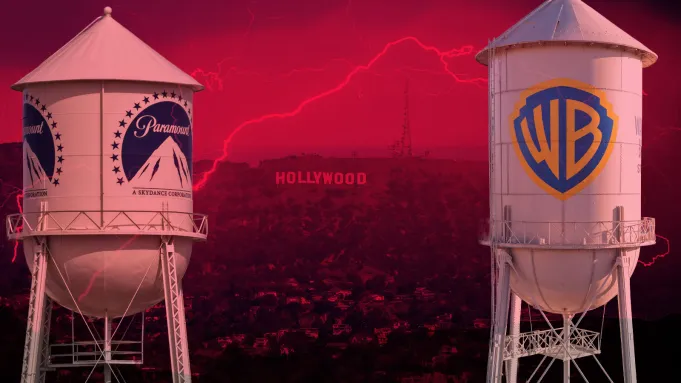
The Paramount Warner Bros merger has cleared one of its biggest hurdles, with the Justice Department greenlighting David Ellison’s $111 billion megadeal—a pivotal approval that removes a major regulatory roadblock and sets the stage to fundamentally reshape Hollywood.
But while the federal government has signed off, the fight over the deal is far from finished.
A Sweeping Federal Endorsement
In its announcement on Friday, the Justice Department’s Antitrust Division concluded that the acquisition would “increase competition across the media and entertainment ecosystem.” The agency determined that markets for streaming, linear TV, and the development, production and distribution of theatrical films would not be harmed.
The ruling carries enormous implications. Unless another party manages to block it, the merger clears the way for Paramount to become:
- The largest theatrical distributor in the United States
- The owner of a top-five streamer by subscriber count
Notably, the approval doesn’t appear to require any divestitures, behavioral remedies, or concessions—a clean win for Paramount.
Paramount’s Case
The company has consistently framed the deal as a competitive necessity rather than a threat. A Paramount spokesperson expressed gratitude for the Justice Department’s “thorough review,” describing the transaction as “pro-competitive.”
The core argument is about scale in a brutally competitive landscape. Paramount contends the merger will create a stronger company better equipped to take on dominant technology platforms—naming Netflix, Amazon and Apple—in an industry increasingly defined by fierce competition for audiences, talent, technology and investment.
The Justice Department ultimately embraced that logic. The agency reasoned that in technology-driven industries, “the disruptors of the recent past may quickly become the entrenched monopolists of the present day,” framing its investigation around protecting the contestability of dynamic markets.
The Obstacles That Remain
Despite the federal approval, the path to completing the merger is still crowded with potential challengers. The Justice Department was only one of several groups standing in the way, alongside state attorneys general, the FCC, the European Union, and consumers—some of whom have already filed suit to stop the deal.
The most immediate threat is brewing at the state level. A coalition led by California is preparing a lawsuit to block the merger, expected to be filed within a month. According to a source familiar with the situation, several states are in talks to join, including New York, Colorado, Oregon, Nevada, Washington, Connecticut and Tennessee.
Political Pushback
The deal has also drawn sharp criticism from Washington. In a post on X, Sen. Elizabeth Warren urged state attorneys general to press ahead with their challenge.
Warren didn’t mince words, calling the approval “terrible news for every American who doesn’t want Trump-aligned billionaires to control what they watch and how much they pay.” She argued the deal “has reeked of corruption and influence-peddling,” vowing that “this fight isn’t over.”
International Approvals Pile Up
While domestic opposition mounts, Paramount has been steadily clearing hurdles abroad. According to Paramount legal chief Makan Delrahim, regulators in Saudi Arabia, Ukraine, Serbia and North Macedonia have all found the deal doesn’t violate antitrust laws.
Foreign Direct Investment authorities in a string of other countries have signed off as well, including Germany, Italy, France, Romania, Slovenia, Belgium, Czechia and New Zealand—giving the merger growing international momentum.
Looking Ahead
For now, Paramount is pushing to get the deal across the finish line. “We remain focused on completing the transaction as soon as possible and delivering its benefits to consumers, creators, and the entertainment industry as a whole,” the company said.
Yet with a multi-state lawsuit looming and prominent voices in Congress rallying opposition, the Justice Department’s approval may prove to be just one chapter in a much longer battle. The federal government has opened the door—but whether David Ellison’s vision for a reshaped Hollywood ultimately becomes reality may now rest in the hands of the courts.
Author