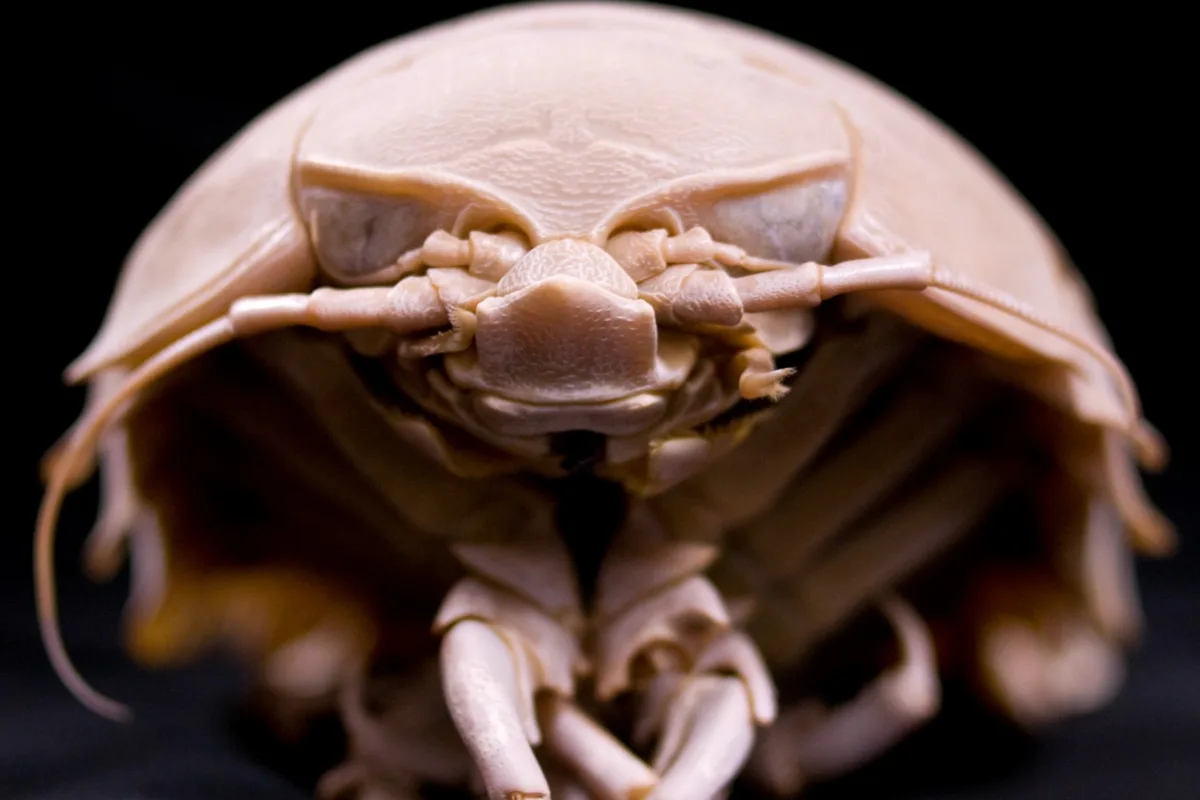
Deep-sea isopods have long puzzled scientists with a seemingly impossible feat: the supergiant bathynomid can survive more than five years without a single meal. Now, researchers have figured out exactly how these remarkable creatures pull it off — and the answer comes down to an elegant two-part survival system.
The Energy Paradox
The mystery starts with a contradiction. These isopods live in one of the most nutrient-starved environments on Earth, the deep sea, where food arrives only sporadically. Yet they grow to enormous sizes, a trait known as body gigantism that normally demands a great deal of energy.
That sets up a genuine paradox. How can an animal that appears so energy-hungry maintain such a massive body when meals are so rare and unpredictable? A team from the Institute of Oceanology of the Chinese Academy of Sciences set out to answer precisely that.
A Strategy of “Increasing Revenue and Reducing Expenditure”
By combining multi-omics analyses with functional experiments, the researchers uncovered a dual strategy that lets these giants thrive under extreme scarcity. The approach boils down to two complementary tactics:
- An enlarged stomach that can store huge quantities of food when it’s available.
- An extremely low basal metabolic rate that stretches those reserves over years.
In essence, the animals maximize what they take in while minimizing what they burn — a biological version of saving aggressively and spending almost nothing.
To investigate, the team studied two species living at different depths: Bathynomus jamesi from around 898 meters and Bathynomus doederleini from roughly 300 meters. They wove together comparative genomics with morphological, physiological, behavioral, and metagenomic analyses to map out the full picture.
A Stomach Built for Feast and Famine
The most striking adaptation is the stomach itself. In deep-sea isopods, it occupies about two-thirds of the entire body — far larger than in their shallow-water or intertidal relatives.
When fully packed, the stomach holds a finely ground, heavily digested, mud-like mixture. Interestingly, it contains a relatively low proportion of typical digestive bacteria like Firmicutes. Instead, it’s enriched with Chlamydiae, microbes associated with lipid (fat) storage.
The implication is clever: when a rare feeding opportunity arises, the isopod gorges itself. It then slashes its metabolic rate, allowing that single enormous meal to be digested and used gradually over an extended period — sometimes years.
A Borrowed Gene With a Surprising Origin
The second half of the story involves a genetic curiosity. The researchers identified a gene called ND1 that didn’t originate in the isopod at all. It came from a symbiotic bacterium and was later integrated into the isopod’s own genome — a process known as horizontal gene transfer.
ND1 is similar to a component of Complex I in the electron transport chain, the cellular machinery responsible for energy production, suggesting it plays a key role in metabolism. What makes it especially notable is that, after being acquired, the gene managed to duplicate itself and reach extraordinarily high levels of expression — overcoming some of the usual limitations of borrowed genes.
The team also found that this ultra-high expression is finely controlled through epigenetic means, specifically histone acetylation. The result is a system the researchers describe as achieving high efficiency, energy conservation, and precise control all at once.
Putting the Gene to the Test
To confirm what ND1 actually does, the scientists inserted it into zebrafish, nematodes, and human 293T cells. The results revealed a temperature-dependent twist.
At normal temperatures, ND1 sped up energy metabolism, which actually made the organisms less able to tolerate starvation. But under cold conditions designed to mimic the deep sea, the gene did the opposite — it suppressed energy metabolism and reduced mitochondrial activity. In zebrafish, this boosted starvation tolerance by 37%.
That finding is the crux of the whole puzzle. ND1 fine-tunes the degree of metabolic depression depending on the environment, resolving the fundamental tension between the high energy cost of being gigantic and the need to power down in an extreme, food-poor habitat.
Why It Matters
This research is the first to reveal such an evolutionary strategy in deep-sea megafauna — animals that effectively reprogram how they allocate energy through a blend of horizontal gene transfer and epigenetic optimization.
As Yuan Jianbo, first author of the study, put it, the work doesn’t just solve the riddle of how deep-sea isopods endure such extraordinary stretches without food. It also offers a broader model for understanding how life manages to balance growth against survival in the planet’s harshest environments.
The Bigger Picture
What emerges is a portrait of evolution as a remarkably resourceful problem-solver. Faced with an environment that seems to forbid large, energy-demanding bodies, these isopods didn’t abandon their size — they engineered a way to support it, borrowing a gene from bacteria and learning to throttle their metabolism with surgical precision.
For scientists, the supergiant bathymonid is now more than a deep-sea oddity. It’s a window into the ingenious strategies life uses to persist where survival looks, at first glance, impossible.
Author