The Iran US interim deal signed roughly a month ago is effectively dead. Tehran announced Saturday that it has suspended its commitments under the agreement, cutting one of the last remaining threads between the two countries as strikes continue in both directions.
Kazem Gharibabadi, Iran’s deputy foreign minister, told state television that the United States had violated its own obligations under the deal and that Iran is no longer implementing them.
The announcement came the same day both sides struck infrastructure and military targets, and as the conflict tightened around a single geographic point: the Strait of Hormuz.
Seven Straight Nights
U.S. Central Command said early Saturday it had completed a seventh consecutive night of strikes.
The stated targets were surveillance sites, military logistics infrastructure, underground weapons storage, and maritime capabilities — a list weighted heavily toward Iran’s ability to monitor and control the waterway.
That emphasis isn’t accidental. The war has increasingly narrowed to a contest over who controls a channel that once carried a fifth of the world’s crude oil.
Kuwait Takes the Heaviest Damage
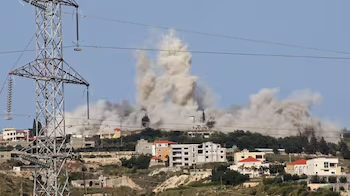
Saturday’s most severe destruction landed in Kuwait, where Iranian strikes hit a water desalination plant and an oil facility.
Kuwaiti authorities and the Kuwait Petroleum Corporation confirmed both strikes but declined to specify locations. Several people were injured at the oil facility. The desalination plant caught fire, forcing multiple power generation units offline.
This was the second attack on a desalination plant in the country in two days — a targeting pattern with severe implications for a small desert nation that draws 90 percent of its drinking water from desalination.
Kuwait’s Fire Force reported that several firefighters and a worker were injured fighting two additional blazes started by Iranian strikes. The country briefly closed its airspace over missile threats, and Kuwait Airways began rescheduling most flights in and out of the capital.
The Warning to Host Nations
The Islamic Revolutionary Guard Corps escalated its rhetoric toward countries hosting American forces, saying via Iranian state television that such nations should be prepared to receive a corresponding response.
The follow-through was regional and immediate.
Iraq said it downed attack drones over Irbil. Jordan’s state-run Petra news agency reported that the kingdom’s air defenses intercepted Iranian missiles. Air raid sirens sounded repeatedly in Bahrain through the day, and in Saudi Arabia during the morning, according to both governments.
The strategy is transparent: make hosting American forces expensive enough that host governments reconsider.
The Casualty Numbers
Iranian officials say recent U.S. strikes have killed dozens and wounded hundreds inside Iran. Their fuller accounting puts at least 50 killed and more than 500 wounded over the past three weeks, including eight people killed when a bridge was struck Friday.
On the American side, officials acknowledged 13 additional service members injured since Monday — 10 Army soldiers and three Navy sailors — without offering details.
The cumulative toll since the war began: 14 U.S. service members killed and 427 wounded.
What the U.S. Is Hitting Inside Iran
American airstrikes struck an electricity and desalination plant in Iran’s southern Hormozgan province, according to Iranian state TV. The attack hit Bonji, a coastal village on the strait.
Overnight strikes damaged two tunnels and a bridge, disrupting a main highway toward Bandar Abbas — Iran’s principal port, located near the narrowest point of the strait. Iran also reported strikes on Qeshm Island, strategically positioned inside the waterway.
On Friday, Iran acknowledged attacks on power infrastructure for the first time when its Energy Ministry asked residents of southern provinces experiencing extreme heat to reduce electricity use. It did not identify what had been hit.
Asking people to conserve power during a heat wave is its own form of admission.
The Fight Over the Strait
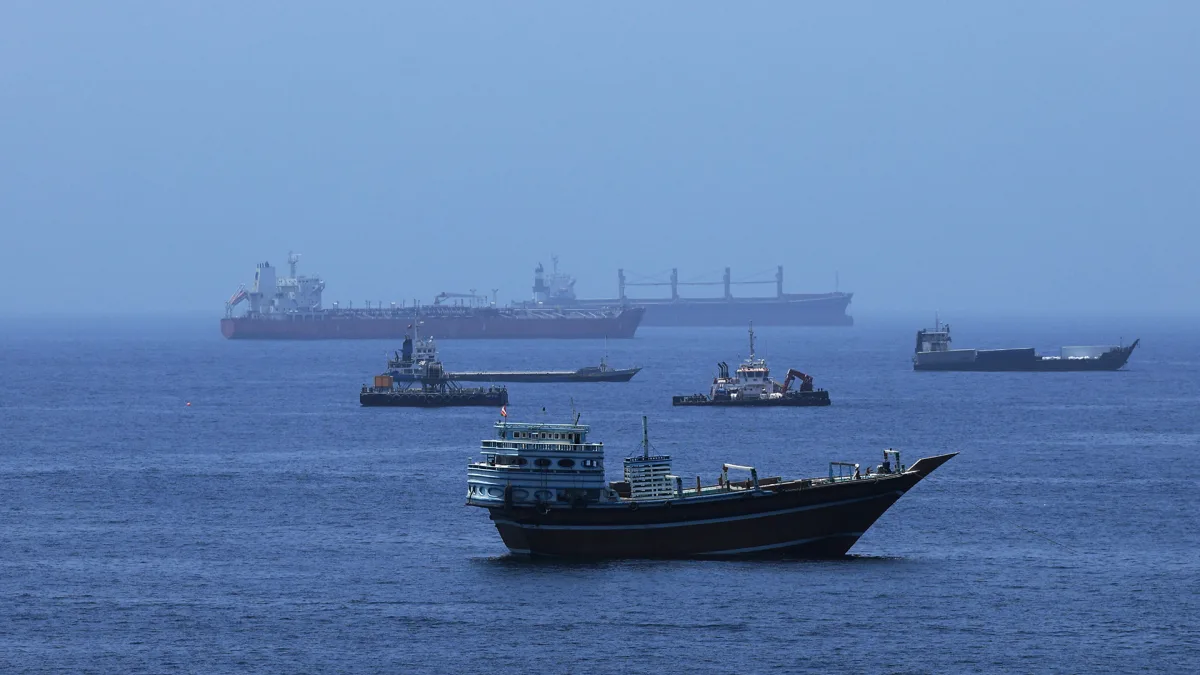
Iran effectively closed the strait to shipping after the war began with U.S. and Israeli strikes on Feb. 28.
That single decision transformed the conflict’s economics. Oil prices surged, and Iran acquired substantial leverage at the negotiating table — leverage it has shown no interest in surrendering.
Tehran’s position is that the strait must fall under its exclusive control and that vessels should pay fees to Iran for passage. That claim breaks with decades of international consensus treating the waterway as international.
Trump has responded by returning to threats against power stations and bridges, aiming to pressure Iran into loosening its grip. The U.S. has also reimposed a naval blockade on Iranian ports to halt crude oil shipments.
Both sides are now attacking the other’s ability to move energy.
The Market Reaction
Oil climbed above $86 a barrel Friday, approaching its highest point in a month, as transits through the strait dropped to a three-week low according to international shipping tracking.
Regional producers are shifting more energy to pipelines, but the capacity gap is substantial. Pipelines cannot come close to replacing the volume that normally moves by sea through Hormuz.
That shortfall is what keeps global markets exposed to every development in this conflict.
The Political Pressure on Washington
Before the fighting started, the U.S. had been negotiating with Iran over its nuclear program.
Trump now faces a difficult domestic position. He campaigned against exactly this kind of extended Middle East entanglement, and the war has now produced American casualties, a suspended agreement, and no visible off-ramp.
The pressure to end it grows with each week the strikes continue.
Where This Stands
The interim deal’s collapse removes the main structure that existed for de-escalation. What replaces it is unclear.
Three things will determine the near-term trajectory. Whether the nightly strike tempo continues into a second week. Whether Gulf states hosting U.S. forces absorb continued attacks or begin pressing Washington for changes. And whether anything moves in the strait — because as long as it stays closed, the economic pressure builds on every government watching.
For now, both sides are targeting the infrastructure civilians depend on, and the waterway at the center of it all remains largely still.
Author