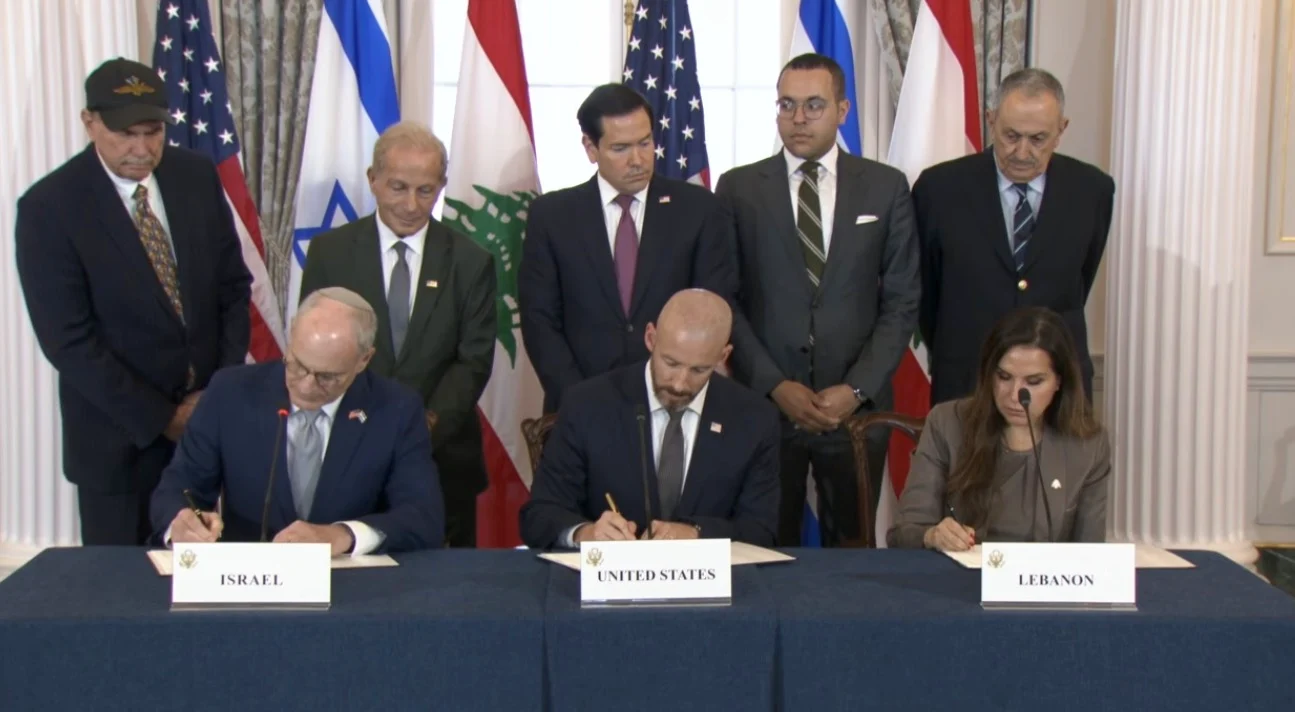
Israel-Lebanon framework agreement was signed in Washington on Friday, marking what U.S. Secretary of State Marco Rubio called “the beginning of the beginning.” His cautious framing captured the reality of a deal that opens a path forward while leaving major obstacles firmly in place.
A Hard First Step
At the signing ceremony, Rubio stressed that significant work still lay ahead, describing the moment as merely the first step and acknowledging that the first step is often the most difficult. The United States, which brokered the direct talks that began in April, is also a signatory to what is officially a trilateral arrangement.
Yet the agreement carries notable limitations. It does not compel Israel to withdraw from the substantial portion of southern Lebanon it continues to occupy. Israel has also signaled that it intends to keep striking targets inside Lebanon whenever it considers such action necessary. The country has been locked in conflict with the pro-Iranian group Hezbollah since October 2023, with fighting fluctuating in intensity and more than 4,000 people killed in Lebanon since March.
What the Agreement Contains
According to Rubio, the deal lays out a clear and structured process aimed at restoring Lebanon’s sovereignty, disarming Hezbollah, and dismantling its infrastructure, allowing Israel to return to its borders once the threat is removed. He also noted that it establishes a trilateral Military Coordination Group to help both sides implement the framework.
Lebanese Prime Minister Nawaf Salam described the agreement as one intended to secure Israel’s withdrawal from all Lebanese territory. He emphasized, however, that the deal largely continues earlier agreements and United Nations resolutions calling for the Lebanese military to hold authority over the entire country, a stance that challenges both Israel and Hezbollah.
When the State Department released the text hours later, it outlined a sequenced process in which the Lebanese army would restore effective sovereign authority across all Lebanese territory, contingent on the verified disarmament of non-state armed groups, a clear reference to Hezbollah. Only after that step would Israel be able to progressively redeploy out of Lebanon.
The framework designates two pilot zones for an initial Israeli withdrawal. In these areas, the Lebanese military would gradually take on full security responsibility. The agreement specifies that once disarmament is confirmed:
- The Lebanese army will assume complete control of the zones
- Internationally supported reconstruction efforts will begin
- Civilians will be able to safely return under exclusive Lebanese state authority
The Situation on the Ground
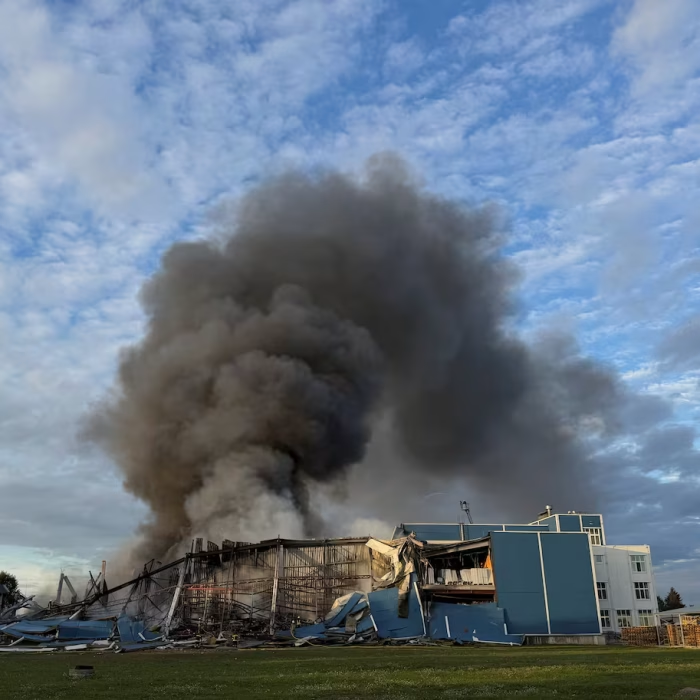
The military reality remains volatile. Israel has destroyed villages and towns throughout southern Lebanon, the focus of most of its operations, and has more recently struck Beirut and the eastern Bekaa Valley, claiming to target Hezbollah.
A ceasefire reached during earlier talks in Washington produced a partial de-escalation, but Israel has not fully halted its attacks and still occupies roughly one-fifth of Lebanon. On the very day the framework was signed, an Israeli air raid reportedly killed two people in the town of Mayfadoun, while additional strikes hit Nabatieh al-Fawqa. The Israeli military also dropped leaflets ordering residents to leave the town of al-Mansouri.
Periodic clashes between Hezbollah and Israeli forces have continued as well. Still, a Lebanese military source denied reports that Israel had seized the Ali al-Taher heights, insisting there had been no Israeli advance there.
Can the Deal Bring Lasting Peace?
The path to peace is complicated by the fact that Israel is effectively in conflict with two parties at once: the Lebanese state and Hezbollah. Israel and Lebanon, though neighbors, have technically been at war since 1948, and Israel has waged several wars against Lebanon over the decades, occupying parts of the south between 1982 and 2000.
Prime Minister Benjamin Netanyahu has portrayed the current war as a matter of protecting northern Israel. He has been firm that Israeli forces will not leave Lebanon as long as Hezbollah remains armed and continues to pose a threat to Israel.
Lebanese leaders offered a more hopeful interpretation. President Joseph Aoun called the framework the first step toward Lebanon reclaiming sovereignty over all its land and toward allowing displaced people to return to their towns under state control.
Hezbollah’s Resistance
Although Hezbollah was absent from the Washington talks, the group still holds considerable influence over any outcome. It has demanded that Israel leave Lebanon unconditionally, and its secretary-general has rejected any normalization with Israel.
The group’s core position is that Israel cannot be trusted and that it must retain its weapons to defend Lebanon if the national army proves unable to. One Hezbollah lawmaker warned that any effort by the Lebanese army to enforce a Washington-brokered deal could trigger civil war. The framework’s sequencing, which requires disarmament before any Israeli withdrawal, is certain to face fierce opposition from the group.
Lingering Doubts
While the agreement includes a line stating that Israel has no territorial ambitions, some Israeli officials have suggested a long-term presence. The finance minister indicated earlier in the week that Israeli forces would remain until Hezbollah disarms, and possibly beyond, citing the need for defensible borders.
That gap between the framework’s stated goals and the signals coming from Israeli leadership underscores why Rubio’s modest description felt apt. The agreement may represent a genuine first step, but the road toward a durable peace remains long, uncertain, and heavily contested.
Author