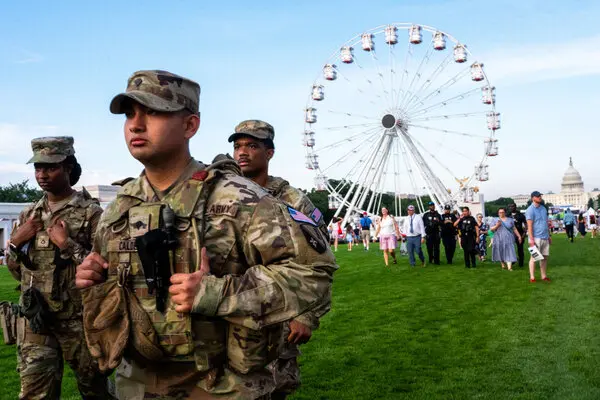
Great American State Fair opened on the National Mall this week with an unusual blend of patriotic celebration and conservative messaging. Visitors arriving on the first day found none of the traditional county-fair staples like butter sculptures, prize livestock, or award-winning pies. Instead, they encountered a polished portrait of President Trump, handbills promoting Turning Point USA, and a speaker reciting a poem that described every teenager as a recruit in a spiritual war.
A Fair With a Political Backdrop
The 16-day event, which launched Thursday, was put together by Freedom 250, a Trump-aligned organization that has been quietly competing with America250, the bipartisan group Congress tasked with coordinating the nation’s 250th birthday celebrations.
The fair was designed around exhibits and pavilions meant to represent every U.S. state and territory, along with the federal cabinet departments. However, at least 11 states declined to participate officially, many pointing to budget concerns. To fill the empty spaces, Freedom 250 brought in smaller groups it selected on its own.
A Mix of History and Ideology
Much of what was on display amounted to a fairly apolitical collection of history and Americana. Among the attractions, visitors could find:
- A talking hologram of Abraham Lincoln representing Illinois
- A NASCAR stock car from North Carolina
- A Georgia display celebrating state icons like Vidalia onions and Waffle House
- A rodeo featuring bull riding
Yet alongside these lighthearted exhibits, conservative and religious undertones were never far away. Volunteers from a Florida church approached attendees to share that Jesus loved them and had a plan for them. Printed materials proclaimed that Trump was leading a “Great American Comeback.” Exhibitors included Hillsdale College, a conservative Christian school, and the Museum of the Bible, while performers sang hymns in a worship tent at the edge of the grounds.
A Rough Start
The opening day was far from smooth. Under intense heat, turnout was thin, and technical problems compounded the lackluster atmosphere. By Thursday night, the Ferris wheel had been out of service for hours due to power failures.
Nearby, visitors could view a scaled-down model of Trump’s proposed 250-foot triumphal arch. Its vinyl covering, stapled over a wooden frame and bearing the words “One Nation Under God,” had already begun to buckle.
On one of the music stages, a band performed covers of Billy Joel and the Eagles. That stood in for the live performances originally promised from artists such as Martina McBride, the Commodores, and Bret Michaels. Those acts had pulled out the previous month, shortly after their appearances were announced, with several saying they had been led to believe the event would be nonpartisan.
What Attendees Thought
Reactions among visitors were mixed. Charles DeJesus, a 44-year-old from Pennsylvania who said he had voted for Trump three times, had been looking forward to the fair for months. He admitted it fell short of his expectations, having hoped for larger crowds, a livelier atmosphere, and more food options, particularly fried fare. Still, he was glad to attend and said he noticed no partisan slant, summing it up simply as “just America.”
Others were less impressed. A man from New Jersey who gave only his first name, Earl, felt many booths lacked substance and said he would have wanted a refund had there been an admission fee.
A more upbeat visitor from South Carolina, wearing a playful George Washington T-shirt, brushed off the controversy surrounding the canceled musical acts as overblown. He said he tried not to pay attention to the noise and was simply there to celebrate.
The States That Stayed Home
Eleven states opted out of sending official booths: Connecticut, Illinois, Kentucky, Maine, Massachusetts, North Carolina, Oregon, Pennsylvania, Rhode Island, Vermont, and Washington. Most are led by Democratic governors. Many of these states were represented only by empty, unstaffed rooms featuring photo murals and chairs.
In a few cases, volunteers stepped in to fill the void. A 72-year-old woman drove ten hours to set up a replacement booth for Massachusetts after deciding just the week before that she wanted to represent her state. Her display offered maple candies and syrup, which she said was the quickest thing she could pull together and felt represented western Massachusetts. A flier featuring the late conservative activist Charlie Kirk also sat on her table, though she insisted the entire event was nonpartisan.
Some Booths Embraced Complexity
Among the official state exhibits, several were notably elaborate. Mississippi spent six months preparing its display, according to the state’s tourism director. The booth showcased the state’s literary heritage with authors like Jesmyn Ward and William Faulkner, while also honoring Delta blues musicians, Elvis Presley, and civil rights leaders. The goal, she said, was to teach visitors things about Mississippi they might not already know.
Tennessee likewise leaned into its history, including its more challenging chapters. Its showcase highlighted whiskey and country music but also presented the state as a “frontier of freedom,” home to Revolutionary War heroes and pivotal struggles over women’s suffrage and school desegregation.
A Broader Fight Over History
The National Mall is surrounded by Smithsonian museums, each displaying banners promoting their own 250th anniversary programming. For more than a year, the Smithsonian has been at odds with the Trump administration, which has accused the institution of falling under the influence of divisive, race-centered ideology and of promoting an unflattering portrayal of American history.
The administration’s preferred version of history appeared in a Freedom Truck, part of a fleet of mobile museums touring the country in partnership with Hillsdale College and the conservative platform PragerU. Critics among historians argue the trucks present a sanitized account of the past. They largely narrate the American Revolution through the founders, who recount their lives in AI-generated videos. The exhibits include brief mentions of Native Americans, women, and free and enslaved Black Americans who fought in the Revolution.
Notably, the trucks feature a quote from Frederick Douglass’s 1852 speech, “What to the Slave is the Fourth of July?” but omit the portion challenging why the principles of the Declaration of Independence had not been extended to the enslaved.
Politics at the Podium
Trump delivered a brief, campaign-style welcome speech on Wednesday before a sparse crowd, claiming that his second term had revived a country he described as “dead” under his predecessor. Before he spoke, Transportation Secretary Sean Duffy praised the performing military band and singers, calling them far better than the artists who had canceled and using a disparaging term for liberals.
The next day, the visitor from South Carolina chose to set politics aside. Reflecting on the meaning of the milestone, he emphasized that 250 years earlier the founders declared that all men are created equal, and he took pride in the fact that the country remains a democracy. Whether or not someone likes the current occupant of the White House, he noted, voters always have the chance to choose someone else next time.
Author