Israeli Strikes Continue in Gaza Days After Disarmament Deal Announcement
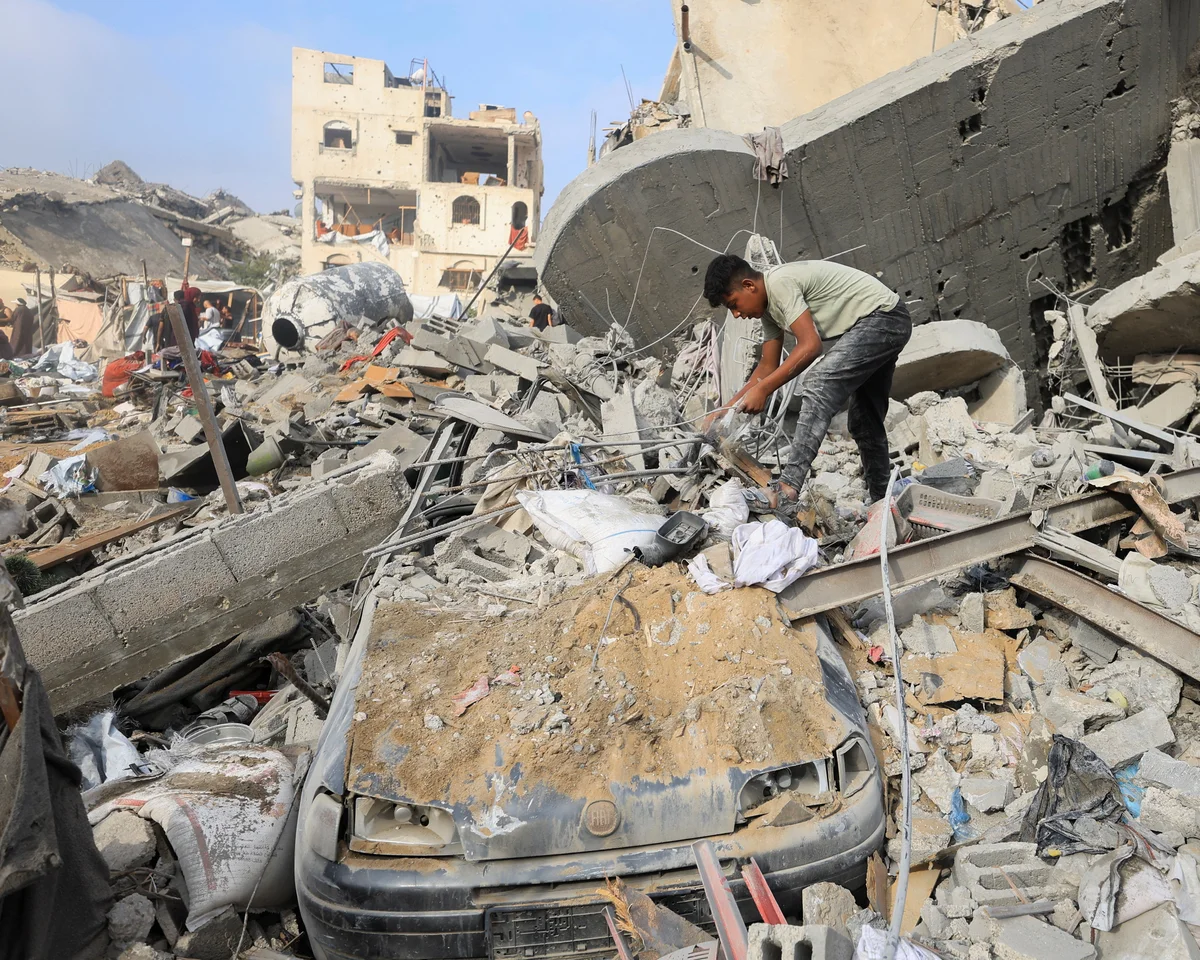
The Gaza ceasefire disarmament deal announced earlier this week has not stopped the bombing. Israeli strikes on Saturday killed at least two people and damaged medical supply warehouses, according to Palestinian officials, underscoring the distance between what was agreed on paper and what is happening on the ground.
The Hospital Strike
One strike hit before dawn Saturday, destroying and damaging warehouses at the Al-Aqsa Martyrs Hospital in central Gaza.
Hospital spokesman Khalil Dagran said the facility’s outpatient clinic sustained damage as well, though no casualties were reported from that attack.
The Israeli military stated it targeted the warehouses because Hamas was storing weapons there and using the site as a hideout.
Dagran rejected that characterization. He also noted that Israeli forces had issued warnings for Palestinians to evacuate before the bombing, a practice that reduces casualties while confirming the strike was planned rather than reactive.
A Second Strike in Gaza City
The day’s fatalities came from a separate attack in the Sheikh Radwan neighborhood of Gaza City, where local health officials reported two Palestinians killed.
The Israeli military confirmed carrying out the strike but declined to explain why those individuals were targeted.
What the Deal Actually Said
The strikes came days after Trump announced that Hamas had agreed to surrender its weapons in negotiations with his Board of Peace, a body created last year to oversee the truce between Israel and Hamas.
Disarmament had been the central obstacle for months, blocking progress beyond the initial ceasefire.
Hamas responded on Friday with conditions. The group said the first step must be an Israeli commitment to halt attacks, and tied the handover of what it termed heavy weapons to a broader list of requirements.
The road map itself calls for a phased withdrawal of Israeli troops from Gaza and a cessation of military operations as prerequisites for Hamas to decommission and store its weapons.
Israel’s Position Remains Unclear
Whether Israel has accepted the arrangement has not been established.
Prime Minister Benjamin Netanyahu has offered no comment on the deal, which surfaced Thursday night.
A written statement circulated by the Israeli government on Friday, attributed to an unnamed diplomatic official, said the military would not pull back from its current lines in Gaza absent genuine disarmament by Hamas.
That formulation inverts the sequence Hamas described. One side wants withdrawal before disarmament; the other wants disarmament before withdrawal. Nothing in the announced deal resolves which comes first.
The Political Calculation
Israel’s demand for disarmament rests on preventing any repeat of the Oct. 7, 2023 attack that began the war.
Netanyahu faces a difficult re-election contest later this year, which complicates his position. Any step voters might read as accommodation of Hamas carries political risk, potentially making him more resistant to the reciprocal concessions the road map requires.
Hamas faces a mirror-image problem. Armed struggle has been central to the group’s ideology and to its hold on power. Many within it regard giving up weapons as indistinguishable from surrender.
Two leaderships each constrained by their own constituencies is not a promising foundation for sequenced concessions.
The Human Toll So Far
The war began with the October 2023 Hamas-led assault on southern Israel, which killed roughly 1,200 people and resulted in about 250 being taken hostage.
The Israeli campaign that followed devastated the enclave. Local health officials report more than 70,000 people killed over two years. That figure does not distinguish combatants from civilians, though it includes thousands of children.
A ceasefire brokered by the Trump administration last October was intended to end the fighting. It provided Gaza’s two million residents relief from full-scale war, but the situation that followed has not resembled peace.
Since that truce, more than 1,000 people have been killed according to local officials, young children among them. Israel has bombed Gaza on a near-daily basis, saying Hamas is attempting to rearm and that it is striking the group’s fighters.
Territory Has Shifted
The ceasefire initially required Israeli forces to pull back to an agreed boundary described as the yellow line.
Since then, those forces have advanced steadily. Israel now controls more than 60 percent of the Gaza Strip, compressing most Palestinian residents into a shrinking coastal area.
That territorial reality shapes any negotiation over withdrawal. Returning to the yellow line would now represent a substantial concession rather than a restoration of the status quo.
Reconstruction Held Hostage
Both the United States and Israel have said Gaza will not be rebuilt while Hamas governs the territory and maintains armed formations.
That position links the humanitarian recovery of two million people directly to a political and military outcome that neither side appears close to accepting.
What Is Missing From the Agreement
The most significant gaps are practical ones.
The deal contains no firm timeline for Hamas to relinquish heavy weapons. It contains no schedule for Israeli forces to withdraw. Without sequencing and dates, each side can claim compliance while waiting for the other to move first.
Analysts have questioned whether either party genuinely intends to complete the process. Saturday’s strikes, occurring days after the announcement, offer little to counter that skepticism.
Author
-
Lucienne Albrecht is Luxe Chronicle’s wealth and lifestyle editor, celebrated for her elegant perspective on finance, legacy, and global luxury culture. With a flair for blending sophistication with insight, she brings a distinctly feminine voice to the world of high society and wealth.