Jay Clayton Set to Take Over US Intelligence Community on Monday
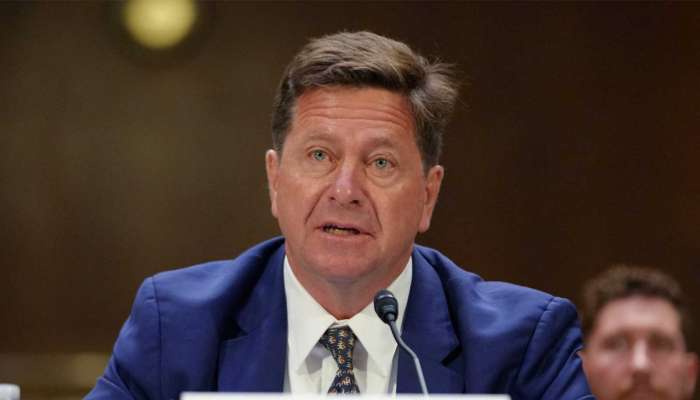
Jay Clayton will become the nation’s intelligence director on Monday, according to a Saturday post from Acting Director of National Intelligence Bill Pulte, closing out a contentious confirmation process and installing a new leader over the sprawling American intelligence apparatus.
Senate Republicans approved his nomination earlier in the week. Democrats opposed it, and the confirmation hearing that preceded the vote was described as heated.
What the Job Entails
The Director of National Intelligence sits atop 18 separate intelligence agencies, coordinating collection, analysis and priorities across organizations that often operate with distinct cultures and competing interests.
It is a position defined as much by managing internal friction as by briefing the president. The office was created to fix coordination failures, and its authority has always depended partly on the incumbent’s ability to command respect from agencies that predate it by decades.
Clayton’s Background
Clayton arrives from the U.S. attorney’s office for the Southern District of New York, one of the most prominent prosecutorial posts in the country.
That office handles complex financial crime, terrorism cases and public corruption, giving him exposure to classified material and to the intersection of law enforcement and intelligence. It is not, however, a traditional pipeline to the intelligence directorship, which more commonly draws from military, agency or congressional intelligence backgrounds.
The Confirmation Fight
The central objection from Democrats concerned his testimony rather than his qualifications.
During his hearing, Clayton repeatedly declined to state directly that Trump lost the 2020 presidential election to Joe Biden. That refusal became the focal point of Democratic criticism, framed as a question about whether the person overseeing the intelligence community would resist political pressure when the facts prove inconvenient.
For an office whose value depends entirely on delivering unwelcome assessments accurately, that concern carries a particular resonance. Republicans nonetheless carried the vote.
The Vacancy He Inherits
The position opened in June when Tulsi Gabbard resigned.
Her time in the role was marked by sustained conflict with congressional Democrats, who accused her of advancing Trump’s political priorities through the office and of amplifying election claims that had been discredited.
That history shapes the environment Clayton enters. The office has been a site of partisan conflict for the better part of a year, and rebuilding confidence across the aisle would be a substantial project on its own.
The Interim Period
Pulte has held the acting role since June while simultaneously serving as Trump’s director of the Federal Housing Finance Agency.
That dual assignment drew objections from Democrats, who pointed to his lack of background in national security as disqualifying for even a temporary appointment.
His tenure was consequential despite its brevity. After stepping into the position, Pulte ordered layoffs affecting intelligence staff, a decision that will shape the organization Clayton inherits.
What Clayton Walks Into
The incoming director faces several immediate realities.
Workforce disruption. Staff reductions carried out during the interim period mean Clayton takes over an office in the middle of personnel turbulence rather than a stable organization.
Damaged bipartisan standing. Two consecutive directors have generated significant Democratic opposition, and Clayton’s own hearing did nothing to reset that dynamic.
Operational demands. The intelligence community is currently working amid active military operations and negotiations involving Iran, ongoing conflict between Russia and Ukraine, and a range of persistent threats requiring continuous assessment.
Institutional credibility. The office’s influence rests on being trusted by policymakers across parties. Restoring that trust, if he chooses to pursue it, would require demonstrating independence early.
Questions That Remain
Whether Clayton addresses the 2020 election question differently once in office is one open item, though there is no particular reason to expect him to revisit it.
More consequential is how he handles the first significant disagreement between intelligence findings and administration preferences. That moment, whenever it arrives, will define his tenure more than any confirmation exchange.
Also unclear is whether the staffing reductions initiated under Pulte will continue, be reversed, or simply be absorbed. Clayton has not publicly outlined his approach to the workforce he is inheriting.
The Broader Pattern
The rapid turnover at the top of the intelligence community, with a resignation, an interim director drawn from an unrelated agency, and now a third leader within roughly a year, represents unusual instability for an office designed to provide continuity.
Analysts and career staff tend to weather political changes at the top, but frequent leadership turnover complicates long-term planning and can leave agencies uncertain about which priorities will hold.
Monday’s transition ends the interim arrangement. What it produces beyond that will depend on decisions Clayton has not yet had to make.
Author
-
Lucienne Albrecht is Luxe Chronicle’s wealth and lifestyle editor, celebrated for her elegant perspective on finance, legacy, and global luxury culture. With a flair for blending sophistication with insight, she brings a distinctly feminine voice to the world of high society and wealth.