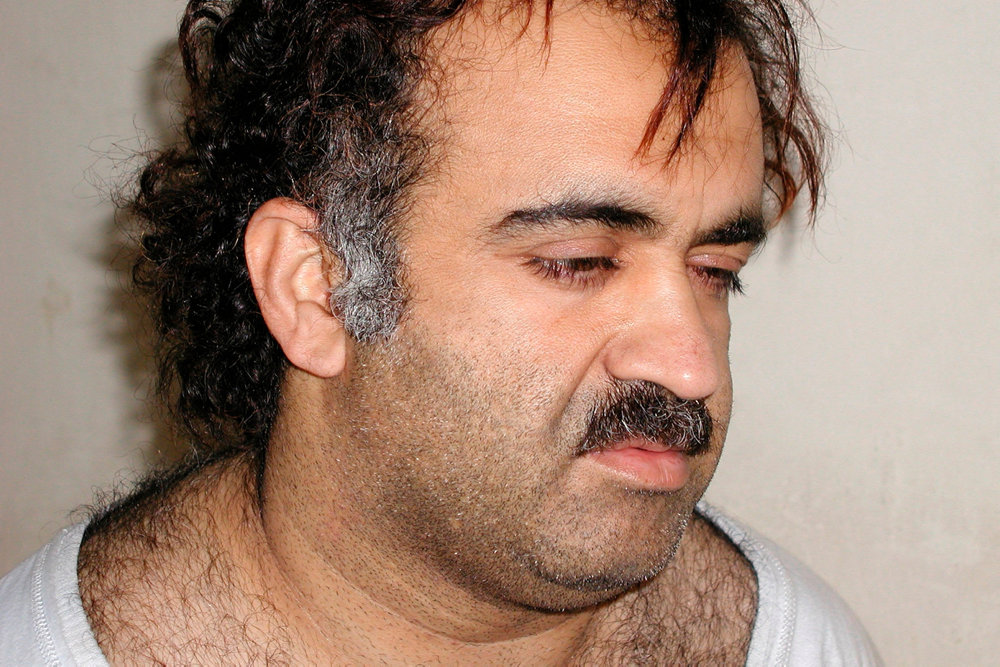
The Khalid Sheikh Mohammed confession that federal investigators secured nearly two decades ago has been suppressed by a military judge, who concluded the statements were not made voluntarily. The decision lands as a serious setback for a prosecution that has already consumed more than twenty years without reaching trial.
Mohammed is accused of designing the plot that sent hijacked aircraft into the World Trade Center and the Pentagon. He remains held at Guantanamo Bay, Cuba, alongside several co-defendants still awaiting proceedings.
What the Judge Decided
Lieutenant Colonel Michael Schrama issued the order on Friday. It has not been made public, but its effect is clear: the statements Mohammed gave during four days of FBI questioning at Guantanamo in January 2007 cannot be used against him.
Schrama’s reasoning rested on what had happened to Mohammed before those interviews took place.
Years earlier, after his capture, Mohammed was held in CIA custody and subjected to waterboarding along with other interrogation methods widely regarded as torture. The judge found that this treatment left him carrying a genuine fear of severe mistreatment should he decline to cooperate with whoever questioned him next.
Two additional findings compounded the problem. Mohammed was never given a Miranda warning advising him that he had the right to stay silent. He was also told that access to a lawyer was not available to him.
Together, those circumstances undercut the government’s position that the 2007 statements represented a free and independent choice.
The “Clean Team” Strategy Under Strain
The 2007 interviews were not an accident of scheduling. They reflected a deliberate approach by prosecutors, who sent a separate FBI team — untainted by the CIA program — to re-obtain admissions in a setting that could survive legal scrutiny.
That strategy has now failed at least once. Defense attorneys have argued for years that no interrogation conducted after prolonged torture can be treated as truly voluntary, regardless of who asks the questions or how politely they are posed. Schrama’s order accepts a version of that argument.
The government has not signaled its next move. Rear Admiral Aaron C. Rugh, the prosecutor handling the case, said a decision on whether to appeal would come in the near future.
The Agent Who Was in the Room
Frank Pellegrino, a retired FBI agent who conducted the 2007 interviews, offered a different view of what happened.
He told CBS News he believes Mohammed’s admissions about his role in the September 11 attacks were made willingly. In his account, he could not have been clearer with Mohammed that participation was optional and that he was under no obligation to speak.
Pellegrino also acknowledged the limits of his own perspective. Whether his approach satisfied legal requirements, given everything that preceded it, was a question for a court to resolve rather than an interrogator.
He and fellow agent Brian Antol discussed the case for an upcoming CBS News special, “Daughters of 9/11,” scheduled to premiere on September 11, 2026, on CBS and Paramount+.
A Case Measured in Decades
The timeline surrounding this prosecution is difficult to overstate.
Earlier this week, Schrama set a trial date for Mohammed and three co-defendants: June 2028. That would place the proceedings nearly twenty-seven years after the attacks themselves, and more than two decades after Mohammed entered American custody.
Much of that delay traces back to the interrogation program. Litigation over what evidence is admissible, what remains classified, and what the CIA did in secret facilities has repeatedly stalled the military commissions at Guantanamo. Friday’s ruling is another entry in that long record.
The Collapsed Plea Agreements
The case reached what appeared to be a resolution once before, and it did not hold.
In 2024, Mohammed and two other defendants negotiated plea deals that would have removed capital punishment from the table in exchange for guilty pleas. For families who had waited more than twenty years, the agreements represented a definite conclusion, however imperfect.
Then Defense Secretary Lloyd Austin intervened and overruled the deals during the Biden administration. An appeals court subsequently invalidated the agreements last year, returning the case to its previous posture — headed toward a capital trial with no settlement in place.
If convicted in the military commission proceedings, Mohammed still faces a possible death sentence.
Why This Ruling Matters Beyond One Case
The decision reaches further than a single defendant’s statements.
Central to the government’s case is proof of Mohammed’s role in planning the attacks. Removing his own words from the evidentiary record forces prosecutors to lean more heavily on documentary material, intercepted communications, and testimony from other sources — none of which carries the weight of a defendant describing his own conduct.
It also revives a question the United States has never fully answered. The interrogation program produced information the government considered valuable, but it simultaneously created legal obstacles that have proven remarkably durable. Two decades on, courts are still working through what can be used and what cannot.
For the families of the nearly 3,000 people killed, the practical consequence is more waiting. Each ruling, appeal, and rescheduled hearing pushes accountability further into the future, and the 2028 trial date now carries the same uncertainty that has attached to every previous date in this case.
What Happens Next
The immediate question is whether prosecutors appeal. If they do, the appellate process could consume months or longer, and could itself disturb the June 2028 schedule.
If they do not, the government proceeds toward trial without the confession, building its case from other evidence gathered over more than two decades of investigation.
Either path leads through the same territory the case has occupied since the beginning — a prosecution shaped less by the events of September 11 than by what came after, in facilities the public still knows only partially, under rules that courts are still defining.
Author