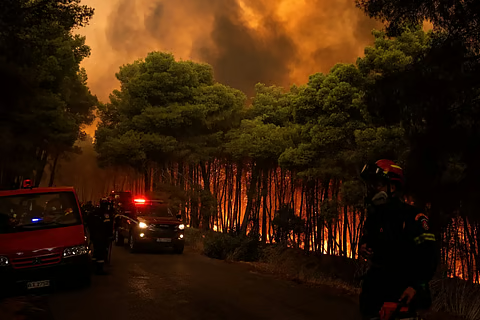
The Greece wildfire burning through Western Attica has entered its second week, driven by winds strong enough to make conventional firefighting close to impossible and claiming the lives of two aviators in a mid-air collision. Greece is now the third Southern European country to face a major blaze this summer, following weeks of destruction across France and Spain.
Where the Fire Is Burning
The blaze broke out in Western Attica, the region immediately west of Athens. Proximity to the capital raises the stakes considerably, placing populated areas, road networks, and infrastructure within reach of a fire that has proven difficult to contain.
Greece is contending with the same broader conditions affecting much of Southern Europe: sustained heat, dry vegetation, and landscapes primed to burn.
The Wind Is the Real Problem
What has made this particular fire so intractable is the Meltemi, the strong seasonal wind that sweeps across Greece through July and August.
In some areas, gusts have reached speeds of between 80 and 100 kilometres per hour, according to multiple reports.
At that velocity, a wildfire behaves differently. Flames spread laterally at speed rather than creeping outward. Embers are carried well ahead of the main front, igniting new fires in places crews have not yet reached. Containment lines dug in one location become irrelevant when the fire jumps past them entirely.
Aerial firefighting also becomes hazardous or simply impossible. Aircraft cannot operate safely in severe turbulence, and water dropped from height disperses before it reaches the ground in useful quantity.
Four Deaths in a Mid-Air Collision
The most serious loss came on Sunday, when two helicopters collided over the Western Athens region.
Four people were killed: two firefighters, a Danish pilot, and a Greek fire service official.
Two firefighters aboard the second helicopter survived after carrying out an emergency landing. Both are currently receiving hospital treatment.
The presence of a Danish pilot reflects the international nature of European fire response. When national resources are overwhelmed, crews and aircraft are drawn from across the continent through shared emergency arrangements. Those who respond take on the same risks as local personnel.
Aerial firefighting is among the most dangerous forms of aviation. Pilots operate at low altitude, in poor visibility, through smoke and heat turbulence, often with several aircraft working the same airspace simultaneously. Under high winds, the margin for error shrinks to almost nothing.
A Break in Conditions on Monday
As winds eased on Monday, water-bombing aircraft were able to return to the skies and resume operations against the flames.
These windows matter enormously. Aerial drops are most effective when they can be delivered accurately and repeatedly, and calmer conditions allow crews to make genuine progress on containment rather than simply holding a line.
Whether that progress holds depends on whether the wind stays down. The Meltemi is a seasonal pattern rather than a passing weather event, and further gusty periods are likely before August ends.
Part of a Wider European Crisis
Greece’s fire is the latest chapter in a summer that has already tested emergency services across Southern Europe.
A major wildfire broke out in France’s Bordeaux region in late July and subsequently crossed into parts of Spain. Between the two countries, it has burned hundreds of thousands of acres.
Officials have described that situation as unprecedented and historic. It triggered the largest evacuation ever carried out in France, a benchmark that captures the scale of what authorities were dealing with.
Why This Summer Has Been So Severe
Several factors have combined to produce these conditions across the region.
Prolonged heat has dried out vegetation to the point where it ignites readily and burns intensely. Extended dry periods have removed the moisture that would normally slow a fire’s advance. And in Greece specifically, the seasonal winds have added a multiplier that other countries have not faced in the same form.
The result is that fires which might once have been contained within days are instead running for weeks, consuming resources and personnel at a rate that stretches national capacity.
The Strain on Emergency Services
Greece is now into a second week of sustained firefighting, and duration brings its own problems.
Crews working consecutive shifts in extreme heat accumulate fatigue, and fatigue drives mistakes. Equipment breaks down under continuous use. Aircraft require maintenance that cannot be indefinitely deferred.
When multiple countries face simultaneous emergencies, the shared European resource pool comes under pressure too. Aircraft deployed to France cannot also be in Greece. Every additional national emergency reduces what is available to the others.
What Comes Next
The immediate priority is exploiting any calm weather to gain ground on containment before winds pick up again.
Beyond this fire, the longer question facing Greece and its neighbours is capacity. Fire seasons across the Mediterranean have grown longer and more intense, and the assumption that existing resources are adequate is becoming harder to sustain.
For now, the focus is on the crews still working in Western Attica, and on the four people who did not come back from Sunday’s flight.
Author
-
Lucienne Albrecht is Luxe Chronicle’s wealth and lifestyle editor, celebrated for her elegant perspective on finance, legacy, and global luxury culture. With a flair for blending sophistication with insight, she brings a distinctly feminine voice to the world of high society and wealth.