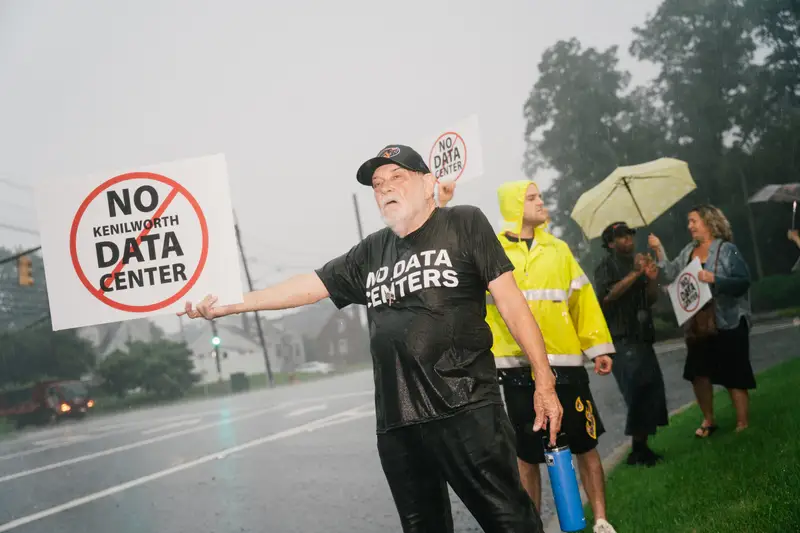
The anti-data center protests that have simmered in individual towns for months became a coordinated national event on Saturday, with demonstrations staged in more than 100 locations across the country.
The organizing force behind them is new: Humans First, a conservative nonprofit founded to challenge what it calls Big AI.
A Map That Stretches From Alaska to Florida
The scale was deliberate. Protests ran from Wasilla in southcentral Alaska to Naples on Florida’s Gulf coast, with many states hosting multiple events.
Texas led with 18. That is not an accident. The state offers the three things data center developers want most — available land, grid access, and the prospect of tax incentives — which has made it a premier destination for AI infrastructure.
Kenilworth Shows the Pattern
One of New Jersey’s two protests took place in Kenilworth, a borough of roughly 8,500 residents.
A crowd assembled outside the municipal court around 10 a.m. to oppose a planned $1.8 billion AI data center. The local planning board approved the project last May, but resistance has grown steadily since. An April petition seeking to halt construction collected more than 12,000 signatures — well above the town’s entire population.
The signs captured the mood. One read: you think this is pressure, wait until there’s no water pressure. Another simply said build community, not data centers.
Residents brought plastic horns, whistles, and a drum. Others carried colored chalk to mark the sidewalks. When heavy rain arrived later in the day, they pulled on ponchos, shared umbrellas, and kept marching.
Who Is Behind Humans First
The group is led by Amy Kremer, a familiar figure in conservative organizing since 2009. A former Tea Party member, she cofounded Women for Trump and served with the Republican National Committee.
She also helped organize the January 6, 2021 rally for President Trump that preceded the Capitol riot. Kremer neither planned nor took part in the riot itself.
She has now redirected those organizing skills toward the AI industry. In an earlier interview with Business Insider, she called it the most important fight of our lifetime and said the technology could wipe humanity off the planet.
The America First Framing
Humans First advocates an approach it describes as America First — one that puts ordinary residents at the center of decisions about how AI develops.
Kremer’s argument is about ownership. The technology, she says, was built on American data, funded partly by American taxpayer dollars, and runs on American energy and American land. Yet the public has no voice in how it is used or how it affects their lives.
On Saturday she thanked volunteers and posted on X that the data center boom has been sold as inevitable when it is not. Communities, she wrote, have every right to ask what they are surrendering and what they receive in exchange. America is not for sale, she added, and communities are not collateral.
Why the Industry Says It Needs Them
The case for data centers is straightforward from the industry’s side.
AI cannot advance without enormous computing capacity. Companies including Anthropic, OpenAI, Google, and Meta depend on these facilities to train and operate their products. Without them, there is no AI industry.
By the end of 2025, more than 1,400 AI data centers had been built or approved. Many more have been proposed during 2026.
Supporters argue the buildout is necessary for national security and for maintaining an edge over China, where researchers are closing the gap with well-funded American labs. They also point to economic growth and job creation, particularly during construction phases.
What Critics Are Worried About
Opponents question whether the returns justify the costs. The concerns cluster around a few themes:
- Environmental damage in host communities
- Rising electricity bills for nearby residents
- Heavy water consumption for cooling
- General degradation of local quality of life
- Approval processes that residents describe as opaque
Some opposition is simpler: people who dislike AI itself, including because prominent figures in the industry have warned it could eliminate large numbers of white-collar jobs.
Tactics Beyond Protest
The movement has been operating through conventional channels as well. Residents have filed petitions, packed planning meetings, and pursued litigation to stop projects.
Results vary. Some cities and towns have paused construction. Others have banned new data centers outright. At the federal level, Democratic Reps. Alexandria Ocasio-Cortez and Bernie Sanders have called for a national moratorium.
A Bipartisan Movement That Disagrees With Itself
The backlash crosses party lines, but the coalition is not unified on remedies.
Kremer rejects the moratorium approach entirely — nationwide or statewide. Her position is that each community should decide what gets built within it, and her complaint is that those decisions are being made behind closed doors rather than in public.
That is a meaningfully different argument from the one Sanders and Ocasio-Cortez are making. One frames the issue as local control; the other as a problem requiring federal intervention.
The Trump Complication
Tech companies have found a receptive administration. Trump has placed AI advancement at the center of his agenda and backed the Stargate Project, a $500 billion effort to build data centers and speed federal permitting.
That creates an awkward position for a conservative group organizing against the industry. Kremer resolves it by directing criticism elsewhere.
She predicted that when Republicans lose control of Congress, tech leaders will pivot to courting Democrats, arguing that what they ultimately want is power and control regardless of party.
As for Trump himself, she defended him and placed responsibility on Congress, saying lawmakers need to listen to and protect the American people. She added that Trump’s executive orders — including his recent one on testing frontier AI systems — need to go further.
What Saturday Actually Demonstrated
A single day of protests does not stop a $1.8 billion project or reverse 1,400 approvals.
What it does show is that scattered local fights have found a national framework and an organizing infrastructure. That is usually the precondition for a movement mattering politically rather than just locally.
The question now is whether the coalition holds together long enough to translate attention into policy — given that its members cannot yet agree on what the policy should be.
Author