The Ukrainian drone attack on Moscow that unfolded through Monday night and into Tuesday morning was one of the largest aimed at the Russian capital region to date, with local officials putting the number of aircraft tracked at close to 400. Separately, in the border region of Belgorod, a strike on an intercity bus left at least 19 people hurt, according to regional authorities.
The two events together illustrate how differently the war now registers depending on distance from the front. Around Moscow, the story was interception counts and a damaged facade. In Belgorod, it was casualties.
What Moscow Officials Reported
Mayor Sergei Sobyanin said 390 drones had been detected over the wider Moscow region between Monday night and Tuesday morning. He described most of them as intercepted and reported no damage or injuries within the city itself.
That phrasing carries some weight. “Most” is not “all,” and the mayor’s statement left unaddressed what became of the remainder.
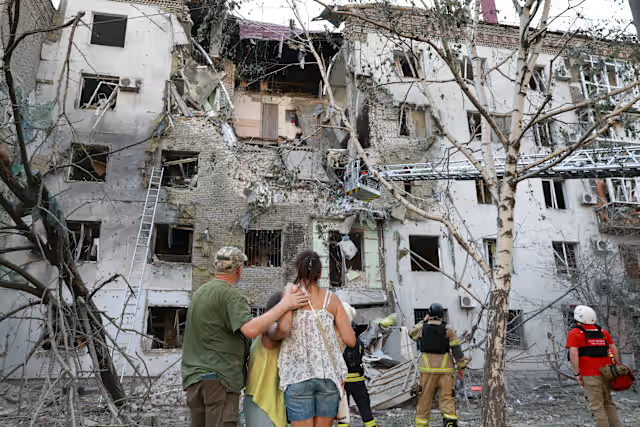
Moscow region Governor Andrei Vorobyov filled in part of that gap. He confirmed that an apartment building in Chekhov, a town roughly 50 kilometres south of the capital, had been struck. Local officials said the impact damaged the building’s facade and two individual apartments, and that nobody was hurt.
Vorobyov added that air defence systems brought down what he described as a few dozen drones at other points across the region, naming Podolsk, Domodedovo and Kolomna among the locations.
Scattered Damage South of the Capital
Closer detail came from Podolsk, which sits roughly midway between Moscow and Chekhov. District head Grigory Artamonov reported property damage across several villages in the area. In Koledino, the damage he described was modest, involving a fence at a private home.
Koledino also generated the one piece of unverified information circulating from the night. Unconfirmed reports suggested a warehouse near a Wildberries logistics facility had been damaged. The retailer issued a denial, saying its own site was not hit during the overnight strikes and that operations were continuing normally.
Russia’s Defence Ministry offered a nationwide figure, stating that 356 Ukrainian drones had been intercepted across Russian territory and annexed Crimea over the same period.
Reading the Numbers Carefully
The various figures released by Russian officials do not resolve into a single clean total, and that is worth noting rather than smoothing over.
Sobyanin’s 390 refers to drones tracked over the Moscow region alone. The Defence Ministry’s 356 covers interceptions across the entire country plus Crimea. Those two numbers measure different things, and neither is independently verifiable.
Interception claims in this war have consistently been difficult to confirm from outside. Governments on both sides have incentives to present air defence as effective, and independent verification of what was launched, what was downed and what reached a target is rarely available in the hours immediately afterward. The confirmed physical damage reported by local officials, a struck apartment block and a damaged fence, is a narrower and firmer set of facts than the aggregate totals.
Belgorod Bears the Human Cost
The picture in Belgorod region, which shares a border with Ukraine and has absorbed repeated strikes throughout the war, was considerably grimmer.
Authorities said a man was killed in a drone attack on the regional capital the previous evening.
They also confirmed a death connected to an earlier incident. A woman critically wounded in a July 20 attack on a passenger bus in Shebekino died in hospital, more than a week after being injured.
Then, on Tuesday morning, Shebekino was hit again. Acting regional Governor Alexander Shuvayev said 19 passengers aboard an intercity bus were injured in the attack. Shebekino lies directly across the border from Ukraine, close enough that warning time for anyone on the ground is measured in seconds rather than minutes.
Two Attacks on Buses in Eight Days
The recurrence of bus strikes in the same town within a short window is the detail most likely to draw scrutiny.
Intercity buses carry civilians going about routine business. Border regions like Belgorod also host substantial military activity, and both sides have accused the other of positioning military assets among civilian infrastructure. Neither side’s account of any individual strike can be independently confirmed from available reporting.
What is verifiable is the outcome: two people dead in connection with attacks in the region over the past week, and 19 more injured on a bus Tuesday morning.
Why Moscow Is Being Targeted at This Scale
Ukraine has steadily expanded the reach and volume of its long-range drone campaign over the past year, and operations against the Moscow region have become more frequent and considerably larger.
The strategic logic runs in several directions. Sustained pressure on the capital region forces Russia to allocate air defence assets far from the front line, where they might otherwise be protecting supply routes and forward positions. Strikes near logistics hubs and industrial sites aim at the machinery that sustains the war effort. And there is an unmistakable political dimension: drones over Moscow make the conflict impossible to treat as a distant matter for residents who have largely been insulated from it.
The practical damage from Monday night appears limited. A facade, two apartments, a fence. But launching several hundred drones toward a defended capital is not primarily an exercise in destroying buildings. It is an exercise in saturating defences and demonstrating that they can be reached.
Where This Sits in the Wider War
The exchange comes as diplomatic activity around the conflict continues elsewhere, with Ukrainian officials pressing Washington and European partners for sustained support and additional air defence capability.
Both capitals have reason to publicise their own version of nights like this one. Kyiv points to reach and volume. Moscow points to interception rates. The residents of Chekhov and Shebekino experience something considerably less abstract.
For now, the pattern holds: large-scale drone waves aimed deep into Russian territory, mostly intercepted with limited confirmed damage, and border communities absorbing the casualties that the capital largely avoids.
Author
-
Lucienne Albrecht is Luxe Chronicle’s wealth and lifestyle editor, celebrated for her elegant perspective on finance, legacy, and global luxury culture. With a flair for blending sophistication with insight, she brings a distinctly feminine voice to the world of high society and wealth.