Wildfire Halted at the Border, Rivers Running Dry: Germany’s Monday Roundup
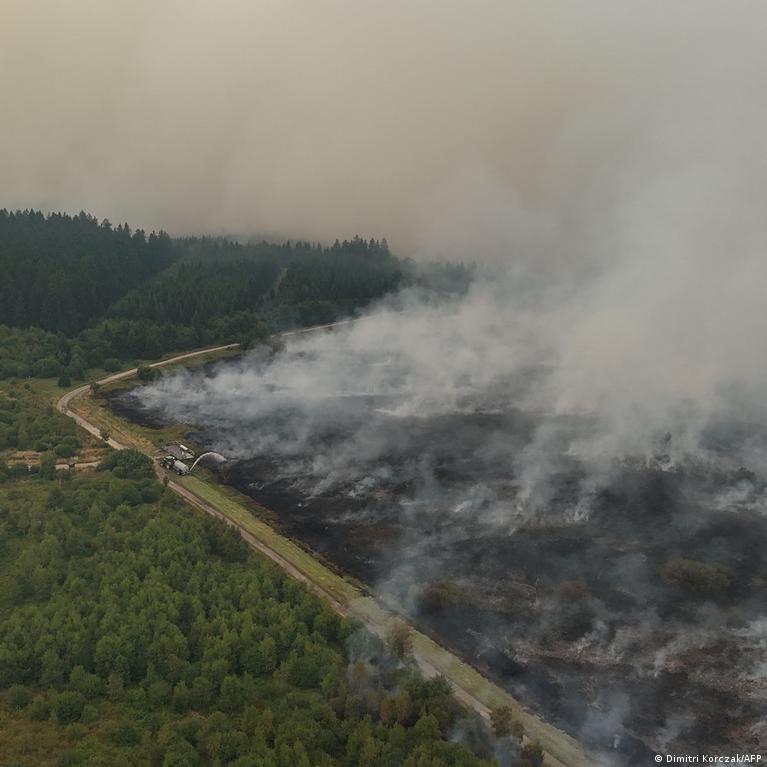
The Belgium wildfire German border situation has eased for the moment, with firefighters confirming that the blaze has stopped advancing toward German territory after threatening communities in the Eifel region.
Residents of the town of Monschau were evacuated as the fire approached, a precautionary measure taken while the direction of the flames remained uncertain. For now, the immediate danger appears contained, though fire behaviour can change quickly depending on wind and terrain.
Low Water Levels Threaten Construction Supplies
A separate concern is developing on Germany’s inland waterways, where reduced water levels have cut into cargo shipping capacity.
Industry associations have warned that the shortfall could ripple into the construction sector. Rivers carry substantial volumes of bulk materials such as sand, gravel and cement, commodities that are heavy, cheap per tonne, and therefore poorly suited to road or rail transport as a substitute.
When barges cannot load to full capacity because of shallow channels, the effect is not merely a delay but a reduction in total volume moved. Construction sites dependent on steady material supply are the first to feel it.
Germans Are Staying Closer to Home
New figures from the Federal Statistical Office, released Monday, show a clear shift in travel habits during 2025.
Domestic trips involving at least one overnight stay climbed to 169 million, an increase of 3.9 percent compared with 2024. Foreign travel moved in the opposite direction, falling roughly 8.3 percent to 105 million trips.
That divergence is substantial enough to suggest more than seasonal variation. Whether it reflects cost pressures, changing preferences or a combination of factors, the pattern points toward a domestic tourism sector gaining ground while outbound travel contracts.
Where Germans Went Abroad
Among those who did travel internationally, the destination rankings held few surprises.
Italy took the top spot, followed by Austria, Spain, France and the Netherlands. All five are within reasonable driving distance for much of Germany, which aligns closely with how people chose to travel.
The Car Still Dominates
Transport preferences revealed a pronounced gap between the car and everything else.
Across all trips taken, personal vehicles accounted for 60.2 percent of journeys. Rail followed at a distant 19.2 percent, with air travel close behind at 15.2 percent.
For a country with an extensive rail network and ongoing policy discussions about reducing transport emissions, those numbers illustrate how far actual behaviour sits from stated environmental ambitions. The car remains the default choice for the clear majority of leisure travel.
More Young Adults Outside Work and Training
A second set of statistics released alongside the travel figures points to a troubling trend among young adults.
The proportion of 20 to 24-year-olds in Germany who were neither employed nor engaged in training or study reached 10 percent in 2025. That represents a continuation of an upward pattern, with the figure standing at 8.8 percent as recently as 2022.
The data comes from the Federal Statistical Office drawing on comparative figures compiled by Eurostat, the European statistical authority.
How Germany Compares Across the EU
Placed in a European context, Germany’s position looks considerably more favourable than the domestic trend alone would suggest.
The German figure of 10 percent sits below the EU average of 12.9 percent across all 27 member states.
The Netherlands recorded the strongest performance in this measure, with just 5.6 percent of people in the 20 to 24 age bracket outside both employment and training.
At the other end of the scale, three countries reported notably high rates:
Romania at 22.8 percent
Bulgaria at 17.3 percent
France at 16.2 percent
A City-Country Divide
One detail within the German data runs counter to common assumptions about rural disadvantage.
Young people living in rural areas were less likely to fall into the not-in-work-or-training category than their counterparts in large cities. The rural figure stood at 7.9 percent, compared with 10.6 percent in major urban centres.
That gap invites several explanations. Rural areas may offer stronger apprenticeship traditions and closer links between local employers and school leavers. Cities, meanwhile, attract young people who move for opportunities that do not always materialize quickly, and they concentrate populations facing more complex barriers to employment.
Reading the Numbers Together
Taken as a set, Monday’s releases sketch a country adjusting on several fronts at once.
Households are travelling closer to home. Waterways that underpin heavy industry are running low enough to disrupt supply chains. And a growing share of young adults is spending the years typically devoted to establishing a career doing neither work nor study.
None of these developments is dramatic on its own. Together they suggest an economy and a population making incremental adaptations, some by choice and some imposed by circumstances beyond anyone’s immediate control.
Author
-
Lucienne Albrecht is Luxe Chronicle’s wealth and lifestyle editor, celebrated for her elegant perspective on finance, legacy, and global luxury culture. With a flair for blending sophistication with insight, she brings a distinctly feminine voice to the world of high society and wealth.