Nearly a Thousand Aftershocks Rattle Flores as Indonesia’s Earthquake Death Toll Climbs to 53
The Indonesia earthquake Flores disaster has entered a grim second phase, with disaster officials confirming that a 7.7-magnitude tremor which killed at least 53 people was followed by close to a thousand aftershocks in the days that followed.
For thousands of displaced residents, that statistic translates into a simple decision: sleep outdoors rather than risk returning to a structure that may not survive the next jolt.
How the Disaster Unfolded
The main earthquake struck the Flores region at 5:58 a.m. local time on Saturday, catching most residents at home and asleep.
According to the U.S. Geological Survey, the epicentre was located 42 miles north-northwest of Ende, a city in East Nusa Tenggara province.
A second quake registering 6.4 magnitude followed shortly afterward, striking the island of Sumatra on the opposite side of the country, a separate event that added to the strain on national emergency resources.
The initial tremor prompted a tsunami warning that sent coastal communities scrambling toward higher ground. Authorities later withdrew the alert after monitoring stations detected no meaningful change in sea levels.
Counting the Dead and Injured
Rescue crews recovered at least 47 bodies on Saturday in the immediate aftermath, according to Suharyanto, who heads the National Disaster Management Agency. Most of those recoveries occurred in the regencies of Sikka, Manggarai and East Manggarai.
Teams working through Sunday located six additional victims, raising the confirmed toll to 53. More than 130 people sustained injuries.
Officials have been clear that the figure will almost certainly increase.
The Aftershock Problem
Abdul Muhari, who serves as the agency’s chief for disaster prevention, reported that at least 995 aftershocks have been recorded since the main event.
Only 46 of those were strong enough for residents to feel, but the largest reached magnitude 6.2, powerful enough to cause damage on its own in a region where buildings have already been compromised.
The psychological effect matters as much as the physical one. Thousands of people spent the night in the open, unwilling to sleep beneath roofs that shifted and cracked during the initial quake.
Destruction Across the Province
The damage tally in East Nusa Tenggara province is substantial:
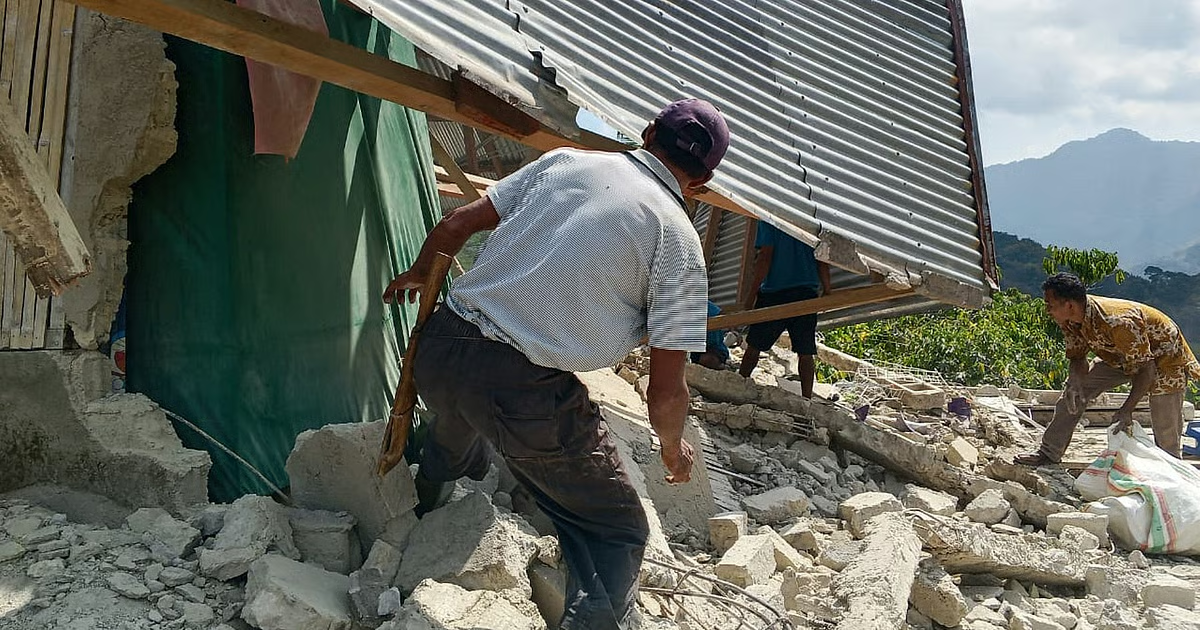
More than 900 homes destroyed outright
An additional 450 homes damaged
Roughly 5,000 people forced into temporary shelters
At least 241 damaged homes in the Flores region alone
More than 100 public facilities destroyed, including schools, medical centres and churches
The loss of public buildings compounds the crisis. Schools and clinics often serve as evacuation points during disasters, and their destruction removes shelter capacity precisely when it is most needed.
Communications and Access Collapse
East Nusa Tenggara Police Chief Rudi Darmoko described severe structural damage and collapsed buildings across the affected area, but identified a different obstacle as the most pressing operational problem.
Power outages across cities and villages have disrupted the flow of information, making it difficult to assess where help is needed. Darmoko said officials are still gathering reports on damage and casualties while contending with communication breakdowns.
Transportation has failed as well. Landslides triggered by the quake in Ende regency severed the Trans-Flores highway, the roughly 435-mile paved mountain road that runs the length of Flores Island from Labuan Bajo to Larantuka.
That road is the island’s primary artery. With it cut, entire sections of Flores have become difficult or impossible to reach by ground.
An Account From Ruteng
Yulian Juita Ekalia, a 37-year-old university lecturer living in Ruteng city more than 60 miles west of the epicentre, described an experience she had never encountered before.
She said she had never felt an earthquake of that magnitude, comparing the sensation to standing on a trampoline and calling it genuinely frightening.
As she rushed toward the door, she recalled, the contents of her home came down around her: the television, her son’s trophies, dish racks, suitcases stored atop wardrobes. By the time she reached the street, her son and neighbours were already outside, screaming.
Remote Villages Still Unreached
Fathur Rahman, who leads the Search and Rescue Office in Maumere, the capital of Sikka, warned that the death toll is likely to rise for a specific reason.
Landslides set off by the earthquake have buried or isolated numerous remote villages spread across six regencies on Flores Island. Until crews reach those settlements, the full scale of the disaster cannot be known.
Hospitals Operating Outdoors
Local television footage showed patients being evacuated from several hospital buildings as a precautionary measure after the quake.
Staff moved essential equipment into open areas, including beds, IV stands and oxygen cylinders, establishing improvised treatment zones outside the structures. Treating patients in the open is far from ideal, but it eliminates the risk of a ward collapsing during an aftershock.
Helicopter Support Deployed
The National Disaster Management Agency has committed a helicopter to logistics and emergency response work, including potential evacuations.
Air support carries particular importance in East Nusa Tenggara, where the geography consists of numerous scattered islands and where road access is limited even under normal conditions. With the Trans-Flores highway severed, aviation may be the only reliable route to some communities.
A Region Shaped by Catastrophe
Indonesia spans more than 17,000 islands and sits along the Ring of Fire, the arc of volcanoes and fault lines encircling the Pacific Basin that makes seismic activity a permanent feature of life there.
Flores itself carries a painful history. A powerful earthquake in 1992 generated a tsunami that killed roughly 2,500 people on the island.
Elsewhere in the country, a magnitude 7.5 quake in 2018 produced a localized tsunami that destroyed coastal areas and killed more than 4,400 people. The deadliest event came in December 2004, when a magnitude 9.1 earthquake off Sumatra triggered a tsunami that claimed 230,000 lives across a dozen countries.
For residents of Flores, that history is not abstract. It is the reason coastal communities moved to high ground within minutes of Saturday’s shaking, and the reason the tsunami warning was taken seriously before it was lifted.
Author
-
Lucienne Albrecht is Luxe Chronicle’s wealth and lifestyle editor, celebrated for her elegant perspective on finance, legacy, and global luxury culture. With a flair for blending sophistication with insight, she brings a distinctly feminine voice to the world of high society and wealth.