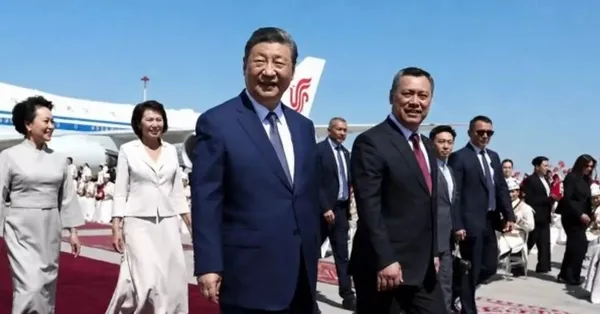
The SCO summit Bishkek is hosting this week has drawn an unusually consequential guest list, with Chinese President Xi Jinping welcomed by his Kyrgyz counterpart ahead of a gathering that brings together the leaders of China, Russia and India in the Central Asian capital.
The Shanghai Cooperation Organization has long been described as a counterweight to American global influence, and this year’s meeting places that framing under fresh scrutiny.
Who Is in the Room
The presence of three leaders in particular gives the summit its weight.
- Xi Jinping, whose government treats Central Asia as both a security buffer and an economic corridor
- Russia’s leadership, seeking demonstrations of partnership while under sustained Western pressure
- India’s leadership, balancing membership in this bloc against its own relationships with Washington and its complicated history with Beijing
That last combination is what makes the SCO difficult to read as a unified front. India and China are both members and both rivals. Their coexistence within the organisation is the clearest evidence that this is not a bloc in the way NATO or the EU are blocs.
Why Kyrgyzstan Matters as Host
Bishkek does not often host summits of this profile, and hosting carries genuine value for a country of Kyrgyzstan’s size.
Smaller Central Asian states have spent the past three decades navigating between larger neighbours. Hosting a summit gives Bishkek a stage, direct access to leaders who rarely visit, and leverage in discussions about infrastructure, energy and trade routes that pass through its territory.
For Kyrgyzstan, the practical agenda tends to be concrete: investment, connectivity, labour migration arrangements, and border cooperation.
What the SCO Actually Does
The organisation began with a narrow focus on border security and counterterrorism cooperation among China, Russia and the Central Asian republics. Its remit has widened considerably since.
Its current areas of activity typically include:
- Regional security coordination and joint exercises
- Counterterrorism and information sharing
- Trade facilitation and transport corridors
- Energy cooperation
- Cultural and educational exchange
What it does not have is a mutual defence clause, a common currency, or binding enforcement mechanisms. Decisions are made by consensus, which means the organisation moves at the pace of its most reluctant member.
The Counterweight Question
The description of the SCO as a challenge to US influence appears in almost every account of its summits, and there is substance behind it. The organisation covers an enormous share of the world’s population and landmass, and its leading members have all had periods of friction with Washington.
But the counterweight framing has limits worth noting.
Members do not share a common threat assessment. India maintains defence ties with the United States. Central Asian states pursue relationships in multiple directions simultaneously. Russia and China cooperate closely at present but have historically competed for influence in exactly the region hosting this summit.
The result is an organisation that offers its members an alternative venue rather than an alternative alliance. That distinction matters when assessing what any summit declaration is likely to mean in practice.
What to Watch For
Summits of this kind produce a mix of substance and symbolism, and the two are not always easy to separate.
Worth watching in the coming days:
- Bilateral meetings held on the margins, which frequently matter more than the plenary sessions
- Any language on trade settlement outside the dollar, a recurring theme in recent years
- Announcements on transport and energy infrastructure through Central Asia
- Whether India signs on to the strongest versions of joint language, or moderates it
- Signals about further membership expansion
The images produced by these gatherings are themselves part of the point. A leader under sanctions standing alongside partners on a summit stage sends a message that no communiqué needs to state explicitly.
The Broader Picture
What the Bishkek meeting reflects is a slow reorganisation of how middle and large powers manage their relationships. Countries that once operated largely within a single set of Western-led institutions now participate in several overlapping arrangements at once, taking what suits them from each.
The SCO is one expression of that shift. It does not require members to choose sides, which is precisely why states as different as India and Russia can both sit at the table.
Whether that flexibility is a strength or a structural weakness depends on what the organisation is eventually asked to do. For now, it functions well as a forum and less well as a bloc, and this week’s summit in Bishkek is unlikely to resolve which of those it ultimately becomes.
Author