The Myla warehouse strike has become the deadliest single attack in Ukraine this year, with the toll climbing to 38 dead and four people still unaccounted for, President Volodymyr Zelenskyy announced on social media Sunday.
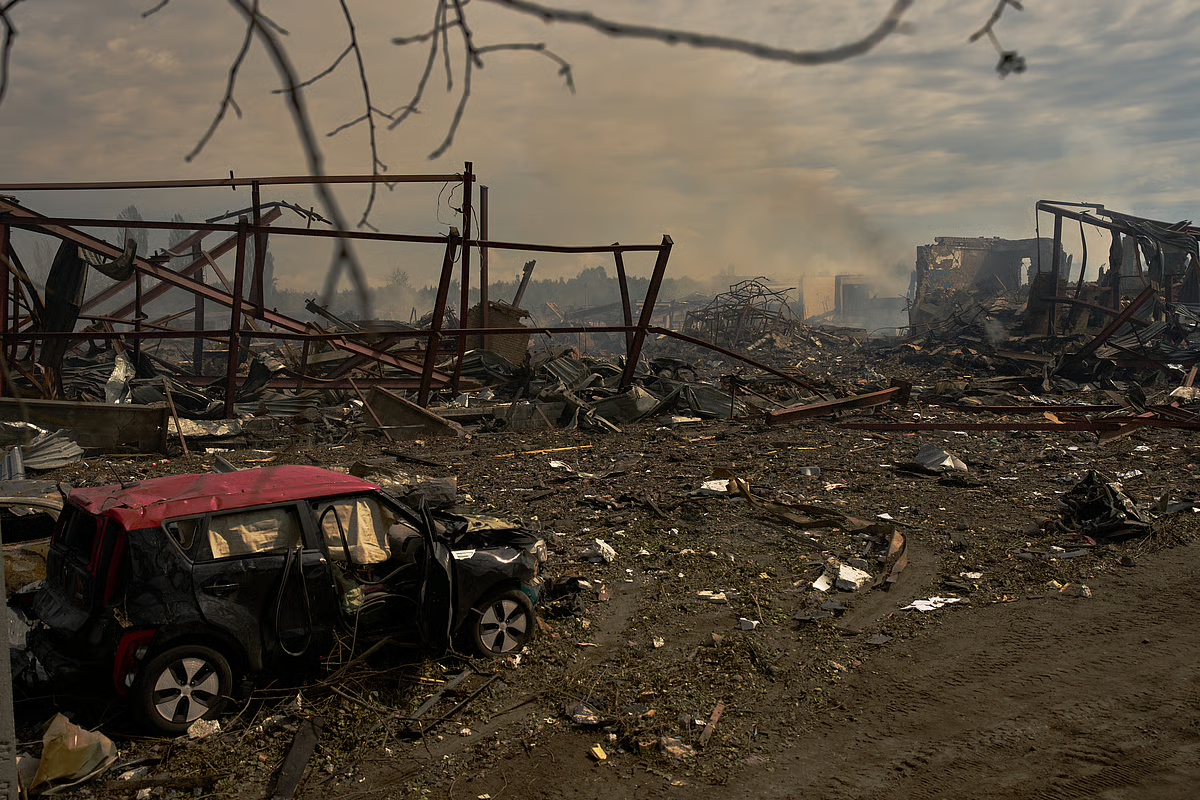
The Russian strike hit on Friday night in the village of Myla, west of Kyiv. Ukrainian officials have identified the site as an ammunition storage facility.
What Happened at Myla
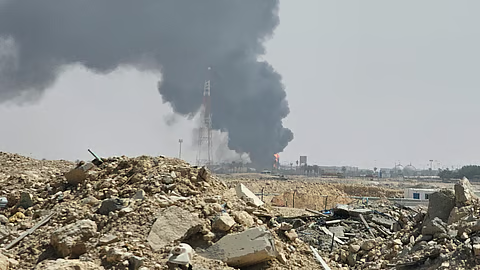
The strike triggered enormous secondary explosions and fires that spread through dozens of nearby homes and buildings. That chain reaction, rather than the strike itself, appears to account for much of the destruction.
Zelenskyy said emergency crews were still working to put out fires and to locate and neutralise unexploded ordnance at the site. Twenty people were injured, two of them children.
His comments on Saturday were notably critical of his own side. He called the situation terrible and attributed it to serious negligence by those who stored explosives directly alongside a residential area. An investigation is now underway into how and why the ammunition ended up there.
That admission is unusual. It shifts part of the accountability inward, toward decisions about munitions placement, even while the strike itself came from Russia.
A Shift in Russian Tactics
The attack landed during a marked intensification of Russian air operations. Air raid sirens have been sounding repeatedly across Kyiv, with explosions and the sound of air defences audible throughout the day.
The daytime pattern represents a change. Attacks on the capital during daylight hours had been comparatively uncommon, and the shift serves two purposes: it stretches Ukrainian air defences that were already under strain, and it keeps civilians in a state of alert for extended periods rather than concentrated overnight windows.
Moscow Threatens the Power Grid
Russia’s Defence Ministry announced Sunday that it is preparing what it called massive strikes against Ukraine’s energy infrastructure.
The stated justification was Ukraine’s continuing attacks on Russian civilian infrastructure and its fuel and energy sector.
Kremlin spokesman Dmitry Peskov promised an appropriate response to what he described as Kyiv’s path of escalation and its targeting of Russia’s civilian economy. He told Russian state media that Moscow has been conducting fairly systematic strikes against Ukrainian military and war-related infrastructure.
Ukraine’s own campaign has been significant. Its drones have struck facilities belonging to Wildberries, Russia’s largest online retailer, sometimes described as the country’s Amazon. Kyiv argues the company sells dual-use goods supporting the war effort. Ukrainian drones have also repeatedly hit Russian oil refineries and energy infrastructure, producing an extraordinary fuel crisis in one of the world’s leading energy producers.
The winter dimension is unavoidable here. In previous years Russia systematically targeted the Ukrainian power grid, leaving large numbers of people without heat or electricity in freezing conditions. Ukrainian officials have warned the coming winter could be the hardest since the full-scale invasion began in February 2022.
A New Defence Minister and a $27 Billion Hole
Ukraine’s newly appointed Defence Minister Yevhen Khmara held his first press briefing on Saturday, with remarks released Sunday.
He inherited a defence funding shortfall of 27 billion dollars and said the ministry has options for closing it, including seeking increased contributions from international partners.
His appointment followed a turbulent period. Weeks of protests followed the dismissal of Mykhailo Fedorov, prompting a broader reset in Kyiv and culminating in a video in which Fedorov called for elections.
Khmara, a former special forces officer who left military service for a civilian role, outlined his priorities:
- Preventing shortages on the battlefield
- Ensuring soldiers are paid
- Covering other essential needs
- Possibly advancing part of a 90 billion euro European loan, roughly 104 billion dollars, currently planned for next year
- Opening separate talks with identified partners on financing specific requirements
He said Ukraine would present partners with a clear vision and plan, and indicated he intends to retain much of the existing ministry team.
Hundreds of Drones Sent Into Russia
Russia’s Defence Ministry said its forces downed or neutralised nearly 500 Ukrainian drones launched overnight into Sunday.
Independent Telegram channels on both sides reported that the strikes set fire to a major refinery in Kirishi, southeast of St Petersburg. Kirishi Petroleum Organic Synthesis is among Russia’s largest refineries and the only one serving the country’s northwest.
Official confirmation was not immediate, though regional Governor Alexander Drozdenko reported a fire in Kirishi’s industrial zone following the strikes and said 62 drones had been shot down over the surrounding area.
Casualties on Both Sides
The weekend produced losses across multiple locations.
- A 2-year-old girl was killed and 12 people injured in Russian strikes on Kyiv Saturday, according to Mayor Vitali Klitschko
- A 13-year-old and an adult died in Bilbasovka in eastern Ukraine after Russian aircraft bombed private homes Sunday, said local official Vadim Lyakh
- A female mine employee was killed and five others injured in Russian-occupied Luhansk by a Ukrainian strike, according to Kremlin-installed official Leonid Pasechnik
- At least four people were injured by Ukrainian drones in the Russian border regions of Kursk and Belgorod
Where This Leaves Things
The pattern emerging is one of mutual escalation aimed at infrastructure rather than front lines. Ukraine is degrading Russian refining capacity and fuel supply. Russia is threatening to repeat its assault on the Ukrainian grid as cold weather approaches.
Neither approach produces territorial change. Both impose costs on civilian populations, and both sides describe their targets as legitimately connected to the other’s war effort.
For residents of Myla, the immediate question is narrower and more painful: why the munitions that amplified Friday’s strike were stored where people lived. That investigation may prove as consequential locally as anything decided in Moscow or Kyiv.
Author