Canada US tariffs moved from threat to reality overnight after negotiators in Washington ran out of both time and common ground. A sweeping 50% duty on a long list of Canadian products took effect at midnight, ending nearly two weeks of intense bargaining that, until the final hours, both sides had described as promising.
The Deal That Slipped Away
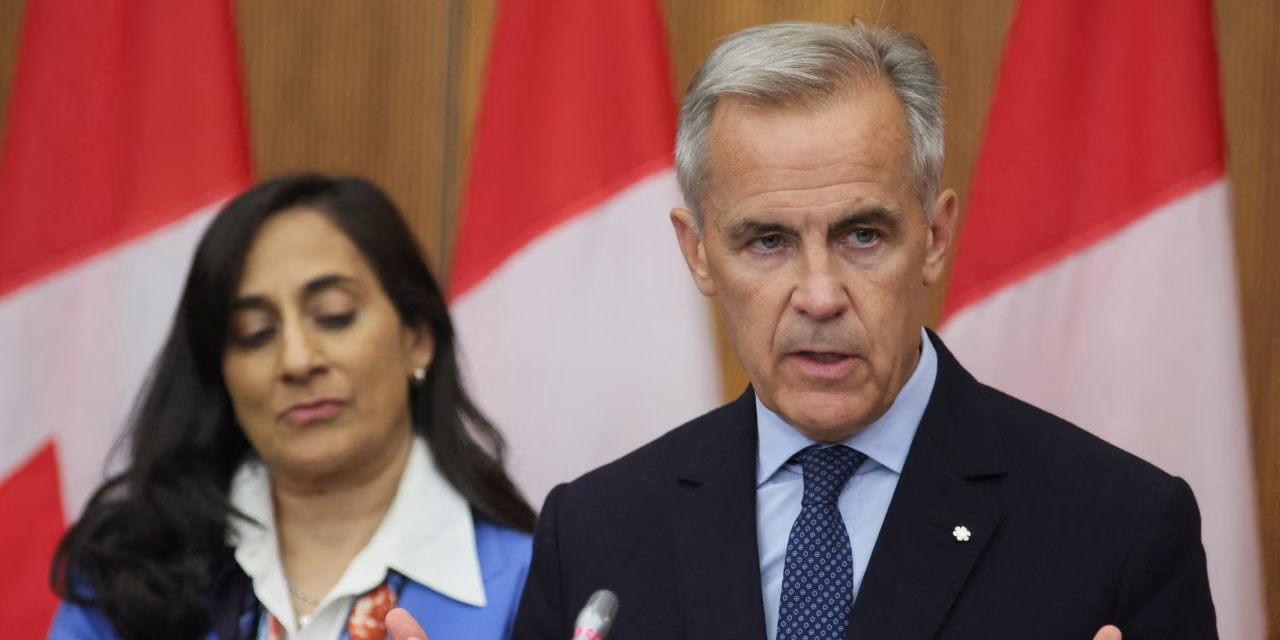
Prime Minister Mark Carney delivered the news in a written statement issued only minutes before the clock ran out. He acknowledged that negotiators had covered real ground but concluded that what was on the table simply did not serve Canadian interests. With that, he pulled the plug, instructing his team to leave Washington and head back to Ottawa.
According to Carney, the breaking point came late. He argued that Washington altered its terms at the eleventh hour in ways he described as unreasonable and economically unsound, and said those changes made it hard to trust that any agreement would actually hold. His broader message was blunt: the relationship between the two countries has fundamentally shifted, and Canada has no intention of pretending otherwise.
What the Tariffs Actually Cover
The new Canada US tariffs apply to roughly $20 billion worth of goods crossing the border into the United States, based on figures from the Office of the U.S. Trade Representative. The affected list is unusually varied and touches consumer shelves as directly as it does industrial supply chains.
Among the products now facing the 50% rate:
Hockey sticks and related sporting goods
Certain categories of construction and building materials
Spirits and other alcoholic beverages
Selected lines of apparel and clothing
For American shoppers, that translates into higher price tags on items many people would never associate with a trade dispute.
Ottawa Promises to Hit Back
Carney did not leave any ambiguity about Canada’s response. He pledged immediate countermeasures matched precisely to the American action, framing it as necessary protection for Canadian workers and businesses rather than an escalation for its own sake.
That position drew quick backing at home, including from political figures who had been quiet during the talks. Ontario Premier Doug Ford, whose province carries the largest share of the country’s population and industrial base, posted his endorsement online shortly after the announcement, calling for a matched response and urging national unity. Manitoba Premier Wab Kinew had already been pushing a harder line, arguing Ottawa should confront Washington directly.
A Reversal Nobody Saw Coming
The collapse was jarring partly because of how the week began. On Tuesday, the U.S. president had paused the tariff threat for three days and posted publicly that an agreement had been reached, a message that fueled optimism on both sides of the border.
That optimism held almost to the end. Dominic LeBlanc, the Canadian minister handling relations with Washington, spent several hours in talks with U.S. Trade Representative Jamieson Greer on Thursday and told reporters afterward that the two teams were nearly there and would keep working. Negotiations resumed Friday and dragged past 10:30 p.m. Eastern time at the USTR’s offices before finally breaking down.
Washington’s Version of Events
Greer offered a very different account early Saturday. In his telling, Canada backed away from terms both sides had already accepted earlier in the week, introducing fresh demands and retreating from prior commitments that had held the package together.
He also pointed to a specific irritant: Canada’s existing retaliatory measures, including outright bans on some American products and services. Those restrictions, imposed by provincial governments on U.S. alcohol sales in 2025, were themselves a response to earlier rounds of American tariffs.
That issue proved thorny inside Canada as well. Carney had reportedly asked premiers to lift the alcohol bans as part of a settlement. Quebec Premier Christine Fréchette said Thursday she was still reviewing the request, and several other provincial leaders stayed silent through the final days of talks.
Greer added that Washington had put meaningful reductions on the table for steel, aluminum, automobiles and lumber, though he did not detail the numbers. Reporting earlier in the week suggested U.S. negotiators had agreed to bring duties on vehicles and metals down from 25% to 15%. Canadian officials, for their part, had been pushing to eliminate the new tariffs entirely while also seeking relief on industrial goods covered by separate trade measures.
An Untested Legal Foundation
What makes this round unusual is the legal instrument behind it. The 50% duties rest on a rarely discussed provision of the Tariff Act of 1930 that permits the White House to impose penalties of up to 50% on any trading partner deemed to discriminate against American commerce. It has never actually been used until now, which almost guarantees a courtroom fight.
Carney has previously argued that tariffs of this kind breach the North American trade agreement negotiated and signed during the president’s first term.
Business Groups Sound the Alarm
Industry reaction has been uniformly negative. The U.S. Chamber of Commerce cautioned earlier in the week that higher duties would wound both economies, raise household costs, tangle supply chains and endanger the roughly 13 million American jobs tied to continental trade.
Its Canadian counterpart echoed that view. Candace Laing, who leads the Canadian Chamber of Commerce, described the outcome as a serious hit to North American competitiveness and warned that Americans will pay more while Canadians lose customers, investment and small businesses.
Where This Goes Next
Greer has framed the 50% rate as a direct consequence of Ottawa’s earlier countermeasures, noting that only two economies have retaliated against U.S. trade actions: China and Canada.
That comparison may be instructive. Last year, a similar standoff with Beijing briefly pushed tariffs into triple digits before months of negotiation cooled tensions and rates came back down. Whether Canada and the United States can find a comparable off-ramp remains an open question, and for now, businesses and consumers on both sides will absorb the cost of the impasse.
Author