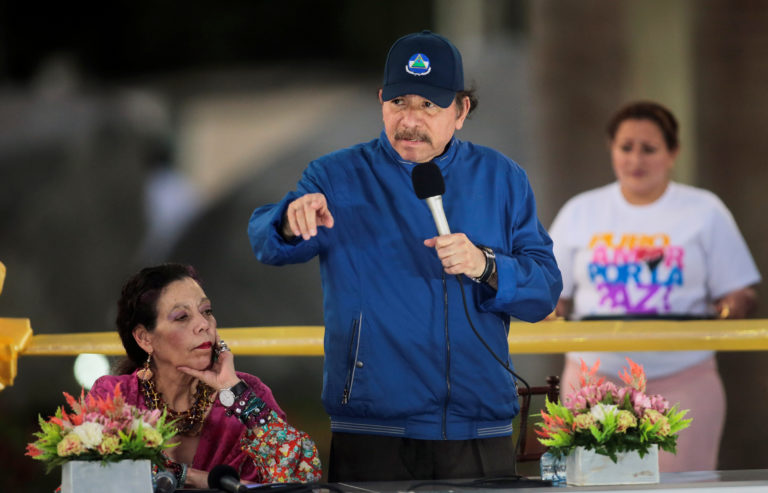
Daniel Ortega has said Nicaragua will hold no further elections, a declaration that removes the last theoretical mechanism for changing a government he and his wife have controlled for nearly two decades.
The announcement, delivered Sunday evening, eliminates any electoral challenge when his current term ends next year.
What He Said
Ortega spoke at a commemoration of the 1979 Sandinista revolution, the uprising in which he helped overthrow the US-backed Anastasio Somoza dictatorship.
He told the audience there would be no more elections for opponents to use as a means of seizing the government and seizing power.
He went further, declaring that the days when parties backed by the Yankees and the Somocistas would return to power are over, and adding the phrase that has since defined coverage of the speech: never again.
It was the 80-year-old’s first public appearance in two months. He offered no details about how the ban would actually be implemented.
How Long This Has Been Building
Ortega has held power continuously since 2007, following an earlier presidential term in the 1980s.
The final election, held in 2021, was widely disputed. Ahead of that vote, Ortega detained opposition figures and business leaders and criminalized dissent, which left the outcome effectively predetermined.
Last year brought a set of constitutional reforms that formalized what was already true in practice:
- His wife Rosario Murillo was named co-president
- The presidential term was extended to six years
- The couple’s control was entrenched across the state apparatus
Together they command virtually every institution of government, including the armed forces and the judiciary.
The Human Rights Record
The UN Human Rights Council has accused the Ortega-Murillo government of transforming Nicaragua into an authoritarian state and of systematically violating human rights.
The most severe episode came in 2018, when widespread anti-government protests were met with a crackdown that killed more than 300 people.
The United States has responded with sanctions on more than 2,350 Nicaraguan officials and their relatives. The Trump administration has described the government as a dictatorship. The State Department did not immediately respond to a request for comment on the latest announcement.
Strength or Fear?
Analysts reading the declaration have largely landed on the same interpretation, and it is not the one Ortega presumably intended.
Tiziano Breda, a senior analyst at Armed Conflict Location & Event Data, said the couple appears afraid that even the slightest political opening could create conditions for dissent to emerge and threaten their hold on power.
Rather than staging another rigged election, he noted, they have chosen to eliminate electoral competition entirely.
Breda described the result as a full-fledged, family-run dictatorship.
Felix Maradiaga, an opposition presidential hopeful who was jailed in Nicaragua from 2021 to 2023 before being expelled to the United States, read it the same way.
He called the comments less a display of strength than a confession of fear, saying Ortega publicly acknowledged what has always been his intention: preventing his project from facing any form of democratic competition.
Why an Election Was Still a Risk
Salvador Marenco, coordinator of the Costa Rica-based Nicaragua Nunca Más Human Rights Collective, pointed out that Ortega had already neutralized competition in the reelections of 2011, 2016 and 2021.
Last year’s constitutional reforms had established a one-party system in a country where opposition leaders no longer exist domestically, having been exiled.
So why abolish elections that were already controlled?
Marenco’s answer is that Ortega is trying to avoid the risk of electoral defeat because he knows the population rejects him.
That logic is worth sitting with. Even a thoroughly managed election requires machinery, participation and a result that can be presented as legitimate. Each of those creates a point where something could go wrong. Removing the process removes the risk.
What It Means Practically
For most Nicaraguans, little changes immediately. The 2021 election was not a genuine contest, and the opposition has been in exile or prison for years.
What changes is the formal architecture. There is now no procedural path, however theoretical, by which power could transfer.
That matters for a specific reason: authoritarian systems often unravel through their own institutions rather than through opposition victories. A managed election that produces an unexpected result, a succession dispute, a legislature that finds independent footing. Eliminating elections closes off one of those avenues.
The Succession Question
Ortega is 80 years old. Murillo holds the co-presidency.
The arrangement makes the intended line of succession fairly clear, and the abolition of elections removes any competing claim to legitimacy that a future opposition might assert.
Whether the transition works as designed is another question. Personalist regimes tend to be more fragile at the moment of succession than at any other point, and Nicaragua’s institutions have been hollowed out precisely to prevent them from acting independently, which also means they may not function when needed.
Where This Leaves the Opposition
Nicaragua’s opposition operates almost entirely from abroad, in Costa Rica, the United States and elsewhere.
Figures like Maradiaga can issue statements and maintain international pressure, but they have no domestic organizational base and now no electoral horizon to organize toward.
That is a difficult position. Exile movements sustained across decades tend to lose relevance to the population they claim to represent, and the removal of any scheduled vote takes away the natural focal point around which such movements typically mobilize.
For now, the response is rhetorical. Ortega has said never again, and the opposition has no immediate mechanism for testing whether he means it.
Author