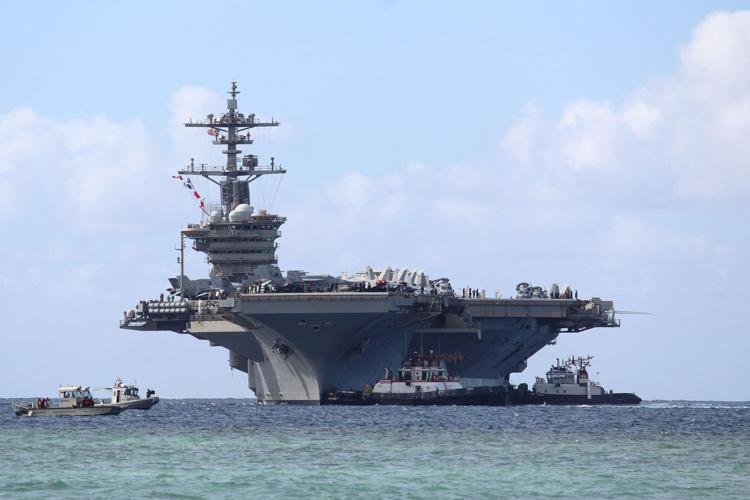
The USS Abraham Lincoln deployment is finally ending. A US official confirmed Thursday that the carrier has been sailing homeward for several days and should reach San Diego in a few weeks, closing out nine months at sea and more than 250 days away from home.
The ship carries roughly 5,000 sailors and Marines. Many of them expected to be back months ago.
The Handover
As the Lincoln departed the Middle East, where it supported operations in the war against Iran, the USS George Washington arrived Wednesday to begin its own deployment, according to US Central Command.
Carrier rotations of this kind are routine in principle. What made this one notable was how long the outgoing ship had waited for relief.
The Announcement Aboard
CENTCOM commander Admiral Brad Cooper visited the crew on Saturday to deliver the news personally. Writing afterward in a Wall Street Journal opinion piece, he described telling the sailors and Marines that they had delivered a performance for the ages and were now going home.
Cooper used the same piece to push back against reporting about conditions aboard the ship.
What Families Have Described
Relatives of crew members have painted a considerably bleaker picture than the official one, describing shortages of supplies and food alongside growing concern about mental health.
There have been several man overboard incidents, including one in which a sailor was rescued, according to US officials. While these events prompted concern within the Navy, one official said they have not been viewed as evidence of a broad mental health crisis aboard the carrier.
A Mother’s Account
One sailor’s mother, herself a former service member, gave NBC News a detailed account of what her son described.
He had expected a six-month deployment. When she finally heard from him roughly a month after the February 28 strikes, he told her he was hungry and losing weight, and that the ship’s commissary had begun limiting what service members could purchase.
He was eating whatever he could get, she said.
Other details she relayed:
- Hot water was unavailable for days at a stretch
- The crew went three to four months without receiving mail after the carrier was redirected from the South China Sea
- Some crew members were struggling noticeably
She described one sailor who had essentially given up, stopped reporting for duty and wanted to be sent home. She could hear in her son’s voice that he was down.
She also acknowledged the operational reality, noting that safety concerns and regional conditions may have driven the historic stretch of consecutive days at sea. Her son told her things improved somewhat in April, after parents began raising complaints.
Her closing sentiment was not accusatory. She said she is proud of everyone who served aboard the Lincoln and hopes they receive the resources they need, adding that everyone deserves to be treated with decency regardless of their job.
The Official Response
Cooper said the concerns had been addressed. He wrote on social media that among the Navy’s 11 active aircraft carriers, the Lincoln currently has among the lowest number of mental health cases.
Defense Secretary Pete Hegseth said last week that reports about conditions aboard the ship had been completely misrepresented.
Trump dismissed the concerns as well, telling reporters Friday that the deployment was not nearly long enough.
The Numbers Behind the Strain
The operational details explain much of the difficulty.
The Lincoln left San Diego on November 21 with a deployment scheduled to conclude in May. It was extended as the conflict with Iran continued following US and Israeli strikes at the end of February.
A typical carrier deployment runs roughly six to seven months. This one reached nine.
More significantly, carriers normally make regular port visits to rest crews and restock food. According to a US official, the Lincoln has not entered a port since December, meaning more than 200 consecutive days at sea.
That figure explains the food shortages better than any individual account. Ships resupply at sea, but underway replenishment cannot fully substitute for port calls, and variety and morale both suffer.
Why Extended Deployments Cause Problems
The strain compounds in ways that are predictable but difficult to solve.
Sailors plan their lives around expected return dates. Extensions disrupt family arrangements, childcare, education plans and finances. The uncertainty itself wears on people, since an extension once granted can be granted again.
Mail interruptions cut off the primary connection to home for many crew members. Limited fresh food affects both nutrition and morale. Confined spaces amplify every irritation.
None of this reflects poorly on the crew. It describes what happens when a ship stays out substantially longer than its cycle was designed for.
The Gap in Accounts
The distance between what families describe and what officials report is wide, and both may be partly accurate.
Formal mental health case counts measure diagnoses recorded by medical personnel. They do not capture how many sailors are struggling quietly, and service members often avoid seeking help for reasons ranging from career concerns to simple reluctance.
Meanwhile, families hear from individuals during difficult moments, which may not represent the average experience across 5,000 people.
Both perspectives are incomplete on their own.
Coming Home
In a few weeks, the pier at San Diego will fill with families who have waited three months longer than they were told to expect.
The USS Abraham Lincoln deployment will end there, and whatever debate continues about conditions aboard will matter less on that day than the simple fact of arrival.
Author