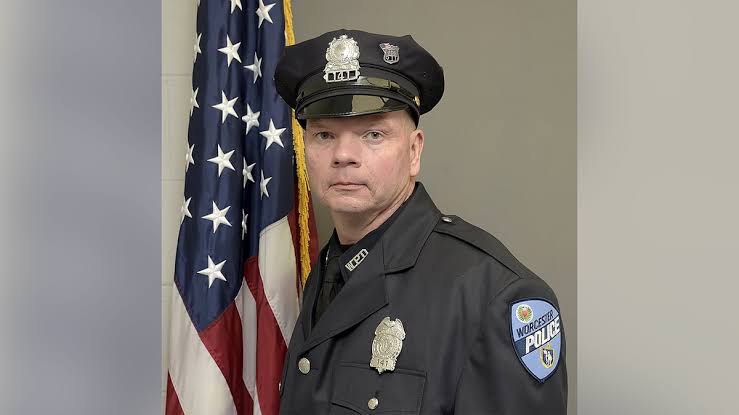
Kurt Solomon spent three decades patrolling Worcester, much of it on foot or on a bicycle, and the people who worked alongside him keep returning to the same word when they describe him: steady.
He was found dead in his Wildwood Avenue home on Tuesday, August 18, at the age of 57. His wife, Karen Solomon, a well-known advocate for police mental health, is being sought as a suspect. The search entered its third day as colleagues gathered their thoughts about the man they knew.
The Officer People Wanted at Their Door
Sergeant Jason Powers, who partnered with Solomon for years, offered a description that doubles as a standard.
He treated everyone with dignity and respect, Powers said, adding that if you imagined the ideal person to respond to a call at your home, Solomon was that person.
Monsignor Francis J. Scollen, longtime pastor of St. Peter’s Church, reached for a single adjective: unflappable. People would lose their composure, he recalled, and Solomon would keep his. He was, in the monsignor’s assessment, always a great cop.
Retired Lieutenant Robert Lotsbom put it more bluntly. If everyone were like Kurt Solomon, he said, the department would have no problems at all. He was a good guy, plain and simple.
Where He Came From
Solomon grew up in the Webster Square area, raised by his father, Thurston “Sol” Solomon, and his mother, Shirley. He graduated from South High School.
Before joining Worcester’s force, he served with the US Army Military Police in Germany. He graduated from the Worcester Police Academy in 1996 and spent the next thirty years working the city’s streets.
One brother retired from the Fire Department. Another works as a teacher.
A Record Without a Mark
Departmental records reviewed by the Telegram & Gazette show that as of 2021, Solomon had never had an internal affairs complaint filed against him.
Thirty years of policing without a single complaint is unusual, and his colleagues were quick to explain why it should not be mistaken for passivity.
That did not mean he avoided the work, Lotsbom said. He did his job every day, did exactly what was asked, and you knew he would do the right thing.
Powers called the record a testament to the man, describing his partner as firm and fair, someone who took time to hear people out.
A lot of the time in this job, Powers said, listening is one of the best gifts you can give someone. People simply want to be heard.
The Partnership
Powers and Solomon met at the police academy in 1996. The friendship deepened when they were assigned together as rookies in Main South.
They clicked, Scollen remembered. He came to know both men during the three years they walked a foot beat in the neighborhood as part of a community policing program.
The pairing worked because the temperaments differed. Solomon brought a calm, understated presence that balanced Powers’s more outspoken style. The two were everywhere in those years, eating at local restaurants, talking with residents, responding to calls.
They made a real difference in relations between police and the community, Scollen said, attending events, playing basketball with kids and simply getting to know people.
The trust paid off in practical ways. People who would never walk into a police station would approach the two officers on the street with information.
They didn’t want to go to the station, Powers said. But they would come tell us.
Lighter Moments and Harder Ones
Scollen recalled occasionally driving the officers to urgent calls in what he described as his dumpy old Chevy when nothing else was available.
He also remembered a much darker day. It was Solomon who first told him the Worcester Cold Storage and Warehouse Co. building was burning on December 3, 1999. Solomon urged the priest to go to the scene, where six firefighters would die. Scollen tried, but could not get past the roadblocks.
He was always around, always part of the community, the monsignor said.
Scollen described Solomon as someone who did the right thing without seeking credit, always under the radar, never promoting himself, simply taking care of people. He said he never once heard Solomon speak unkindly about anyone.
The Humor Underneath
Powers noted that his partner’s quiet exterior concealed a dry, sneaky sense of humor he showed to those who knew him well.
He laughed remembering a golf outing where Solomon invented generous rules on the spot for the monsignor, a novice player, telling him to go ahead and hit again while everyone laughed.
The two spent considerable time golfing together during those first three years on the beat, a period they later described to each other as the best time of their police lives.
The Career That Followed
After the foot beat, the partners patrolled Main South in sector cars on adjoining routes until roughly 2007. They then transferred together into the Anti-Violence Street Crimes Unit, a precursor to the Neighborhood Response Team, before Solomon joined the bike unit in 2009.
Archives show they handled serious calls throughout those years, including a 1997 pursuit of a suspect in a city bus stabbing, a 2003 case where they found a suspect hiding in a kitchen cabinet, and the 2007 capture of a man suspected in a series of convenience store robberies.
Powers remembered one serious call where neither man needed to speak about how to approach a suspect.
We just knew what the other was going to do, he said. That kind of chemistry had developed between them.
People say it often in policing, he added, but Solomon truly was his brother.
Life Outside the Uniform
Away from work, Solomon was a homebody. He maintained a beautiful garden and lawn, fished, and spent time with his family.
Powers laughed about one running joke between them. Of all the beautiful places in the world, he said, Solomon loved going to Hampton Beach.
He was a devoted father to his sons, Niklas and Brandon, now in their twenties, proud of their accomplishments and present through their schooling and sports.
Scollen knew both Solomon and his wife well and attended their wedding. Asked about the past several days, he could offer only one word: indescribable.
An Unprecedented Situation
Lotsbom, a former president of the superior officers union, said that across forty years on the job, he has seen nothing comparable.
He expressed confidence that the department will complete its investigation properly, even with emotions involved.
Powers framed the loss in terms that reached past the department.
It is a terrible loss for the department because of the kind of person Solomon was, he said, and a terrible loss for the city, which lost one of the greatest cops ever to walk its streets.
Author